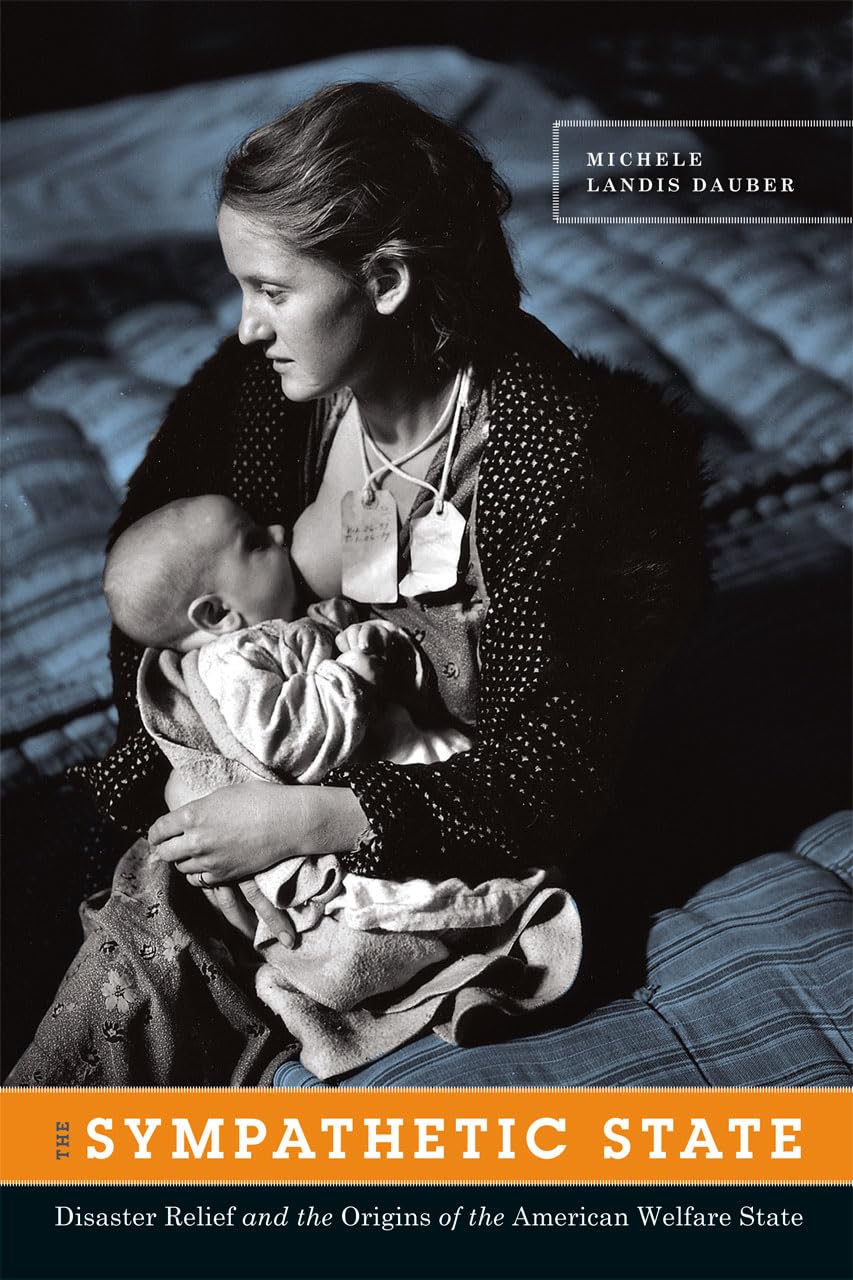
The Sympathetic State: Disaster Relief and the Origins of the American Welfare State
$27.64
by Michele Landis Dauber



Even as unemployment rates soared during the Great Depression, FDR’s relief and social security programs faced attacks in Congress and the courts on the legitimacy of federal aid to the growing population of poor. In response, New Dealers pointed to a long tradition—dating back to 1790 and now largely forgotten—of federal aid to victims of disaster. In The Sympathetic State , Michele Landis Dauber recovers this crucial aspect of American history, tracing the roots of the modern American welfare state beyond the New Deal and the Progressive Era back to the earliest days of the republic when relief was forthcoming for the victims of wars, fires, floods, hurricanes, and earthquakes. Drawing on a variety of materials, including newspapers, legal briefs, political speeches, the art and literature of the time, and letters from thousands of ordinary Americans, Dauber shows that while this long history of government disaster relief has faded from our memory today, it was extremely well known to advocates for an expanded role for the national government in the 1930s, including the Social Security Act. Making this connection required framing the Great Depression as a disaster afflicting citizens though no fault of their own. Dauber argues that the disaster paradigm, though successful in defending the New Deal, would ultimately come back to haunt advocates for social welfare. By not making a more radical case for relief, proponents of the New Deal helped create the weak, uniquely American welfare state we have today—one torn between the desire to come to the aid of those suffering and the deeply rooted suspicion that those in need are responsible for their own deprivation. Contrary to conventional thought, the history of federal disaster relief is one of remarkable consistency, despite significant political and ideological change. Dauber’s pathbreaking and highly readable book uncovers the historical origins of the modern American welfare state. “A marvelous, deeply researched history of the largely forgotten role of federal disaster relief in the historical development of the American welfare state. Michele Landis Dauber shows very creatively how the Great Depression came to be understood as a single, monolithic event—as a disaster—that justified new and expansive forms of relief. Political scientists and historians will have to contend with her central argument: that the New Deal was less the product of a ‘constitutional revolution’ than ordinary lawyering from long-settled precedents.” -- Michael Willrich, author of Pox: An American History “In difficult economic times, how can a nation mobilize support for the relief of poverty? Michele Dauber's The Sympathetic State illuminates this question in an original and powerful way. Studying Franklin Delano Roosevelt's political rhetoric and his use of the arts during the New Deal, Dauber shows that the construction of public sympathy is a complicated task, involving fact-based reasoning, but also involving the emotions and the imagination. Roosevelt was not just a canny social planner, he was also a genius of the heart. And that, Dauber's analysis implies, is what we sorely need today. This is an important, valuable, and amazing book.” -- Martha C. Nussbaum, University of Chicago “ The Sympathetic State is a revisionist history for our contested present. As Dauber masterfully shows, the more than two-hundred-year history of federal disaster relief indicates that national social policies fit comfortably with longstanding American constitutional traditions. You cannot fully understand current debates—or where they might yet go—until you read this book.” -- Jacob Hacker, Yale University, author of The Divided Welfare State "The Sympathetic State forces fundamental revisions in how we think about the history of America’s welfare state. Contrary to what almost all other historians have written, Michele Landis Dauber’s brilliant book demonstrates that, since the earliest days of the nation, the Constitution has provided through its General Welfare clause a powerful justification for frequent extensions of federal cash relief and for constructing the nation’s welfare state. This is history with a crucial message for the American public as well as for historians." -- Michael B. Katz, University of Pennsylvania, author of The Price of Citizenship "Now comes a study that might've helped Obama build his narrative bridge between crisis and reform. In The Sympathetic State , Stanford University professor Michele Landis Dauber looks at the stories Franklin Delano Roosevelt and his allies told in order to sell the New Deal—to the public, sure, but also to a harsher audience, the Supreme Court, which would end up deciding its fate." ― Chicago Reader Published On: 2012-12-10 "We learn in The Sympathetic State that Congress dispensed federal funds in more than one hundred resolutions to help citizens recover from disaster or other circumstances beyond their c