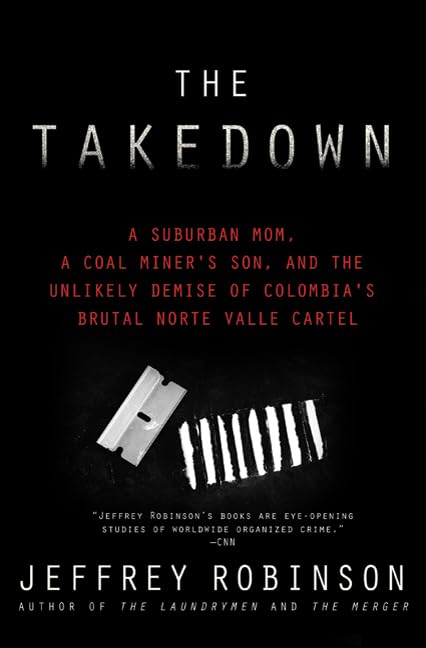
The Takedown: A Suburban Mom, A Coal Miner's Son, and The Unlikely Demise of Colombia's Brutal Norte Valle Cartel
$299.99
by Jeffrey Robinson



If ever there was an odd couple. A suburban mom and a coal miner's son. Bonnie Klapper is an attractive, funny, off-beat but tenacious federal prosecutor who constantly thinks out of the box, often to the chagrin of her superiors. She is a full-time Assistant US Attorney, and a full-time mom to two sons, one of whom is a special needs child. Now retired Special Agent Romedio "Rooney" Viola --- first of US Customs then of the Department of Homeland Security --- is a slightly built, larger-than-life eccentric from West Virginia whose reputation was based on his obsessive-compulsive pursuit of fugitives. They were brought together by happenstance while both assigned to the "El Dorado Task Force," operating out of the World Trade Center. A raid on three wire remitters in Queens, New York uncovered huge amounts of drug money being sent to three tiny villages in a Colombian valley that no one had ever heard of. Neither the Justice Department nor the Treasury Department seemed terribly concerned with where the money was going, as long as this flow of drug cash was stopped. Bonnie and Rooney wanted to know more. Working together out of her tiny office in the implausible outpost of Hauppauge, Long Island, they set off on a 13 year journey to dismantle --- systematically --- the Colombian cartel responsible for 60% of all the cocaine coming into the United States. Her superiors Justice and his superiors at what was then Immigration and Customs Enforcement were quick to write them both off as dreamers. Management believed there were enough drug dealers in the greater New York area to keep everyone busy for a long time. Taking down a barbarous gang of traffickers and murderers 2500 miles away, was pure fantasy. But Bonnie wasn't so sure. And Rooney didn't care what they thought. Veteran author Jeffrey Robinson, whose previous international bestsellers on international organized crime and dirty money include "The Laundrymen," "The Merger" and "The Sink" tells this story of true grit, guile, determination, fighting the system, beating the system and overcoming overwhelming odds with the pace of a great thriller. This is "The French Connection" for 2011! "A gripping end-of-summer read. " --Daily Beast (This Weeks Must Read - 9/2/11) "A real-life Law & Order... the narrative crackles with authenticity." -- Kirkus Reviews "A tribute to Robinson's storytelling..." -- Publishers Weekly "A fascinating, behind-the-scenes look." -- Booklist JEFFREY ROBINSON is the international best-selling author of more than two dozen books, both fiction and non-fiction. A recognized expert on organized crime and money laundering, The Takedown is his fifth investigative true crime exposé. He lives in New York. The Takedown 1 Phones were always ringing and people were always shouting across the room. "Who's got a spare ticket for the Knicks' game tonight?" And, "Where's my goddamned phone book?" And, "The marshals just cancelled so we've got to deliver the fucker to jail ourselves." The huge open-plan office took up a third of the entire fifth floor at No. 6 World Trade Center--referred to in those days as WTC6--an eight-story building off Vesey Street, in the shadow of the North Tower. The smallest building in the complex of seven, it housed the U.S. Commodities Exchange, the New York City headquarters of the U.S. Customs Service, and the El Dorado Task Force. "Who ordered pizza?" And, "Where's Forbes?" And, "My old lady is crazy." A joint venture of Customs and the Internal Revenue Service(IRS), El Dorado was created in 1992 specifically to target drug-money laundering in the greater New York metropolitan area. In theory, the mission was sound. Drug trafficking is a business and like any business, it requires cash flow and reinvestment to survive. Money is the oxygen. Therefore, if you can cut off the trafficker's cash flow and prevent him from reinvesting, you can suffocate him. If he suffocates he goes bankrupt. And a bankrupt business means no product on the streets. The group was made up of 140 investigators from the two lead agencies plus the Secret Service, the New York Police Department, the U.S. Postal Inspection Service, the New York State Police, the New Jersey State Police, and several local law-enforcement agencies. The investigators, all of whom were handpicked, combined drug savvy with street-smarts and a background working money cases. They were backstopped by forensic accountants; authorities from the New York State Banking Department; intelligence analysts from other agencies; plus prosecutors from the U.S. Attorneys' offices in Manhattan, Brooklyn, and Newark, New Jersey; the district attorneys' offices of all five New York boroughs; and the DA's offices in both Nassau and Suffolk counties on Long Island. As soon as they opened their door, they hit the ground running. Their first big job was a classic undercover sting code-named "Wire Drill," that focused on the money remitte