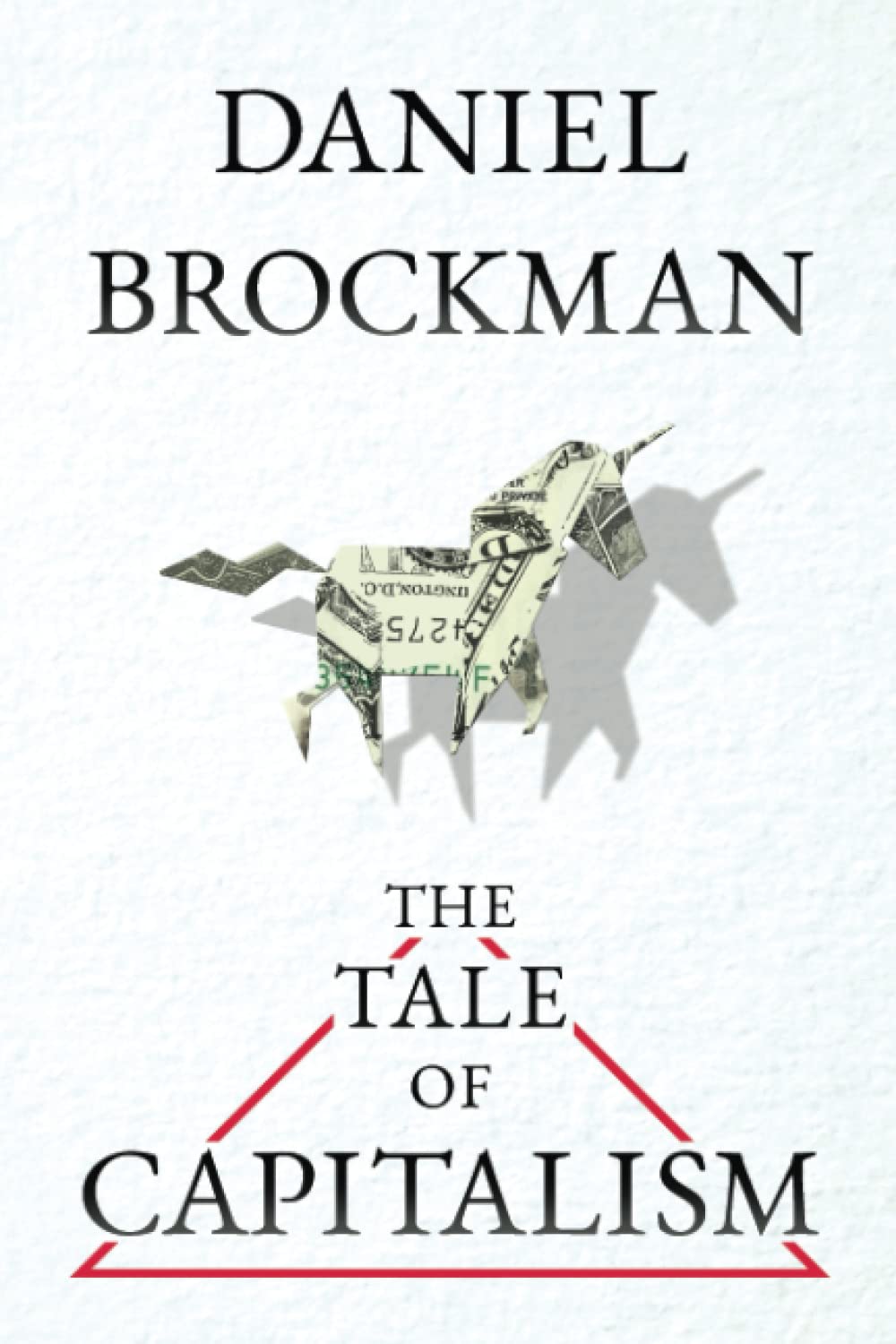



"A simple memorable framework for explaining how economics misconceived the problem." -- Judy Z. Stephenson, PhD, Associate Professor of Economic History at University College London. In our highly productive society a few people have vast wealth. They can purchase anything they desire. They have social influence. Others, in predictably large numbers, will fall asleep hungry tonight. Why the disparity? In its complexity, our basic economic system has many moving parts. Each part has a story. The kaleidoscopic Tale of Capitalism gives you a collection of stories you might tell to friends. You will find out how the economic system works, how it favors some while overlooking others, and how to make it better. DANIEL BROCKMAN has Mathematics and Finance degrees and lifelong interest in history and economics. He worked in statistical analysis and software development in investment companies and banks for 30 years. Dan swims, hikes and rides his bicycle near his home in the state of Washington, USA. The Tale of Capitalism is my first book. In writing it, I felt great desire to provide understandable stories explaining our economic system. And I wanted to promote some basic messages which I believe true, as described in the book. The oddly capitalized words identify concepts the book more fully explains. We can, if we choose, adjust our economic system a little (no disruption and no grand revolution required) so that it preserves the productiveness of its incentives and disincentives, and so that it preserves and enhances the lives of the many who live in it. Our current system doesn't distribute essential goods and services well. Both Capitalism and Socialism, and other sources as well, provide good ideas. We need not subject otherwise good ideas to purity tests to assure they are Capitalist enough or Socialist enough. Rewards for merit can provide incentive, but every person has essential economic necessities. Society can feasibly and usefully assure every person gets part of a subsistence minimum, whether they deserve it or not. Government can tax the wealthy at higher rates to moderate income and wealth inequalities. Free Markets function poorly without regulation and vigorous competition among buyers and sellers. Workers and owners both take significant economic risks, and they can split the profits of business enterprises. Our modern economic system results in a small number of people having wealth beyond dreams, and a large number of people in a scanty existence, with millions underfed. We can change this. DANIEL BROCKMAN provides this microautobio: We are what we do; I was what I did When I moved to San Francisco, I got a job in the actuarial department of an insurance company, mainly because I had a mathematics degree and good test scores. I wrote software. I took a couple of courses in financial accounting. I wrote cash management software for a big aluminum company. I did financial modeling for oil wells, real estate, coal mines and geothermal wells. I worked for Wells Fargo Investment Advisors writing software for bond portfolio management and research. I designed a database for options and thinly traded securities. At Bank of America, I wrote software to value investments held in the trust department, wrote software reconciling trust accounts between two systems, wrote the bank's first online payments system for small businesses, designed automation of their letter-of-credit system, managed systems to monitor trading desk financial positions. I managed systems operations for Total Entertainment Network (online gaming). I got a degree in finance. I consulted on computer systems at Charles Schwab, Southwestern Bell, Providian Bank, NASA, and Mellon Capital Management. At Mellon, I wrote software for investment trading and research. I designed search software enhancements for large merchant customer websites at Amazon. I consulted on systems for payments operations, foreign exchange trading, and anti-money laundering at Wells Fargo. I performed statistical analysis of residential mortgages at Union Bank. In parallel, for about 45 years, I've studied the history of money, stock trading, economics, financial booms and crashes, investment strategies, portfolio selections, and market predictions. I advise a few friends on their investments. My book, The Tale of Capitalism , wasn't among the top ten on the New York Times bestseller list during the last six months.