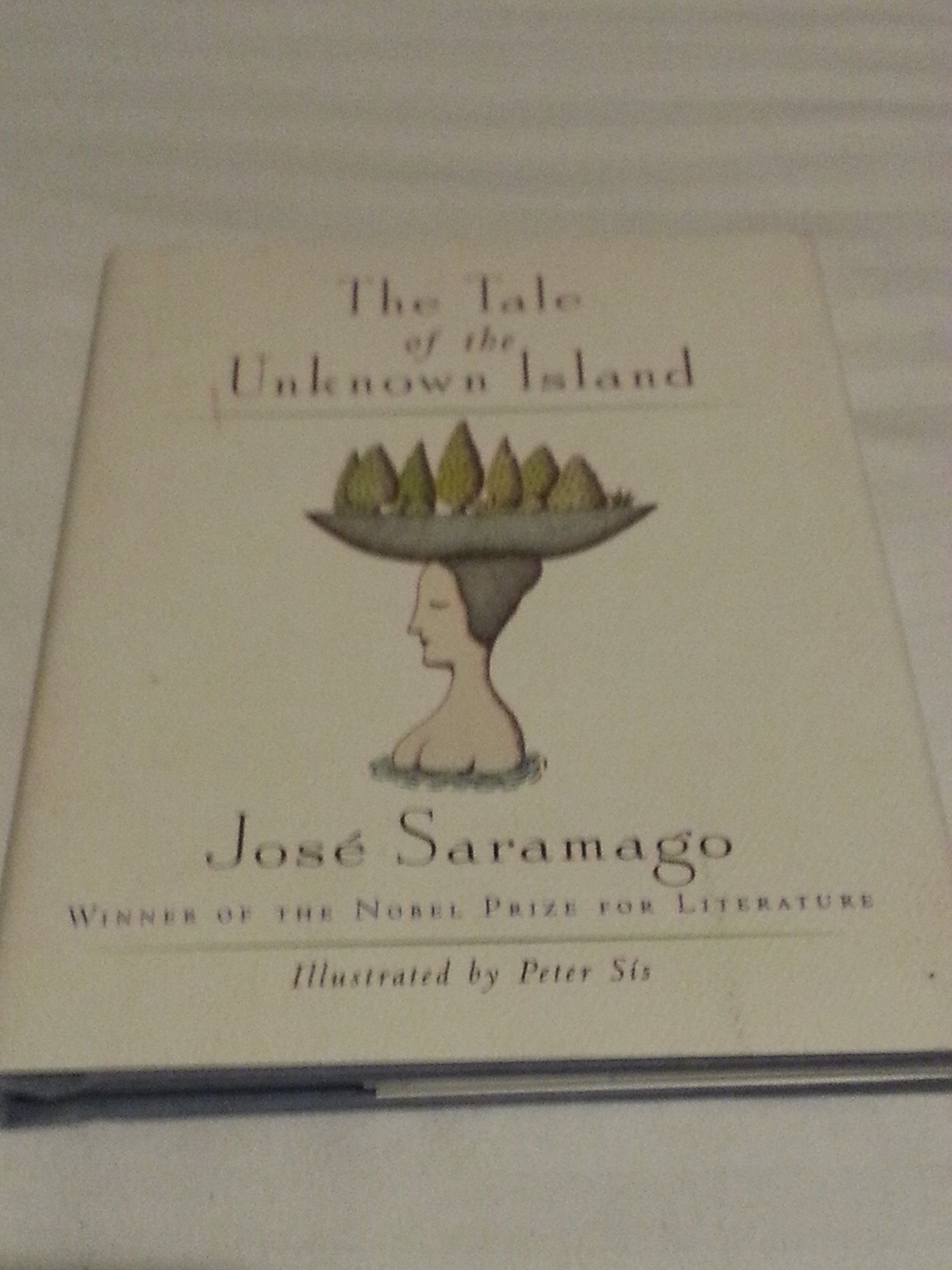



A moving and eloquent fable from the 1998 winner of the Nobel Prize for Literature offers a unique blend of love and philosophy as a man petitions a boat from the king, finds a crew to volunteer, and sets sail. "A man went to knock at the king's door and said, Give me a boat." Even without the "Once upon a time," it's clear from the opening sentence of José Saramago's mischievous and wise The Tale of the Unknown Island that we have entered a somewhat fractured fairy tale. Of course, it could be argued that all of his works are, in some form or another, fairy tales, from the whimsical, revisionist History of the Siege of Lisbon to the darker dystopia of Blindness . Originally published as a short story in Portugal, Unknown Island contains all of the elements Saramago is famous for--dry wit, a seemingly simple plot that works on many levels, and an idiosyncratic use of punctuation, among other things. It begins as a satire concerned with the absurdity of bureaucracy as supplicants arrive at the king's door for petitions while the king himself waits by the door for favors: Since the king spent all his time sitting at the door for favors (favors being offered to the king, you understand), whenever he heard someone knocking at the door for petitions, he would pretend not to hear, and only when the continuous pounding of the bronze doorknocker became not just deafening, but positively scandalous, disturbing the peace of the neighborhood (people would start muttering, What kind of king is he if he won't even answer the door), only then would he order the first secretary to go and find out what the supplicant wanted, since there seemed no way of silencing him. On this particular occasion, the man at the door asks for a boat so that he can search for an unknown island. When the king assures him that all the islands have already been discovered, he refuses to believe it, explaining that one must exist "simply because there can't possibly not be an unknown island." A palace cleaning woman overhears the conversation, and when the king finally grants his supplicant a boat, she leaves the royal residence via the door of decisions and follows the would-be explorer. Saramago then moves from satire to allegory as his two dreamers prepare for their voyage of discovery--and nearly miss the forest for the trees. The Tale of the Unknown Island packs more charm and meaning into 50 tiny pages than most novels accomplish at five times the length. Readers already familiar with the Nobel Prize-winning Saramago will find everything they love about his longer works economically sized; for those who have not yet experienced the pleasures of his remarkable imagination, Unknown Island provides a charming introduction. --Alix Wilber A Nobel prize winner's fable about a man who petitions an indolent king for a boat. Copyright 1999 Reed Business Information, Inc. This richly enigmatic short story, published last year by Portugal's reigning Nobel laureate (Blindness, 1998, etc.), is a mischievous and thoughtful satire on ruling elites and bold dreamers, cast in the form of revisionist fairy-tale. One day an unidentified man knocks at the door of a royal castle and demands that its king (of a likewise unspecified country) give him a boat: ``To go in search of the unknown island.'' The king at first protests that nothing unknown exists any longer (according to his royal geographers); but then, worn down by persistent petitionersand in spite of himself piqued by the stranger's boldnessrelents. The cleaning woman, who has overheard all, joins forces with the man (though a crew cannot be assembled), and their hopes of sailing away to this imprecise Xanadu or Shangri-la are resolved only by the mans complex concluding dream, in which this transparent parable of aspiration (``If you don't step outside yourself, you'll never discover who you are'') opens into a vision (of their ship as a forest that sails and bobs upon the waves'') that assumes the dimensions of creation myth. This delightfully cryptic fiction incorporates vivid imagery, aphoristic concision, superbly wry dialogue, and subtly layered levels of meaning: it's variously ``about'' complacent bureaucracies resistant to change, visionaries who are both courageous enough to reach beyond and unable to see the mud below for the stars above, andjust possiblyChristopher Columbus's successful petition for the reluctant Spanish monarchy's support of his great adventure (in this respect, it is perhaps most closely related to Saramago's witty allegory The Stone Raft, 1995). The Swedes knew what they were doing when they honored Saramago. He may be the world's greatest living novelist. -- Copyright ©1999, Kirkus Associates, LP. All rights reserved. "...a fable with the resonance of a story that might have been called from our memory... It's a carefully wrought story that feels like our own dream." -- Justin D. Coffin, Philadelphia Inquirer, March 10, 2000 Jos Saramago was bor