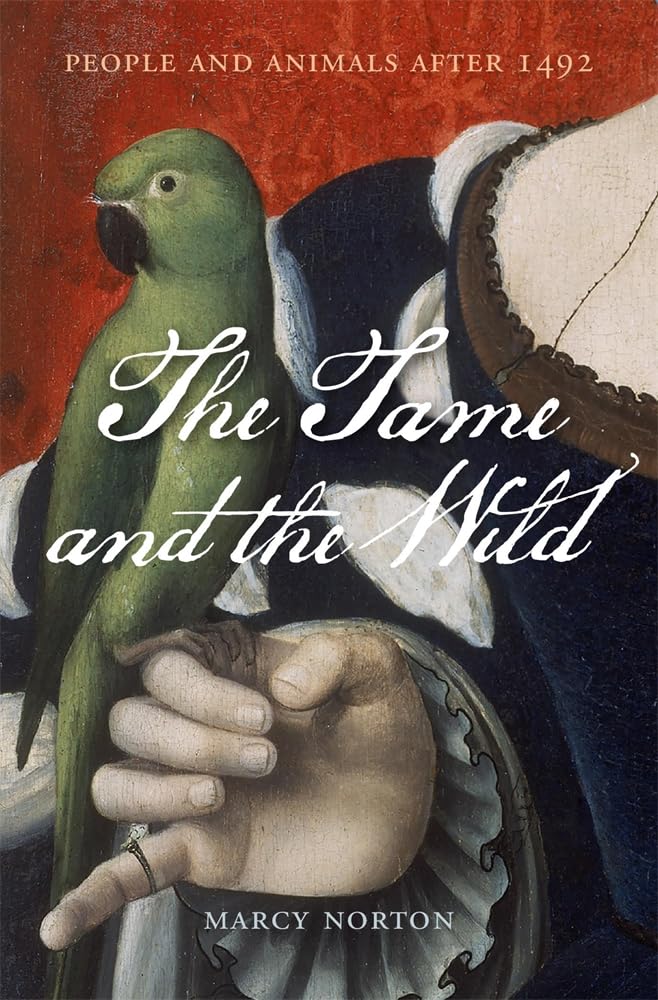



A dramatic new interpretation of the encounter between Europe and the Americas that reveals the crucial role of animals in the shaping of the modern world. When the men and women of the island of Guanahani first made contact with Christopher Columbus and his crew on October 12, 1492, the cultural differences between the two groups were vaster than the oceans that had separated them. There is perhaps no better demonstration than the divide in their respective ways of relating to animals. In The Tame and the Wild , Marcy Norton tells a new history of the colonization of the Americas, one that places wildlife and livestock at the center of the story. She reveals that the encounters between European and Native American beliefs about animal life transformed societies on both sides of the Atlantic. Europeans’ strategies and motives for conquest were inseparable from the horses that carried them in military campaigns and the dogs they deployed to terrorize Native peoples. Even more crucial were the sheep, cattle, pigs, and chickens whose flesh became food and whose skins became valuable commodities. Yet as central as the domestication of animals was to European plans in the Americas, Native peoples’ own practices around animals proved just as crucial in shaping the world after 1492. Cultures throughout the Caribbean, Amazonia, and Mexico were deeply invested in familiarization: the practice of capturing wild animals―not only parrots and monkeys but even tapir, deer, and manatee―and turning some of them into “companion species.” These taming practices not only influenced the way Indigenous people responded to human and nonhuman intruders but also transformed European culture itself, paving the way for both zoological science and the modern pet. “Relationships―between animals and humans, and between humans and other humans―are at the heart of Marcy Norton’s original and ambitious The Tame and the Wild .” ― Alexander Bevilacqua , London Review of Books “[Norton] argues that biology cannot be separated from culture ― a stance that allows her to reconsider why animals were treated in a certain way in the past and how they could be treated in the future… A fascinating book.” ― Henry Mance , Financial Times “A meticulous and profound reckoning with human–animal relationships. Illuminating for anthropologists, ecologists, biologists and historians alike.” ― Surekha Davies , Nature “[An] erudite, interdisciplinary study…Norton rejects the anthropocentrism that separates humans from animals in the biblical myths; rather, she prefers indigenous epistemological systems in which ‘animals and plants were relations, not resources.’ More radically, she would replace the divisive European categories of ‘human’ and ‘animal’ with indigenous understandings of ‘wild and tame,’ which honor the personhood of all creatures.” ― Richard Feinberg , Foreign Affairs “Through historical and anthropological scholarship, including close readings of indigenous American art and writing, Norton demonstrates that indigenous modes of relating to animals, including taming wild creatures and thereby transforming them into kin, had profound ramifications for European culture.” ― Daniel Kraft , Hedgehog Review “[An] ambitious and absorbing exploration of Indigenous American beliefs and practices with regard to animal life before European – here exclusively Spanish – colonisation…[this] is a capacious and richly rewarding book.” ― Mathew Lyons , History Today “Impressive…transforms our understandings of contact and colonization in 1492 and beyond, rewriting that history as one in which differing understandings and practices of relating to animals played a key role…animal history at its best.” ― Adam Warren , William and Mary Quarterly “Offers a much-needed corrective to biological explanations of ‘conquest’ that often strip Indigenous actors of power while downplaying the role of cultural practices and systematic violence…will feed scholarship on people and animals for years to come.” ― John M. Soluri , H-Net Reviews “Exemplifies grounded and mindful interdisciplinary scholarship…an important milestone in ethnohistory, Atlantic history, intellectual history, human-animal studies, and more.” ― Christopher Valesey , H-Net Reviews “Offers a new metaphysical account of the animals and humans that shaped encounters between the Indigenous nations of the Caribbean, Central America, and Greater Amazonia and Europeans since 1492…a remarkable theoretical achievement.” ― Chris Blakley , American Historical Review “A powerhouse of ideas on historical transformations that are highly relevant today…an important contribution to history.” ― Marcelo R. Sánchez-Villagra , Evolutionary Anthropology “An important reminder that the world could have been very different to the one that came to dominate in the Americas. And the current climate crisis would seem to suggest that it should be too.” ― Erica Fudge , International Journal of Mari