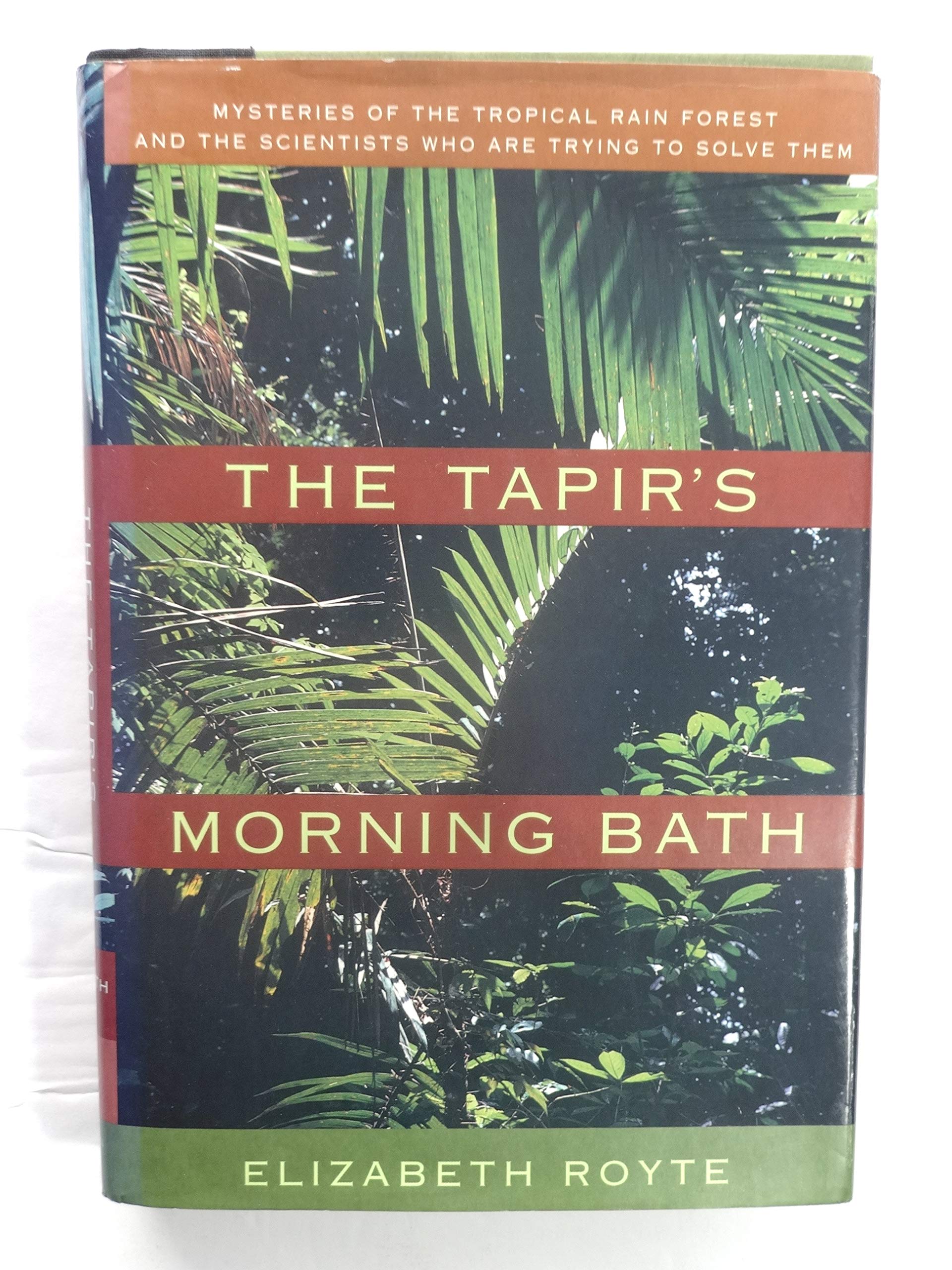
The Tapir's Morning Bath: Mysteries of the Tropical Rain Forest and the Scientists Who Are Trying to Solve Them
$29.90
by Elizabeth Royte



Journeys to the rain forest on Panama's Barro Colorado Island to trace the intricate workings of this complex ecological habitat and examines the work of the scientists racing against time to classify, understand, and preserve an endangered environment. 12,500 first printing. While researching this book, Royte spent a year living and working intermittently with the ardent rainforest researchers on Barrow Colorado Island in the Panama Canal. A contributing writer to Outside magazine, Royte deftly describes these researchers and their work as well as the historical research done on the island and the history of the Smithsonian Tropical Research Institute, which serves as a base camp for researchers on the island. Through stories about spider monkeys, tent-making bats, leaf-cutting ants, spiny rats, innumerable bugs, and even the movement of water in the ecosystem, Royte offers an excellent overview of the need for tropical research. She also discusses the decline of the generalist in the field of biology. Books like Marty Crump's In Search of the Golden Frog (LJ 5/15/00) and Margaret Lowman's Life in the Treetops (LJ 5/15/99) focus on the life-work of one particular scientist (Lowman includes a chapter on her own work on Barrow Colorado), while Royte combines the studies of many researchers, resulting in an introduction to the ecosystem. An excellent book for all libraries. Margaret Henderson, Cold Spring Harbor Laboratory Lib. and Archives, NY Copyright 2001 Reed Business Information, Inc. "By turns comic and poetic, delivers the pleasures of a meandering excursion . . . the act of observing is its own reward." -- The New Yorker "By turns comic and poetic, delivers the pleasures of a meandering excursion . . . the act of observing is its own reward." -- Review "Excellent . . . a superb introduction to tropical ecology and theoretical biology, as well as original and thoroughly engaging travel writing." -- Publishers Weekly "Royte is a remarkable writer . . . a perfect guide. The book is a charmer; I loved it." -- The New York Times Book Review Elizabeth Royte is a contributing writer for Outside magazine. She has written for the New York Times Magazine, Harper's, National Geographic, Smithsonian, The New Yorker, and Rolling Stone. 1 The Lab in the Jungle Gatun lake, the enormous midsection of the Panama Canal, sprawls for thirty-seven kilometers around peninsulas of land, between fragments of drowned mountains, and over the Continental Divide. Oceangoing vessels slice through the canal and shudder into steel locks that close and open almost silently. The lake"s shoreline is wildly irregular, and its waters are as green as the sea. Impenetrable forest flanks the canal. Toucans screech from low branches, and monkeys leap from tree to tree. Iridescent blue butterflies as large as teacup saucers flit along the shore. Inside the forest, a dark tangle of creeping vines and fringed palms battles to reach the sunlight. Here, where two continents meet and the waters of two vast oceans lap against the lake, lies a teeming cornucopia of life at its competitive extreme, a place like few others on Earth. From a spot near the middle of Gatun Lake, opposite a deserted village called Frijoles, Barro Colorado Island rises steeply. Its muddy red banks appear jumbled, its interior black. Isolated by the rising waters of the Chagres River, which was dammed in 1910 to form the canal, Barro Colorado had been the highest point on the Loma de Palenquilla ridge. Now the ridge is gone, and Barro Colorado"s peninsulas and uplifts sprawl over 1,564 hectares, or six square miles; its summit rises 119 meters above the lake"s surface. From where I stood on the deck of the island"s launch as it chugged through the shipping channel, I didn"t see Barro Colorado until we were nearly upon it. Then, just before the place where the canal arcs into Bohio Reach, I spotted several red and green channel markers leading into a small cove. A swimming raft floated there. Looking up, I caught a glimpse of tin-roofed dormitories set into the fringed hillside. Emerging from the background of green was a flight of steep concrete steps, which pulled my eye uphill to a graceful veranda and, behind that, to a peaked roof almost lost in the forest"s lush canopy. The low-lying clouds of early morning draped the thickly forested island, giving it the feel of a Chinese landscape painting. Then a small motorboat puttered up to a dock. A woman in camouflage pants tromped across a metal walkway. The lights flickered on in two low-slung buildings. The laboratory in the jungle came to life. This wasn"t my first visit to Barro Colorado. I had traveled to the island nearly ten years before, in 1990, with the much-lauded Harvard biologist Edward O. Wilson. He was there to collect Pheidole, the largest genus of ants in the New World; I was there to write about him for a magazine. A hero to BCI"s residents, Wilson was ch