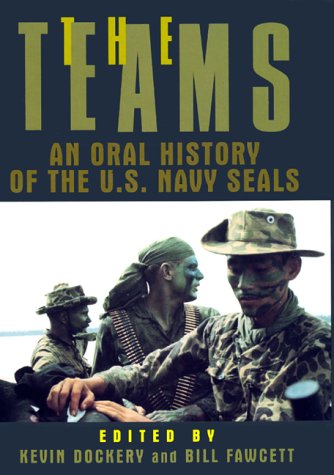



In Hunters and Shooters , fifteen Navy SEALs told their harrowing stories of fighting guerilla-style warfare in the jungles of Vietnam. Legendary in battle, the SEALs -- trained to fight on Sea, Air and Land - were founded in 1962 to fight terrorism, specializing in unconventional combat techniques like diving, demolition, and parachuting. Now, in The Teams six SEALs recount how the program got started - including their excruciating training sessions, first missions and amazing stories for Vietnam - showing how they became one of the most effective special military forces in the world. Richard Brozak takes readers thought the rigorous courses the SEALs took, where he lived off the land in the frozen Canadian Wilderness. Jack Rowell describes covering for his platoon chief in the midst of fierce cross fire during a mission to capture a VC commandant, and James Tipton - recipient of three Purple Hearts - recalls barely escaping in an assault boat while under heavy fire in Vietnam. The secret to the SEAL mystique is perhaps best summed up by Brozak, who characterized the SEALs as men "who knew how to keep going through almost anything without giving a thought to quitting." These are the reminiscences of six individuals who served in the SEALs during the Vietnam War. The stories include that of James Tipton, who earned three Purple Hearts, and Storekeeper Third Class James Janos, better known to the public by the name he used as a professional wrestler, Jesse "the Body" Ventura. After retiring in the late 1980s, he acted in films such as Predator and explains how his SEAL training helped him in both his wrestling and his movie careers. Dockery is coauthor of James Watson's Walking Point: The Experiences of a Founding Member of the Elite Navy SEALs (LJ 4/1/97); Fawcett is a field curator for the UDT/SEAL Museum in Fort Pierce, Florida. People wanting to learn more about the background and history of the SEALs should consult Walking Point or Orr Kelly's Brave Men, Dark Waters: The Inside Story of the Navy SEALs (Presidio, 1992). This book is strictly for Vietnam War collections.?Michael Coleman, Regional Lib. for Blind & Handicapped, Montgomery, Ala. Copyright 1998 Reed Business Information, Inc. In an oral history approach to the often-and well-chronicled SEALs, those formidable amphibious warriors' early days, some of their hitherto untold experiences in Vietnam, and aspects of the post-Vietnam "drawdown" are the major topics. We meet founding father James Tipton, one of the first 60 SEALs; Jack Rowell, whose commitment to the teams cost him his marriage; and James Janos, who parlayed his SEALs-developed fitness into a career as professional wrestler Jessie Ventura. None of these half-dozen testimonies is dull, nor are the men who give them. Indeed, this is one of experienced editors Dockery and Fawcett's better efforts at trying to make the lay reader understand what brings a man into special warfare, especially the demanding form of it practiced by the SEALs. Now, if we can only have enough about the post-Vietnam SEALs actions--up through the Gulf War--declassified to allow a sequel to this volume! Roland Green An oral history of US Navy SEALs, arguably the best elite warriors in the world and trained to fight at sea, in the air, and on land. Editors Dockery and Fawcett (the latter wrote Hunters and Shooters, 1995, a record of SEAL combat in Vietnam) record the hectic ``living on the edge'' experiences of six former SEALs who operated in ``Teams'' of up to 200 officers and men while earning fearsome combat reputations in the jungles and swamps of Vietnam, carrying guerrilla warfare home to the Viet Cong. They penetrated deep into enemy territory, usually at night, with few operations exceeding more than 125 men, yet their missions resulted in a disproportionate number of the highest military decorations and citations given in the war. Evolved from the Under Water Demolition Teams of WW II (the frogmen), the SEALs concentrated on destroying enemy strong points with devastating firepower, shuttling in and out of the lines on hit-and-run missions during the Korean War, and reaching their peak performances (and strength) in Vietnam. The various stories related here stress the incredibly tough and semisecret regimen that eliminates all but a few of the hardiest candidates who sign up for SEAL training. In fact, when not in ``ops'' (combat), SEALs are in constant training, including daily punishing fitness activities. They're expected to master a variety of special skills: jumping, arctic and jungle survival, martial arts, scuba diving, and working with demolitions. These accounts of training and combat show the fierce pride and brotherhood among the SEALs and demonstrate their loyalty to the service. ``You can leave the Navy,'' one says, ``but you can never really leave the Teams.'' A worthy addition to the growing treasury of SEAL lore. -- Copyright ©1998, Kirkus Associates, LP. All rights reserved. In