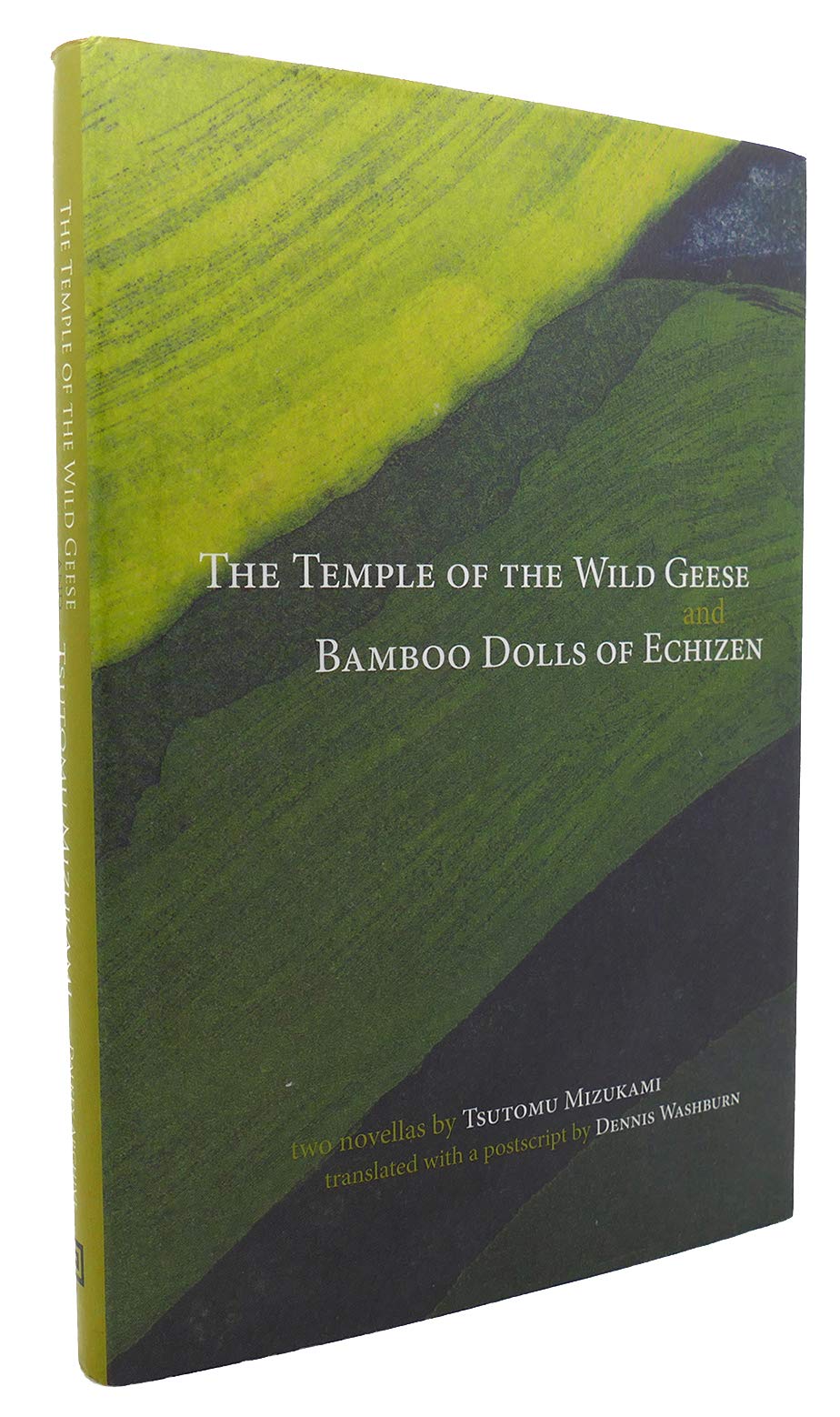



The Temple of the Wild Geese, a semi-autobiographical account of Mizukami's childhood, tells the tale of Jinen, a Buddhist monk raised by villagers after his mother, a beggar, abandoned him. Sent to live at a temple at the age of ten, his resentment smolders for years until it explodes in a shocking climax. In Bamboo Dolls of Echizen, no woman is willing to marry the diminutive Kisuke, a bamboo artisan, until Tamae, a prostitute, comes to pay her respects at the grave of Kisuke's father. In Tamae, Kisuke sees shadows of his own mother, who died when he was young, and the two eventually marry. Since Kisuke seeks only motherly affection from Tamae, the two never become lovers. Instead, Tamae devotes herself to caring for Kisuke as a mother would, and he thrives as a renowned maker of bamboo dolls. *Starred Review* These novellas established the literary credentials of Mizukami (1919–2004) shortly after his first best-selling detective novel was published. Each is written in a precise, impersonal manner that is concentrated enough to brake any rushing that their shortness might spur. They seem to read slowly, but they are rich, not languorous. The Temple of the Wild Geese (1961) is set in a Buddhist temple in the 1930s, where the priest takes a deceased donor’s young mistress for his own. A young teenager is in training under the priest; a diminutive orphan with a misshapen head, Jinen is unusually silent and cold-eyed. Next to the omniscient narrator’s, the mistress’ perspective is preferred in this chamber drama of lust, resentment, and, ultimately, a “perfect” murder. Bamboo Dolls of Echizen (1963) occurs a decade earlier, mostly in a poor mountain hamlet whose most outstanding citizen is a dwarfish bamboo craftsman who has inherited his father’s business and thereafter takes in the beautiful prostitute his father visited when in the city. He loves her but will not embrace her, and therefrom springs a wrenching tale, told primarily from the woman’s perspective, of frustrated love, despondent lust, and death. Imagine a Dostoyevsky novel boiled down to pulp-thriller dimensions with no loss but, rather, a distillation of literary merit. That’s true of each of these stunning small masterpieces. --Ray Olson excellent glimpses of worlds of pre-war Japan that have disappeared' -Asian Review of Books "The Temple of the Wild Geese [was] an immediate success. Its thriller techniques are on a par with those of Georges Simenon, Patricia Highsmith, Francois Mauriac, and Leonardo Sciascia. . . . [Mizukami] used his experiences of boyhood and youth as the basis for Bamboo Dolls of Echizen. This is full of the peculiar local colour of a small, creepy village on 'the backside of Japan'. The descriptions are so detailed, they almost give the feeling of reading a fascinating ethnographical study of a primitive and spooky culture. It is a lost world of vicious ghosts, painful obsessions, utter poverty, and the helpless dignity of ugliness. The book became one of Mizukami's most popular works." -- James Kirkup The Temple of the Wild Geese , a semi-autobiographical account of Mizukamis childhood, tells the tale of Jinen, a Buddhist monk raised by villagers after his mother, a beggar, abandoned him. Sent to live at a temple at the age of ten, his resentment smolders for years until it explodes in a shocking climax. In Bamboo Dolls of Echizen , no woman is willing to marry the diminutive Kisuke, a bamboo artisan, until Tamae, a prostitute, comes to pay her respects at the grave of Kisukes father. In Tamae, Kisuke sees shadows of his own mother, who died when he was young, and the two eventually marry. Since Kisuke seeks only motherly affection from Tamae, the two never become lovers. Instead, Tamae devotes herself to caring for Kisuke as a mother would, and he thrives as a renowned maker of bamboo dolls. Tsutomu Mizukami (19192004) was born in the Fukui Prefecture of Japan. As a child, he was sent by his parents to work and live in a temple in Kyoto. After leaving the temple, Mizukami studied literature at Ritsumeikan University in Kyoto, and later became an apprentice to Uno Koji, under whose tutelage he wrote his first book, a bestseller. Apopular and prolific Japanese author of novels, detective stories, biographies, and plays, Mizukami was also awarded several awards and prizes, including the Naoki Prize for The Temple of the Wild Geese . Tsutomu Minakami, also known as Mizukami Tsutomu, was a popular and prolific Japanese author of novels, detective stories, biographies, and plays. Many of his stories were made into movies. Used Book in Good Condition