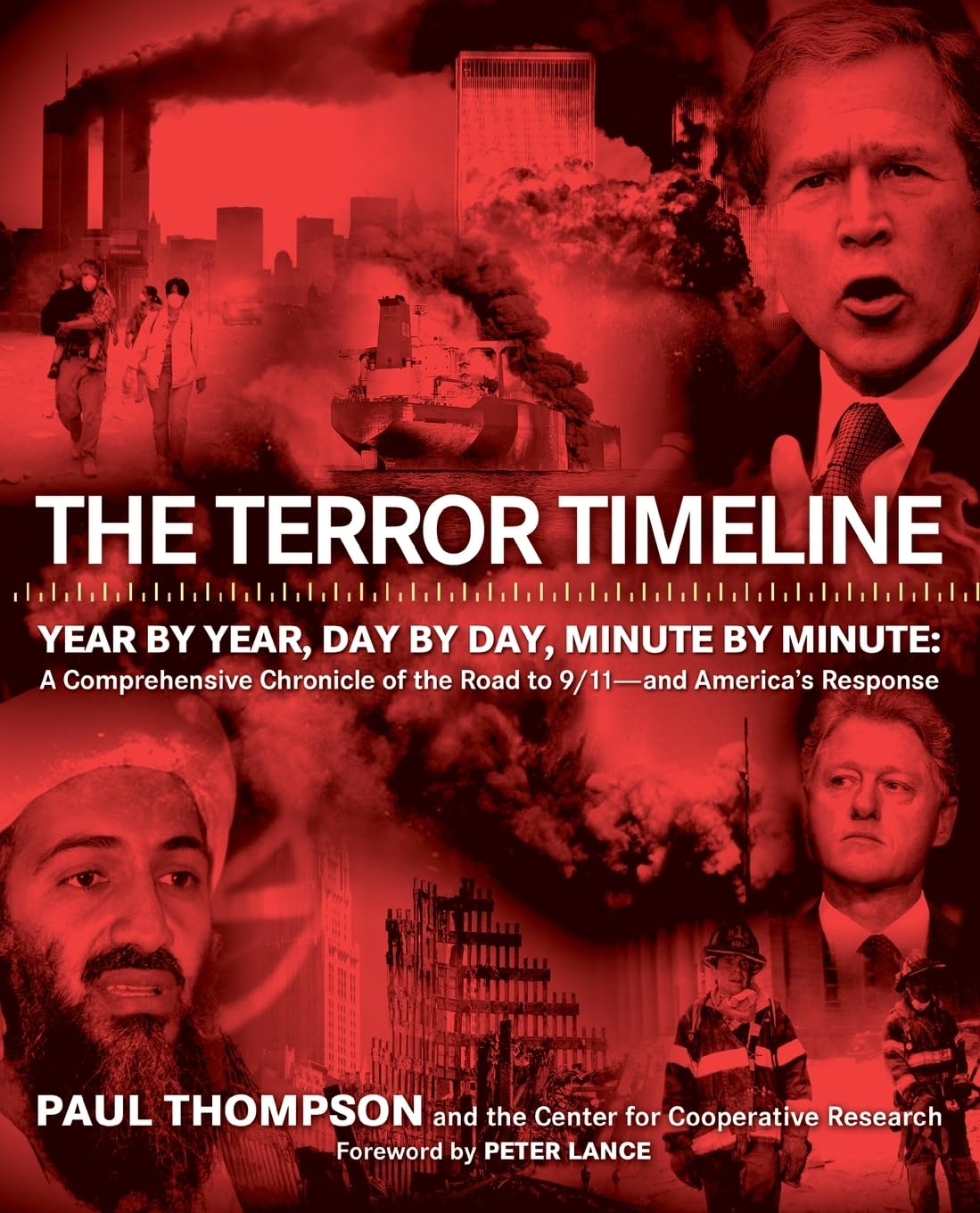
The Terror Timeline: Year by Year, Day by Day, Minute by Minute: A Comprehensive Chronicle of the Road to 9/11―and America's Response – The Definitive
$16.69
by Paul Thompson



Paul Thompson's The Terror Timeline offers a complete and thorough history of the many roads that converged on 9/11, including the development of Islamic fundamentalism, the activities of bin Laden and al-Qaeda, and the failures of U.S. investigations and counterterrorism efforts. It traces the actions (and inactions) of every important figure in the war on terror, both before and after 9/11, bringing them together in a volume that offers a comprehensive and provocative look at this complex subject. Packed with little-known facts and disturbing questions, The Terror Timeline is the first complete reference guide to the events of 9/11 and the war on terror -- the definitive primer on the most momentous issue of our times. Paul Thompson's The Terror Timeline offers a complete and thorough history of the many roads that converged on 9/11, including the development of Islamic fundamentalism, the activities of bin Laden and al-Qaeda, and the failures of U.S. investigations and counterterrorism efforts. It traces the actions (and inactions) of every important figure in the war on terror, both before and after 9/11, bringing them together in a volume that offers a comprehensive and provocative look at this complex subject. Packed with little-known facts and disturbing questions, The Terror Timeline is the first complete reference guide to the events of 9/11 and the war on terror -- the definitive primer on the most momentous issue of our times. Paul Thompson is a freelance researcher and is the creator of the Center for Cooperative Research’s Complete 9/11 Timeline (www.cooperativeresearch.org), a compilation of over 5000 articles and reports on 9/11. A former California environmental activist, he worked to preserve the rainforest in Borneo. Thompson divides his time between California and New Zealand. The Terror Timeline Year by Year, Day by Day, Minute by Minute: A Comprehensive Chronicle of the Road to 9/11 - And America's Response By Thompson, Paul ReganBooks ISBN: 0060783389 Warning Signs U.S. officials, especially those in the Bush administration, have repeatedly insisted that they had no evidence that Osama bin Laden was planning an attack inside the U.S. For example, President Bush insists, "Had I known there was going to be an attack on America I would have moved mountains to stop the attack." [New York Times, 4/18/04] Officials claim that hints of an attack -- to the extent they existed -- always pointed overseas, and also claim that no one thought that terrorists would use airplanes as flying weapons against U.S. symbols. For example, National Security Adviser Condoleezza Rice said in mid-2002 that, "Even in retrospect," the Bush administration had no hints of such a form of attack. [White House, 5/16/02] What are the facts as we know them today? What did U.S. government officials know, and when did they know it? Understanding these warning signs -- and the U.S. government's response to the signs -- is paramount to understanding how 9/11 could have happened and, equally important, whether it can happen again. This chapter chronicles, based on the current public record, what people in our government did know and when they knew it. (Even more warning signs are detailed elsewhere in the book, as in chapter 3 on counterterrorism efforts before 9/11, chapter 7 on hijackers Nawaf Alhazmi and Khalid Almihdhar, and chapter 10 on Zacarias Moussaoui.)The seeds of 9/11 were planted long before the Bush administration came to power. In its quest to win the Cold War, the U.S. spent billions of dollars funding the mujahedeen resistance in Afghanistan, seeking, literally, to spend the Soviet Union to death. Focused on victory, the U.S. directly and indirectly transformed the ill-armed and overwhelmed Afghan freedom fighters into a well-armed, increasingly effective international "army." That many in this "army" were anti-Western, fundamentalist Islamists seemed irrelevant at the time, as they were fighting a common enemy. The U.S. eventually won the Cold War -- but at what price? In Afghanistan, the communist government was eventually replaced with the tyrannical Taliban. Many from the mujahedeen resistance reconstituted into al-Qaeda and similar organizations. Their guerilla-style jihad, so effective against the Soviets, morphed into terrorist jihad against the U.S. and other Western countries.By the time Bill Clinton became president in 1993, bin Laden had already sponsored a number of successful attacks on American targets. During the Clinton administration, he sponsored more. After the simultaneous bombing of two U.S. embassies in Africa in 1998, and the U.S.'s failed retaliation attempt against him, Osama bin Laden became a household name around the world. Each successive attack bin Laden perpetrated was a warning sign -- that his primary target was the U.S., that his primary weapon was terrorism, and that he had the resources necessary to wage his war. Each successive attack foiled was ye