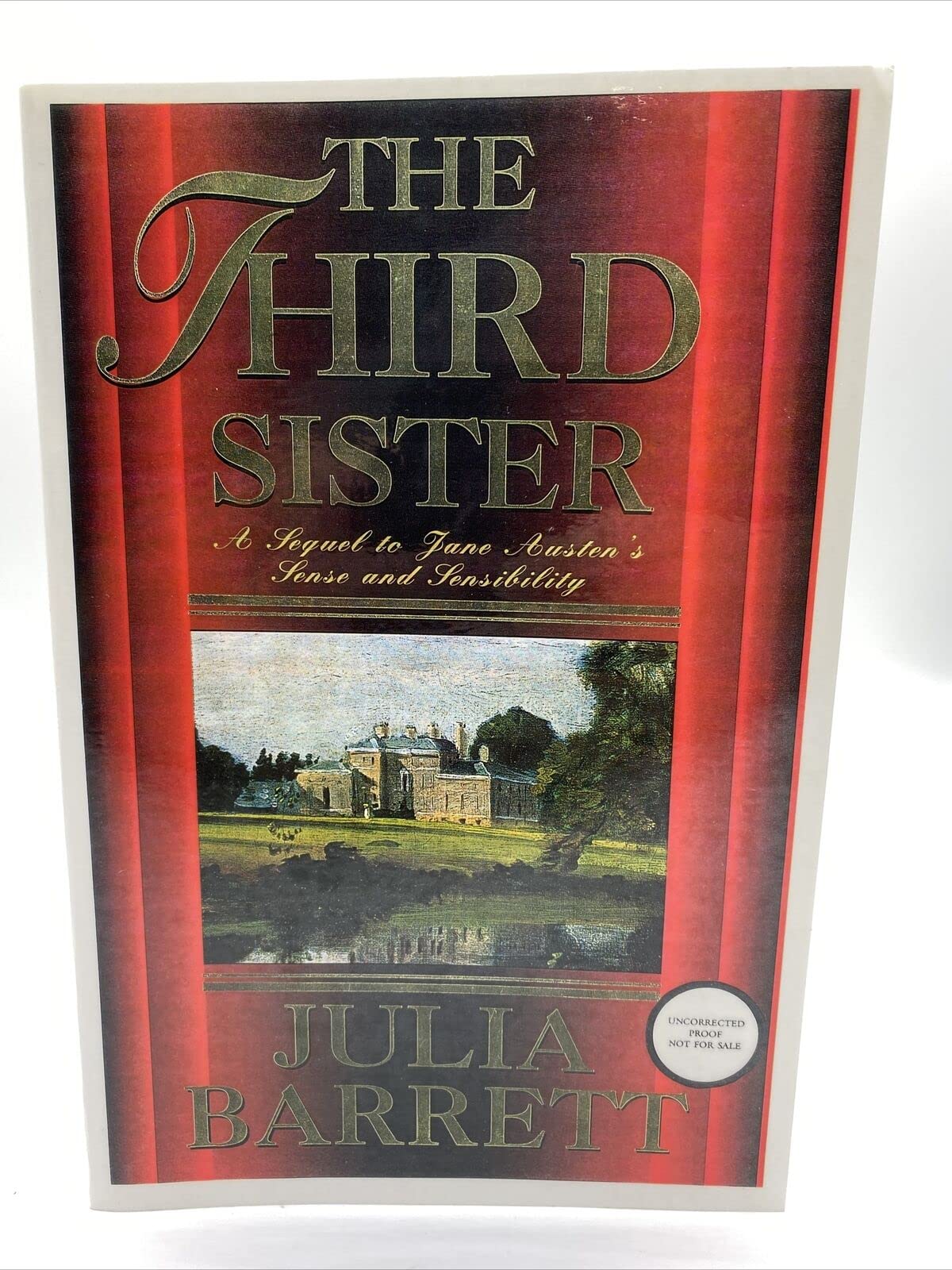
The Third Sister: A Continuation of Jane Austen's Sense and Sensibility
$11.88
by Julia Barrett



In Sense and Sensibility Jane Austen, that so long mistaken avatar of Victorian propriety while actually its wittiest and subtlest critic, wrote of Margaret Dashwood, the third sister: "Margaret, the other sister, was a good-humored, well-disposed girl; but as she had already imbibed a good deal of Marianne's romance, without having much of her sense, she did not, at thirteen, bid fair to equal her sisters at a more advanced period of life." At the same time that she so faithfully, with love and respect, evokes Jane Austen's style and characters and ambience, Julia Barrett bids fair to show Margaret's creator happily wrong in her estimation of Margaret's at first vulnerable, then shrewd and winning potential, the exercise of which makes for the substance of this remarkable novel on its own. But of course, Jane Austen couldn't know of Margaret's metamorphosis. Or perhaps she did, and meant one day to say so herself. Whatever, The Third Sister is an imaginative, creative continuation of Sense and Sensibility, featuring a Margaret Dashwood, the third sister, once so underestimated, who turns out to fool even her creator. Only a writer with considerable skill and a fair amount of confidence would dare a sequel to Jane Austen's Sense and Sensibility , especially given the renewed interest in her work, not to mention her status as a classic author. But Julia Barrett, whose Presumption was a sequel to Pride and Prejudice , has produced a novel that pays homage to Austen by following her style while not mimicking it. Her heroines are smart and well-mannered (including cameos by some of Austen's originals), the pace is quick yet controlled, and the story lines, while echoing Austen's style and tête-à-têtes between characters, are innovative. The pseudonymous Barrett's first novel, Presumption (Evans, 1993), was a sequel to Jane Austen's Pride and Prejudice (1813). Her second features Margaret, the youngest of the three Dashwood sisters. Margaret, who was briefly mentioned in Sense and Sensibility (1811), is now 17. She combines the best of her sisters' character traits: just the right amount of Elinor's good sense and Marianne's emotionality. Despite her attractive appearance and pleasing demeanor, Margaret despairs of ever finding a man who will overlook her lack of a dowry. Shortly after the novel opens, however, she meets two handsome and eligible young men. High-spirited William du Plessy and mysterious George Osborne are both besotted with Margaret. Predictably, she accepts the wrong man's proposal of marriage and, just as predictably, is rescued at nearly the last minute by information fortuitously received. This well-intentioned but often tedious sequel is a far cry from the stylish and witty original. Libraries should skip this and instead purchase another copy of Sense and Sensibility.?Nancy Pearl, Washington Ctr. for the Book, Seattle Copyright 1996 Reed Business Information, Inc. Fans of Jane Austen dream of a suddenly unearthed manuscript to savor and treasure. Barrett's first book in the world of Austen's characters, Presumption (1993), was not that novel, though it is a sincere tribute. Her latest homage is a continuation of Sense and Sensibility . The "third sister" is, of course, Margaret, who as a child lived in the shadow of restrained Elinor and passionate Marianne. Here Margaret embarks on her own journey of love and self-discovery. She has been made cautious and circumspect by Marianne's near-tragic encounter with the cad Willoughby, and so her first meeting with Lieutenant du Plessy, the handsome soldier son of the French expatriate Comtesse du Plessy, finds her attracted but alarmed by his easy flattery and open admiration. Elements of the book depart from true Austen style, such as the masculine badinage over boxing and the faro table, but the dialogue is crisp and amusing and the threat of unhappy marriage compelling in this tale of Margaret Dashwood's emotional blossoming. Roberta Johnson Yet another Jane Austen sequel from the pseudonymous Barrett (Presumption: An Entertainment, 1993), this time continuing the adventures of the Dashwood girls from Sense and Sensibility. Fortuitously timed amidst a virtual Austen revival, Barrett's continuation of the classic marriage novel leaves us with the dilemmas of the forgotten third sister Margaret, described by Austen as a ``well-disposed girl; but as she had already imbibed a good deal of Marianne's romance, without having much of her sense, she did not, at thirteen, bid fair to equal her sisters at a more advanced period of her life.'' Barrett, taking up Margaret's cause, gives her a plot of her own. Her sisters are both happily married and comfortably established: Elinor is a useful matron to her husband's Dorset parsonage, and Marianne is happy as the wife of Colonel Brandon, a wealthy landowner. Margaret, eager to leave the dull life of Barton cottage and her unofficial position as nanny to her cousins, the nearby Middletons, goes look