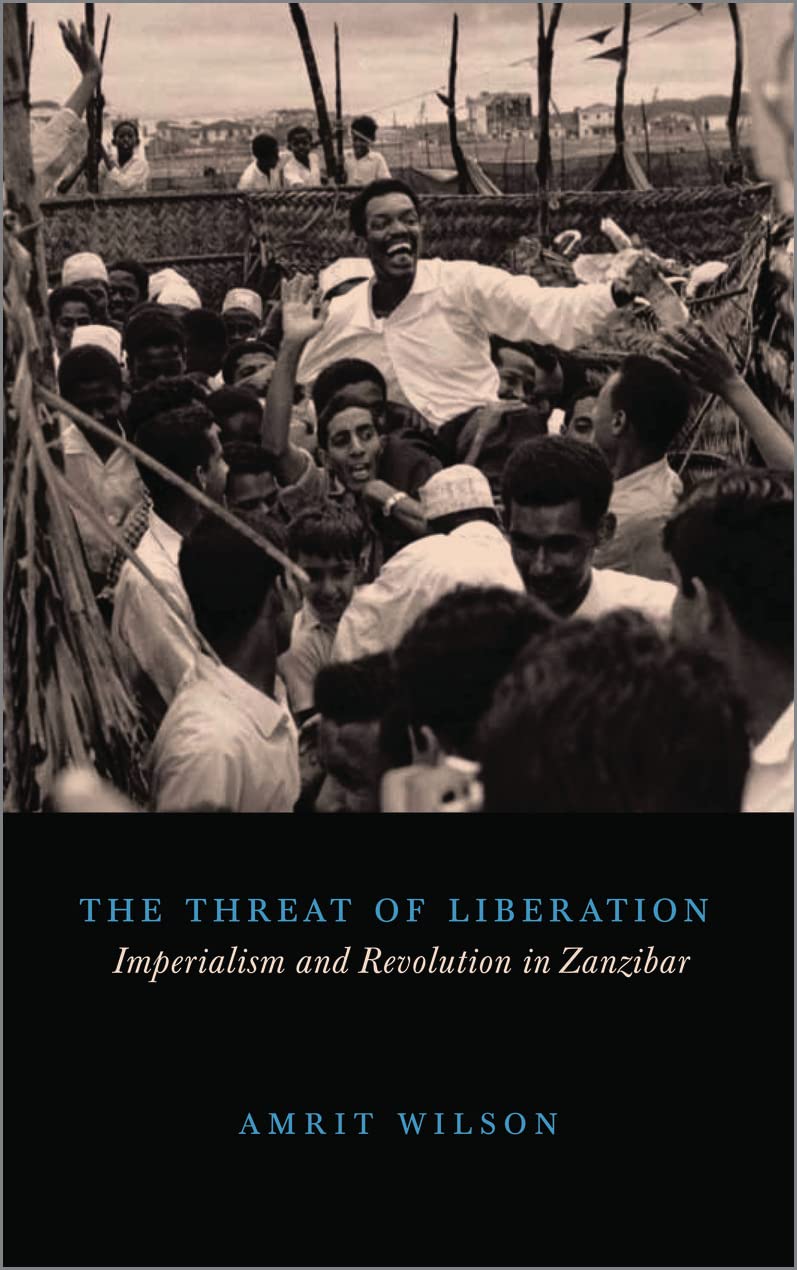



The Threat of Liberation focuses on the tumultuous years of the Cold War, when, in a striking parallel with today, imperialist powers were seeking to institute 'regime change' and install pliant governments. Using iconic photographs, declassified US and British documents, and in-depth interviews, Amrit Wilson examines the role of the Umma Party of Zanzibar and its leader, the visionary Marxist revolutionary, Abdulrahman Mohamed Babu. Drawing parallels between US paranoia about Chinese Communist influence in the 1960s with contemporary fears about Chinese influence, it looks at the new race for Africa's resources, the creation of AFRICOM and how East African politicians have bolstered US control. The book also draws on US cables released by Wikileaks showing Zanzibar's role in the 'War on Terror' in Eastern Africa today. The Threat of Liberation reflects on the history of a party which confronted imperialism and built unity across ethnic divisions, and considers the relevance of such strategies today. “Amrit Wilson has tapped a wide range of sources to tell a story of Zanzibar in modern times. As interesting as the narrative she puts together is the vantage point from which she tells it. This book deserves a wide audience.” - Mahmood Mamdani, Columbia University “Amrit Wilson offers an insightful and compelling analysis of the concrete struggle against neo-colonialism as it has played out, over the last several decades, in Zanzibar and what is now Tanzania. Getting beyond the headlines and the official histories, and with access to material previously unavailable, Wilson introduces the reader to a 1960s movement that could have brought about the revolutionary transformation of Zanzibar, and quite possibly other parts of East Africa, had it not been hijacked. There were moments when Wilson's compelling narrative had the feel of gripping novel!" - Bill Fletcher, Jr., co-editor of Claim No Easy Victories: The Legacy of Amilcar Cabral Amrit Wilson is the author of Dreams, Questions, Struggles: South Asian Women in Britain (Pluto, 2006), The Challenge Road: Women in the Eritrean Revolution (1991) and US Foreign Policy and Revolution: the creation of Tanzania (Pluto, 1989) and the co-editor of The Future that works: Selected writings of A.M.Babu (2002). The Threat of Liberation Imperialism and Revolution in Zanzibar By Amrit Wilson Pluto Press Copyright © 2013 Amrit Wilson All rights reserved. ISBN: 978-0-7453-3408-0 Contents List of photographs, viii, Acknowledgements, x, List of acronyms and abbreviations, xi, Introduction, 1, 1 Anti-Colonial Struggles — The Early Days, 11, 2 The British Transfer Power to the Sultan and His Allies, 35, 3 The Zanzibar Revolution and Imperialist Fears, 46, 4 The Union with Tanganiyka, 61, 5 Karume's Despotic Rule, 77, 6 Trial in Zanzibar's Kangaroo Court, 90, 7 Zanzibar and the Mainland in the Neoliberal Era, 100, 8 US Interventions in Zanzibar and on the Mainland Today, 114, Appendices:, 1 A People's Programme: The Political Programme and Constitution of the Umma Party, 139, 2 Charge Sheet: Case no. 292 of 1973 (the Umma Defendants), 149, Notes, 157, References, 160, Index, 171, CHAPTER 1 Anti-Colonial Struggles – The Early Days The mid-1950s and early 1960s, when this story begins, had a number of striking similarities with today. In Africa, the United States and the United Kingdom were seeking desperately to institute 'regime change' and bring in governments that they could manipulate and use in their own interests. They were using covert methods and ideologies of fear, whipping up paranoia and unleashing witch hunts – but at that time against communists, not 'Islamic terrorists'. In their plan for continuing to exploit the countries of Africa (many of which were either newly independent or fighting colonialism), Zanzibar was regarded as a crucial place. The United States saw it as part of a Central African belt which, if controlled, would protect Southern Africa (with its western investments) from the radical and socialist influences of countries like Algeria and Ghana. If Zanzibar went out of this orbit, they feared, the whole of Africa might follow. Zanzibar was and still is a remarkable place. A hub of commerce for two thousand years connecting Asia, Africa and the Arabian peninsula, it was, as it were, a cosmopolitan centre of the world. Historian Abdul Sheriff describes evocatively what Zanzibar town was like in his childhood in the early 1950s when he played on the narrow streets with kids who were Swahili, Omani, Persian, Hadhrami or Indian in origin, and how every monsoon saw the arrival of 'dhows and sailors from Arabia, the Persian Gulf, India and Somalia ... the harbour was also full of coasting Jahazis from Lamu and Kilwa. There was a great intermingling of peoples' (Sheriff, 2008). This multicultural scene also reflected a vibrant anti-imperialism which came out of the experiences of the Second World War and