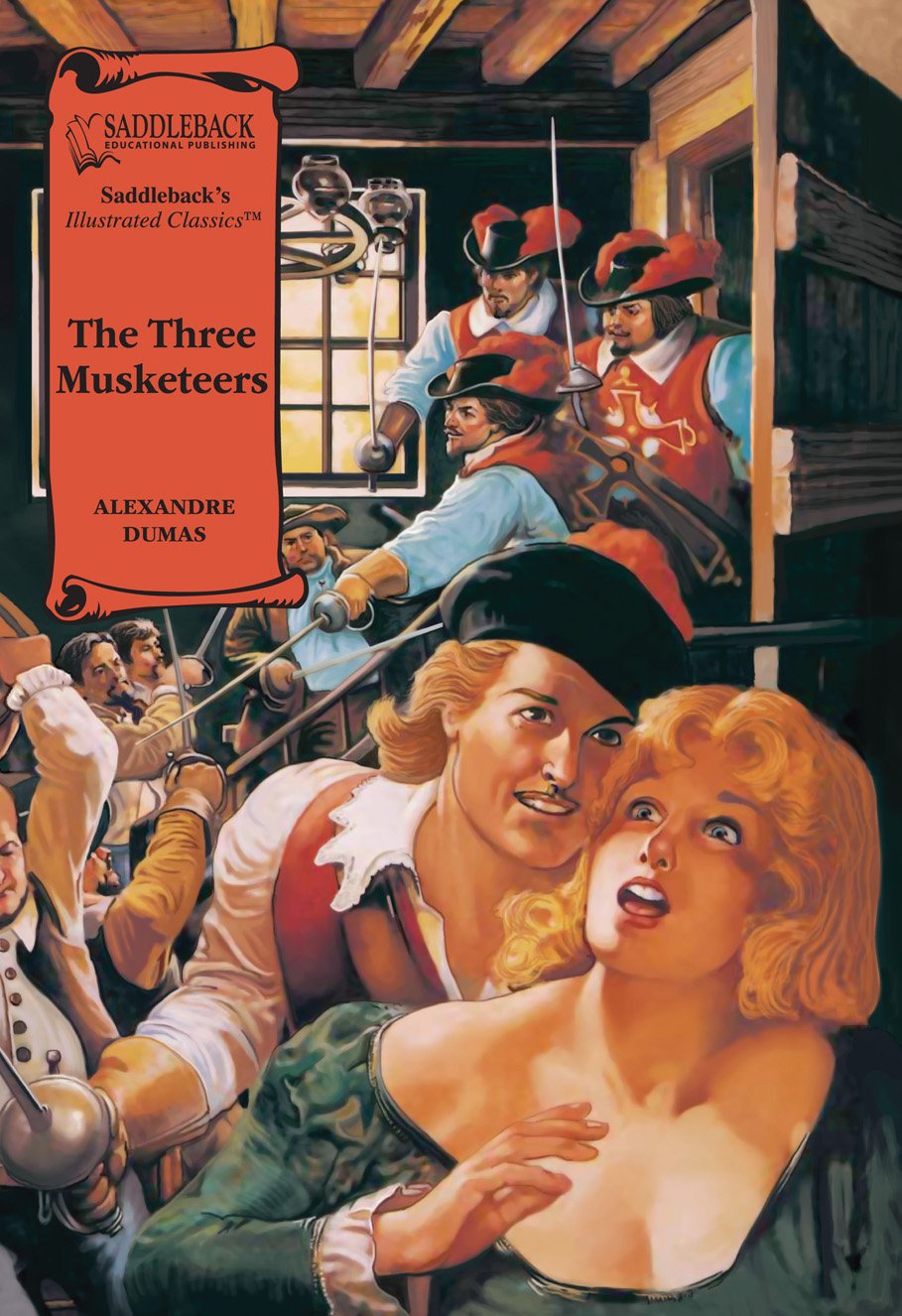



These literary masterpieces are made easy and interesting. This series features classic tales retold with color illustrations to introduce literature to struggling readers. Each 64-page eBook retains key phrases and quotations from the original classics. This story exemplifies camaraderie and the loyalty the musketeers had to their king, queen, and country. The main characters; Athos, Porthos, and Aramis, the adventurous three musketeers, later joined by d'Artagnan, all unite in their dedication to the defense of France and the destruction of Lady de Winter, "Milady," the conniving spy of Cardinal Richelieu and wicked murderer of Constance Bonacieux, the loyal seamstress and friend of the French Queen. The Three Musketeers By Alexandre Dumas Saddleback Educational Publishing, Inc. Copyright © 2005 Alexandre Dumas All right reserved. ISBN: 9781562549428 Chapter One From Alexandre Dumas, a precise and candid description of his particular view of history: I start by devising a story. I try to make it romantic, moving, dramatic, and when scope has been found for the emotions and the imagination, I search through the annals of the past to find a frame in which to set it; and it has never happened that history has failed to provide this frame, so exactly adjusted to the subject that it seemed it was not a case of the frame being made for the picture, but that the picture had been made to fit the frame. This is the point of view of the historical novelist, who approaches the past as theater–the unending melodrama of saints and sinners, and who knows that history, eternally surprising, inspiring, disheartening, sometimes described as “one damn thing after another,” will never fail him. It is all there. And it is all there to be used. Dumas was in his early forties when he wrote The Three Musketeers, an age when novelists are believed to be entering their best creative years. He is traditionally described as “a man of vast republican sympathies,” which, in contemporary terms, made him a believer in democracy, equality, and the rights of man. He had fought in the streets of Paris during the July revolution of 1830; would man the barricades in 1848; would aid Garibaldi, with guns and journalism, in the struggle for Italian independence in 1860. Such politics came to him by inclination, and by birth. His father, Thomas-Alexandre Davy de La Pailleterie, had taken the name of his African slave mother, Marie Dumas, and spent the early years of his life on the island of Santo Domingo. When the French Revolution made it possible for men without wealth or social connections to rise to power, the soldier Alexandre Dumas became General Alexandre Dumas, commanding the Army of the Alps in 1794, serving under Napoleon Bonaparte in Italy, and later in Egypt. But his relationship with Bonaparte deteriorated; his health was destroyed by two years in an Italian prison; and he died, a broken man, in 1806. His son, in time the novelist Dumas, was then four years old, but he would be told of his father’s life, and he knew what it meant. By 1844, France was ruled by Louis-Philippe, duc d’Orleans, a constitutional monarch known as “the bourgeois king,” who presided over the golden age of the French bourgeoisie, a propertied class animated by the slogan “Enrichissez-vous!” (Enrich yourselves!) This was a period of transition, when corrupt capitalism was opposed by passionate idealism–the age of monarchy was dying, the age of democracy was just being born. The best insight into the period is to be found in the novels of Honoré de Balzac–Dumas’s fierce literary rival. Balzac was virtually the same age as Dumas, and, like Dumas, rose from social obscurity and penury by producing a huge volume of work at an extraordinary pace. But Balzac wrote about contemporary life–the vanity, corruption and sexual politics of Paris in the 1840s–and was, throughout his fiction, essentially a novelist of vice. Dumas, on the other hand, was a novelist of virtue, though he had to go back two hundred years to find it. Setting The Three Musketeers in the year 1625–at that distance, a contemporary American novelist might use the revolution of 1776–Dumas was summoning up a remote and heroic era. Yes, it was all different back then. Better. Still, it may be worth remembering that Dumas’s musketeers are proud, courageous men, men without inherited money or the support of prominent family, who must fight their way through a world of political intrigue dominated by predatory, immoral people who scheme and connive, who will do virtually anything, to keep their wealth and position. So, if it is about anything, The Three Musketeers is about betrayal, fidelity, and, like almost all genre fiction, it is about honor. Honor lost, honor gained, honor maintained at the cost of life itself. By 1894, the sale of Dumas’s works totaled three million books and eight million serials. The Three Musketeers, the first book of the d’Artagnan trilogy, with Twent