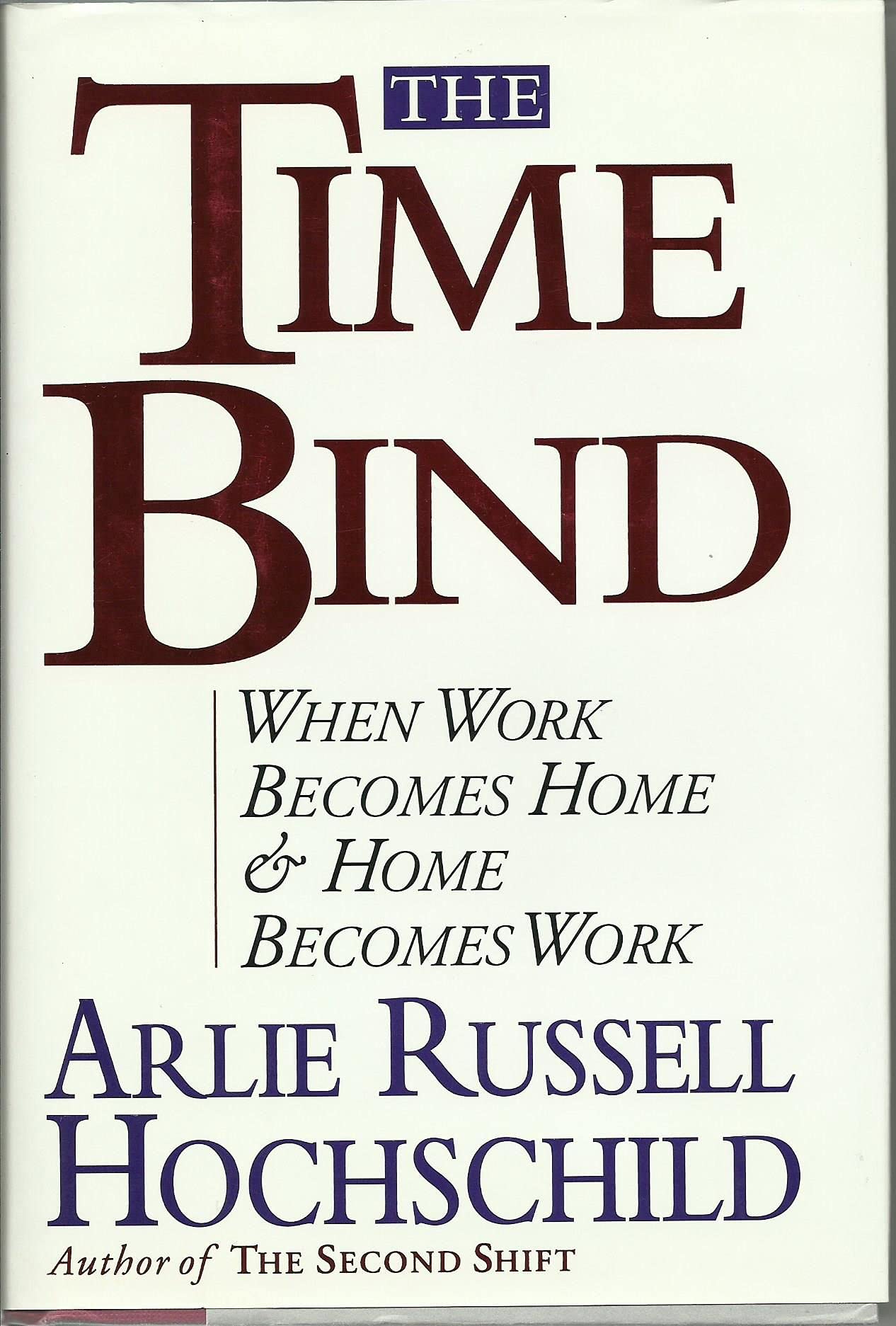
The Time Bind: When Work Becomes Home and Home Becomes Work
$16.38
by Arlie Russell Hochschild



A New York Times Notable Book In the early 1990s Arlie Hochschild exposed The Second Shift , revealing the housework and childcare inequities of working couples. In this book Hochschild exposes the disturbing time bind of American families: parents are putting more hours in at work to support their families, which creates more stress at home, which pushes parents into seeking more work time to escape the tension at home. The result of this time crunch is the unsettling development of the "third shift"--the time parents spend repairing the damage left in the wake of their compulsion to work. Hochschild's solution? Parents of America unite! The final chapters discuss how parents can start a "Time Movement," liberating themselves from work-driven tyranny. Hochschild, coauthor of the acclaimed The Second Shift (LJ 4/15/89), here reports on a study she conducted of a large company (name changed) to see why employees were not taking advantage of the "family friendly" options it offered. She found that employees were the "working scared"; despite options, management had conveyed the sense that employee devotion to the company was based on the number of hours at work. The hourly production workers who did not have access to the family benefits still opted for overtime and double shifts. They wanted to keep their jobs secure, although in the end, the employer laid off half the employees through downsizing. The author also contends that for many employees work was more rewarding than home life and a pleasant escape for parents, and they did not want to give it up. Hochschild gives some attention to the plight of the workers' children, but she could have gone into greater depth. Still, this is valuable study. Recommended for business collections.?Peggy Odom, Texas Lib. Assn., Waco Copyright 1997 Reed Business Information, Inc. With The Second Shift (1989), Hochschild helped popularize that title phrase as she investigated attempts to share household duties and child-care responsibilities in two-job marriages. One of her claims was that more and more couples had less and less time to do the things they said they wanted to do. This new book is an attempt to find out why, and it makes a surprising discovery. Although Hochschild's sample was small and all her subjects worked for the same company, she found that both mothers and fathers were choosing work over home. She spent three summers doing field research at a company identified only as a Fortune 500 firm that had also been credited on several different surveys as being one of America's 10 most "family-friendly" corporations. The couples she observed regularly chose not to take advantage of the company's policies, and they had come to find the workplace more comforting than the tensions of home and family. Hochschild suggests reasons for this and looks at the implications of her observations. David Rouse Along with predictable premises and conclusions, this case study raises unsettling questions about the impact of time on contemporary lives. Sociologist Hochschild (Univ. of Calif., Berkeley) observes a large corporation ostensibly committed to ``family-friendly'' policies and outlines a familiar story: The excessive demands of work create stresses at home because there is insufficient time to do everything. This is especially hard on women, who, as Hochschild documented in The Second Shift (1989), bear the brunt of housekeeping chores, and on children, whose emotional needs require time with parents. Except for some older men, the people Hochschild interviews are aware of and concerned about the implications of this time bind. What is surprising, consequently, is their failure to embrace reduced workloads, flex time, and other components of the company's effort to help employees balance the demands of work and home. While supporting the existence of these policies, few employees take advantage of them. Fears about job security and career advancement are present, of course, but many employees were uninterested in such options because they perceived work, not home, as the less stressful and more emotionally rich environment. With family lives careening on the brink of disaster and parents feeling perpetually out of control, the office or factory floor provides a sense of accomplishment, fulfillment, and camaraderie. Unfortunately, after uncovering this surprising reversal of conventional expectations, Hochschild buries it by simply assuming it is a pathology. Escaping from the home by going to work reflects a dynamic with costs, but it also suggests a need to reconsider common conceptions of what constitutes a satisfying adult life. The disappointing failure to press forward with her observations does not prevent this from being a provocative book. (First printing of 50,000; first serial to the New York Times Magazine; author tour; TV satellite tour) -- Copyright ©1997, Kirkus Associates, LP. All rights reserved. "truly subversive . . . .Mr. Hochschild has expose