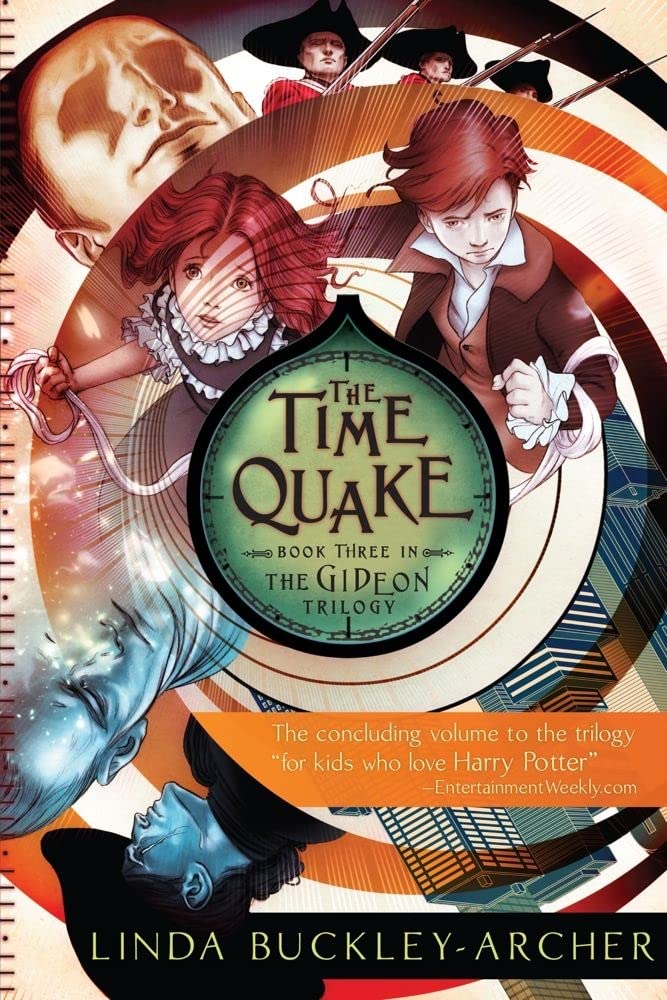



Time itself is splintering. If the catastrophic consequences of time travel are now impossible to ignore, Lord Luxon only has eyes for its awesome possibilities. He has his sights set on no lesser prize than America. Abducted to 1763, Peter and Kate begin to understand that history has arrived at its tipping point. Adrift in time, Kate transforms into an oracle, able to see the future as easily as the past. While Gideon does all he can to help, he is tormented by the knowledge that The Tar Man, his nemesis, is also his own brother. As they pursue him through the dark streets of eighteenth-century London, and the time quakes begin, Peter realises that this monster may hold the fate of all of us in his hands. Readers familiar with Kate, Peter, and Gideon from Gideon the Catpurse (2006) and The Time Thief (2007) will happily find that their exciting adventures continue. However, first-time readers must piece together the background to understand the twists and turns in the story. While greedy Lord Luxon tries to change history by having the British defeat the Americans in 1776, Gideon and the children must overcome obstacles to retrieve the one remaining time machine to stop the quakes and set history aright. In this conclusion of the Gideon trilogy, Buckley-Archer presents a satisfying, yet rather abrupt, neatly packaged conclusion by bringing Kate and Peter safely home. Grades 6-9. --J. B. Petty The concluding volume to the trilogy "for kids who love Harry Potter" -- EntertainmentWeekly.com Linda Buckley-Archer is the author of the critically acclaimed Gideon trilogy. Originally trained as a linguist, she is now a full-time novelist and scriptwriter. She has written a television drama for the BBC and several radio dramas, as well as various journalistic pieces for papers like the Independent . The Gideon Trilogy was inspired by the criminal underworld of eighteenth-century London. The Time Quake ONE MANHATTAN In which Lord Luxon takes a fancy to New York The sun shone down on the remarkable island of Manhattan, whose thrusting castles, too tall and numerous by far to be the stuff of fairy tales, held gravity in contempt as they vied to be the first to reach the sky. Great alleys of skyscrapers seemed to strut across the city, catching the rays of the dazzling sun and casting vast shadows behind them. It was August, and the air was heavy with an intense, moist heat, and those foolish enough to leave the cool shelter of the giant buildings for the scorching street would soon find their shirts sticking to their backs and their hair plastered to their foreheads. More than one New Yorker turning off Sixth Avenue onto the comparative calm of Prince Street found their gaze sidling over to an individual whose stance as well as his dress marked him out, even in SoHo, as somewhat unusual. The buildings were smaller here, on a more human scale, a mere six stories high, some of them with iron staircases zigzagging down toward the sidewalks, which mid-afternoon were already in deep shade. While he waited for his valet to hail a cab, Lord Luxon stood in front of an Italian baker’s shop, its windows piled high with crusty loaves baked in the form of oversized doughnuts, in order to observe his reflection in the dusty window. He adjusted his posture. People were strolling by in various stages of undress, wearing shades and shorts and brightly colored T-shirts, darting from one air-conditioned building to another. Lord Luxon, however, appeared cool and immaculate in an ivory three-piece suit, cut expertly from the lightest of cloths, which skimmed the contours of his slim figure. He assumed his habitual stance: legs apart, one arm neatly behind his back, the other resting lightly on his silver-tipped ebony cane. He consciously lengthened the muscles at the back of his neck so that he held his head at precisely the angle that announced, eloquently, that here was an English aristocrat, born of an ancient line of English aristocrats and accustomed to all that life can afford, in whatever century he happened to find himself. He observed his silhouette and congratulated himself on having discovered a tailor of such exceptional talent in an age when the male of the species seemed to have forgotten both the art and pleasure of self-adornment. And how curious it was that although well more than two centuries separated his tailors, their respective premises, on London’s Savile Row, were but a few dozen paces the one from the other. A middle-aged tourist, his sagging belly bulging over the waist of his shorts, stopped to stare for a moment at this vision in cream linen. Lord Luxon eyed him with distaste and thought of his cedarwood chests in 1763, specially imported from Italy, and the layers of exquisite silks they contained, the frothy lace, his embroidered, high-heeled shoes, his tricorn hats and brocade vests, his dress wigs, his rouge and his black beauty spots in the shape of crescent moons. It was disappointing, he