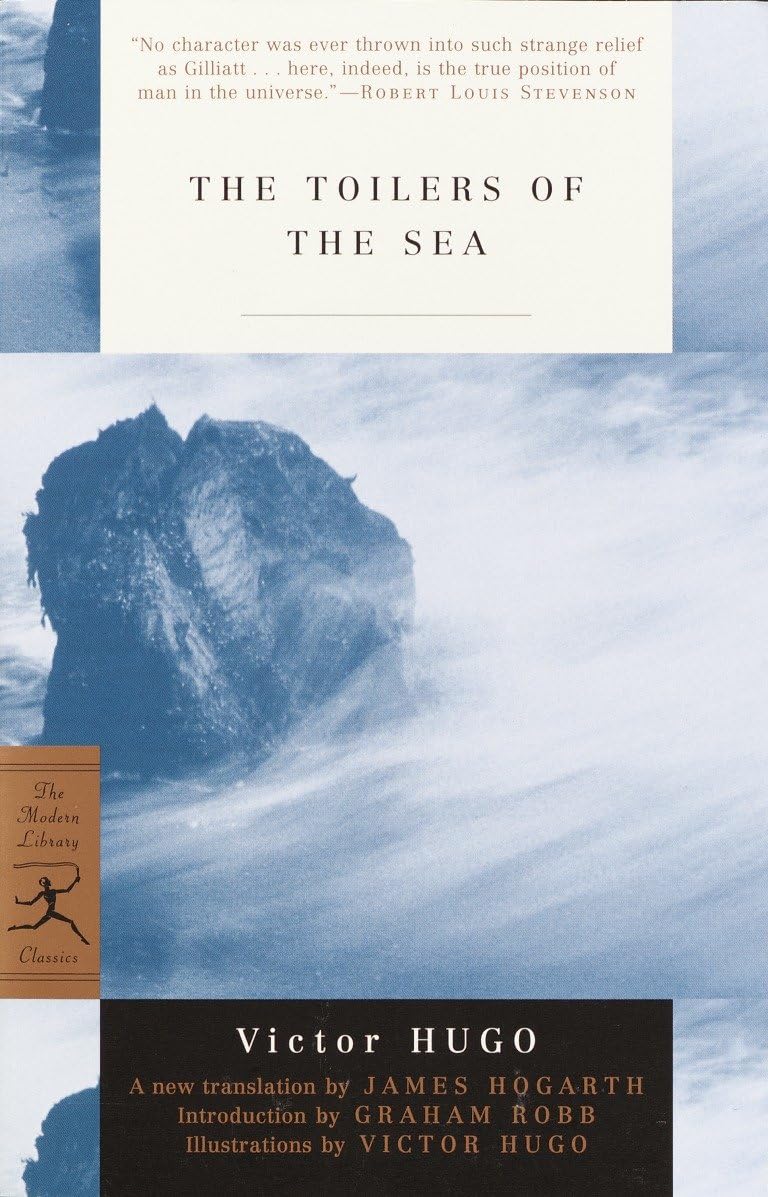



A new translation by Scot James Hogarth for the first unabridged English edition of the novel, which tells the story of an illiterate fisherman from the Channel Islands who must free a ship that has run aground in order to win the hand of the woman he loves, a shipowner's daughter. James Hogarth was educated at Edinburgh University, and was later undersecretary in the Scottish Office. Graham Robb’s many books include Victor Hugo: A Biography , which won the 1997 Whitbread Biography Award. Chapter 1 I Ancient Cataclysms The Atlantic wears away our coasts. The pressure of the current from the Pole deforms our western cliffs. This wall that shields us from the sea is being undermined from Saint-Valery-sur-Somme to Ingouville; huge blocks of rock tumble down, the sea churns clouds of boulders, our harbors are silted up with sand and shingle, the mouths of our rivers are barred. Every day a stretch of Norman soil is torn away and disappears under the waves. This tremendous activity, which has now slowed down, has had terrible consequences. It has been contained only by that immense spur of land we know as Finistère. The power of the flow of water from the Pole and the violence of the erosion it causes can be judged from the hollow it has carved out between Cherbourg and Brest. The formation of this gulf in the Channel at the expense of French soil goes back before historical times; but the last decisive act of aggression by the ocean against our coasts can be exactly dated. In 709, sixty years before Charlemagne came to the throne, a storm detached Jersey from France. The highest points of other territories submerged in earlier times are still, like Jersey, visible. These points emerging from the water are islands. They form what is called the Norman archipelago. This is now occupied by a laborious human anthill. The industry of the sea, which created ruin, has been succeeded by the industry of man, which has made a people. II Guernsey Granite to the south, sand to the north; here sheer rock faces, there dunes. An inclined plane of meadowland with rolling hills and ridges of rock; as a fringe to this green carpet, wrinkled into folds, the foam of the ocean; along the coast, low-built fortifications; at intervals, towers pierced by loopholes; lining the low beaches, a massive breastwork intersected by battlements and staircases, invaded by sand and attacked by the waves, the only besiegers to be feared; windmills dismasted by storms, some of them-at the Vale, Ville-au-Roi, St. Peter Port, Torteval-still turning; in the cliffs, anchorages; in the dunes, sheep and cattle; the shepherds' and cattle herds' dogs questing and working; the little carts of the tradesmen of the town galloping along the hollow ways; often black houses, tarred on the west side for protection from the rain; cocks and hens, dung heaps; everywhere cyclopean walls; the walls of the old harbor, now unfortunately destroyed, were a fine sight, with their shapeless blocks of stone, their massive posts, and their heavy chains; farmhouses set amid trees; fields enclosed by waist-high drystone walls, forming a bizarre checkerboard pattern on the low-lying land; here and there a rampart built around a thistle, granite cottages, huts looking like casemates, little houses capable of withstanding a cannonball; occasionally, in the wildest parts of the country, a small new building topped by a bell-a school; two or three streams flowing through the meadows; elms and oaks; a lily found only here, the Guernsey lily; in the main plowing season, plows drawn by eight horses; in front of the houses, large haystacks on circular stone bases; expanses of prickly furze; here and there gardens in the old French style with clipped yew trees, carefully shaped box hedges and stone vases, mingled with orchards and kitchen gardens; carefully cultivated flowers in countryfolk's gardens; rhododendrons among potatoes; everywhere seaweed laid out on the grass, primrose-colored; in the church yards no crosses, but slabs of stone standing erect, seeming in the moonlight like white ladies; ten Gothic bell towers on the horizon; old churches, new dogmas; Protestant worship housed in Catholic architecture; scattered about in the sand and on the promontories, the somber Celtic enigma in its various forms-menhirs, peulvens, long stones, fairy stones, rocking stones, sounding stones, galleries, cromlechs, dolmens, fairies' houses; remains of the past of all kinds; after the druids the priests; after the priests the rectors; memories of falls from heaven; on one point Lucifer, at the castle of the Archangel Michael; on another, Icart Point, Icarus; almost as many flowers in winter as in summer. This is Guernsey. III Guernsey (continued) Fertile land, rich, strong. No better pasturage. The wheat is celebrated; the cows are illustrious. The heifers grazing the pastures of St. Peter-in-the-Wood are the equals of the famed sheep of the Confolens plateau. The masterpiece