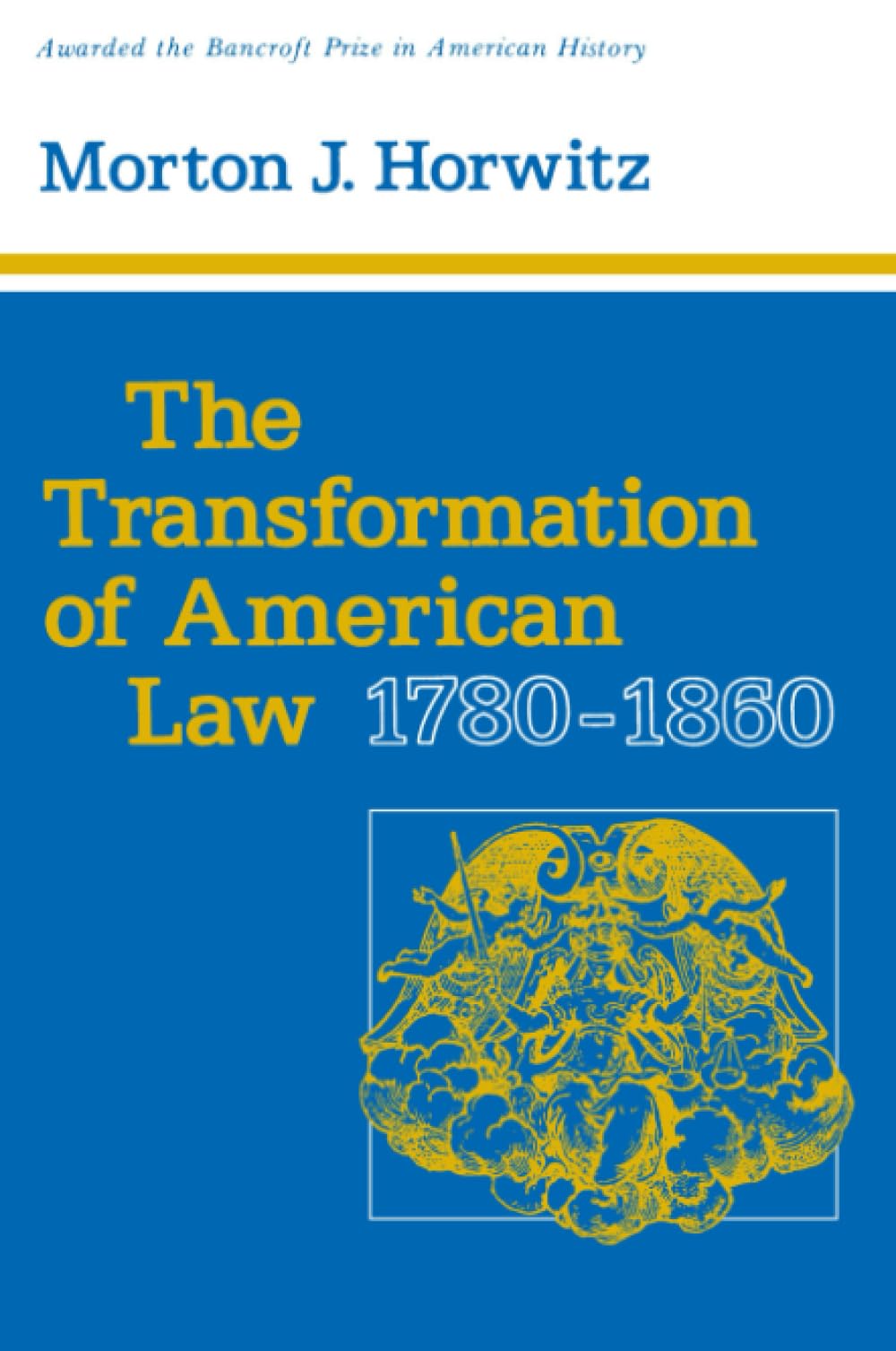
The Transformation of American Law, 1780–1860 (Studies in Legal History)
$27.97
by Morton J. Horwitz



In a remarkable book based on prodigious research, Morton J. Horwitz offers a sweeping overview of the emergence of a national (and modern) legal system from English and colonial antecedents. He treats the evolution of the common law as intellectual history and also demonstrates how the shifting views of private law became a dynamic element in the economic growth of the United States. Horwitz's subtle and sophisticated explanation of societal change begins with the common law, which was intended to provide justice for all. The great breakpoint came after 1790 when the law was slowly transformed to favor economic growth and development. The courts spurred economic competition instead of circumscribing it. This new instrumental law flourished as the legal profession and the mercantile elite forged a mutually beneficial alliance to gain wealth and power. The evolving law of the early republic interacted with political philosophy, Horwitz shows. The doctrine of laissez-faire, long considered the cloak for competition, is here seen as a shield for the newly rich. By the 1840s the overarching reach of the doctrine prevented further distribution of wealth and protected entrenched classes by disallowing the courts very much power to intervene in economic life. This searching interpretation, which connects law and the courts to the real world, will engage historians in a new debate. For to view the law as an engine of vast economic transformation is to challenge in a stunning way previous interpretations of the eras of revolution and reform. “He has read widely in many fields...[and] has gathered a rich harvest for any reader...a remarkable achievement.” ― Yale Law Journal “It is to be hoped that a wide audience will read it since the issues it raises are indispensable...Horwitz's book is written with a passion.” ― New York Review of Books “A thoughtful contribution to the continuing issue of whether and how much we are governed by our judges.” ― Library Journal “One of the five most significant books ever published in the field of American legal history.” ― William E. Nelson, Yale University Awarded the Bancroft Prize in American History in 1978, Morton J. Horwitz's The Transformation of American Law, 1780-1860 is considered one of the most significant works ever published in American legal history. Since its publication in 1977, it has become the standard source on early nineteenth-century American law. In this monumental book, Morton J. Horwitz offers a sweeping overview of the emergence of our national (and modern) legal system from English and colonial antecedents. He begins with the common law, which emerged during the eighteenth century as the standard doctrine with which to solve disputes in an egalitarian manner. He shows that the turning point in the use of common law came after 1790, when the law was slowly transformed to favor economic growth and development, and the courts began to spur economic competition rather than circumscribe it. This new instrumental law would flourish during the nineteenth century as the legal profession and the mercantile elite forged a mutually beneficial alliance to gain wealth and power. Horwitz also demonstrates how the emergence of contract law corresponded to the development of economic and legal institutions of exchange. And he discusses how the rise of the market economy influenced legal practices, how contracts became ways to negate preexisting common law duties, and how (to the benefit of entrepreneurs and commercial groups) the courts were able to overthrow earlier anticommercial legal rules. Previous historical studies have viewed law and policy as an accurate reflection of the needs of an undifferentiated society. In The Transformation of American Law, Horwitz successfully challenges this misconception and shows how, in theeighty years after the American Revolution, a major change in law took place in which aspects of social struggle turned to legal channels for resolution. Looking into the distribution of wealth and power during this time, Horwitz finds indeed that the change in legal ideology enabled commercial groups to win a disproportionate amount of wealth and power in American society. An accessible account of the history of law, this is a powerful statement on the great role of the legal system in American economic development. Morton J. Horwitz is a graduate of City College of New York and received a doctorate in Government and a law degree from Harvard University. Author of numerous articles in law and history, Mr. Horwitz is Professor of Law at the Harvard Law School, where he teaches legal history. Used Book in Good Condition