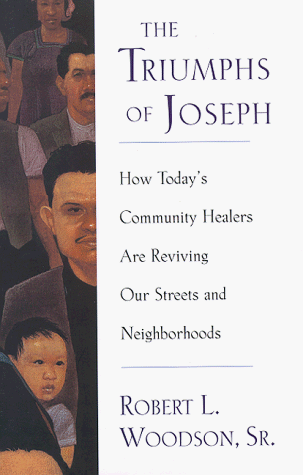
The Triumphs of Joseph: How Today's Community Healers Are Reviving Our Streets and Neighborhoods
$33.99
by Robert Woodson



Using parallels between the biblical story of Joseph and today's urban workers, the author pays tribute to the courageous men and women who are battling to change the lives of residents in the poorest inner-city communities. 25,000 first printing. Woodson, founder and president of the National Center for Neighborhood Enterprise and recipient of a MacArthur "genius" grant, argues for increased recognition and support of agents of grass-roots change in the inner city. Like William Julius Wilson (The Truly Disadvantaged, LJ 10/1/87), Woodson claims that race-based programs like affirmative action disproportionately benefit more privileged people of color. In addition, Woodson blames elitist Civil Rights leaders, social service bureaucrats, and academics for protecting their own positions more than empowering the disadvantaged. He also indicts the media for focusing on dysfunction among the poor but glossing over the moral failings of the privileged. His portraits of three effective programs highlight the potential of flexible programs, open to all, that are run by local people in a way that involves clients and demands discipline and service. While Woodson makes a compelling argument, he does ignore the broader structural causes of lack of economic opportunity. Recommended for larger public libraries.?Paula Dempsey, Loyola Univ., Chicago Copyright 1997 Reed Business Information, Inc. Where Thomas Sowell and other black conservatives are popular, this parable of moral regeneration through religious-based grassroots groups emphasizing self-help will have appeal. Woodson is founder and president of the National Center for Neighborhood Enterprise, formerly affiliated with the American Enterprise Institute, and a 1990 recipient of a MacArthur Foundation "genius" grant. Here he uses the biblical tale of Joseph and the pharaoh to draw a bright line between "modern-day Josephs," who "have forged an effective internal, spiritual response to the spiritual and moral atrophy of our civil society which goes far beyond the limitations of conventional remedies of professional therapy and economic assistance," and "the Pharaoh's Court" --the civil rights establishment, the "poverty industry," some politicians and academics--who preach victimization and define racism as the source of all woe. There's useful information on grassroots programs' success in dealing with addiction, parolees, and former gang members, among others. As for Woodson's polemics: one either believes the Bible and Adam Smith have all the answers, or one doesn't Mary Carroll Inspiring subject matter, disappointing book. Founder and president of the National Center for Neighborhood Enterprise, and a MacArthur awardee, Woodson argues that the leadership and energy required to remedy the ills of poor neighborhoods must come from within. Especially in impoverished black communities, self-identification as victims and failed government policies must give way to self-help inspired by indigenous role models. The latter he calls ``Josephs,'' referring to the biblical figure who rises from slavery and prison to advise the pharoah--an analogy that doesn't really fit Woodson's concept of individuals who would work at a grass-roots level to help recover the lives of drug addicts and ex-cons. No matter. Those concerned about improving the condition of the poor will applaud such efforts, and Woodson's conservative supporters will applaud the supposed policy implications. Unfortunately, description of actual Josephs is relegated to a surprisingly minor role in this slim volume. The primary focus here is not providing evidence that Josephs can spearhead successful antipoverty efforts, but rather providing a testament to Woodson's belief that they can do so, packaged in a largely incommensurate and potentially inconsistent political agenda. Criticism of government policy and established social service networks may be well deserved, but as Woodson notes, Josephs work independently of policies and institutions and will succeed or fail regardless of public policy, so why the overbearing emphasis on a political critique? If Woodson's policy recommendations calling for money and authority to be channeled through Josephs into poor communities and building ``institutional supports around the grass-roots leaders'' were enacted, however, they would become central political figures--and the prized independence that made them Josephs would be forfeited. There is no doubt that Woodson is genuinely concerned with looking for new, more effective ways to alleviate the scourge of poverty--and that his efforts are accompanied by considerable political navet. -- Copyright ©1997, Kirkus Associates, LP. All rights reserved. ...an honest description of urban social decay, an assault on the poverty industry and an uplifting vision for African-Americans. -- The Wall Street Journal, Nicholas Schulz