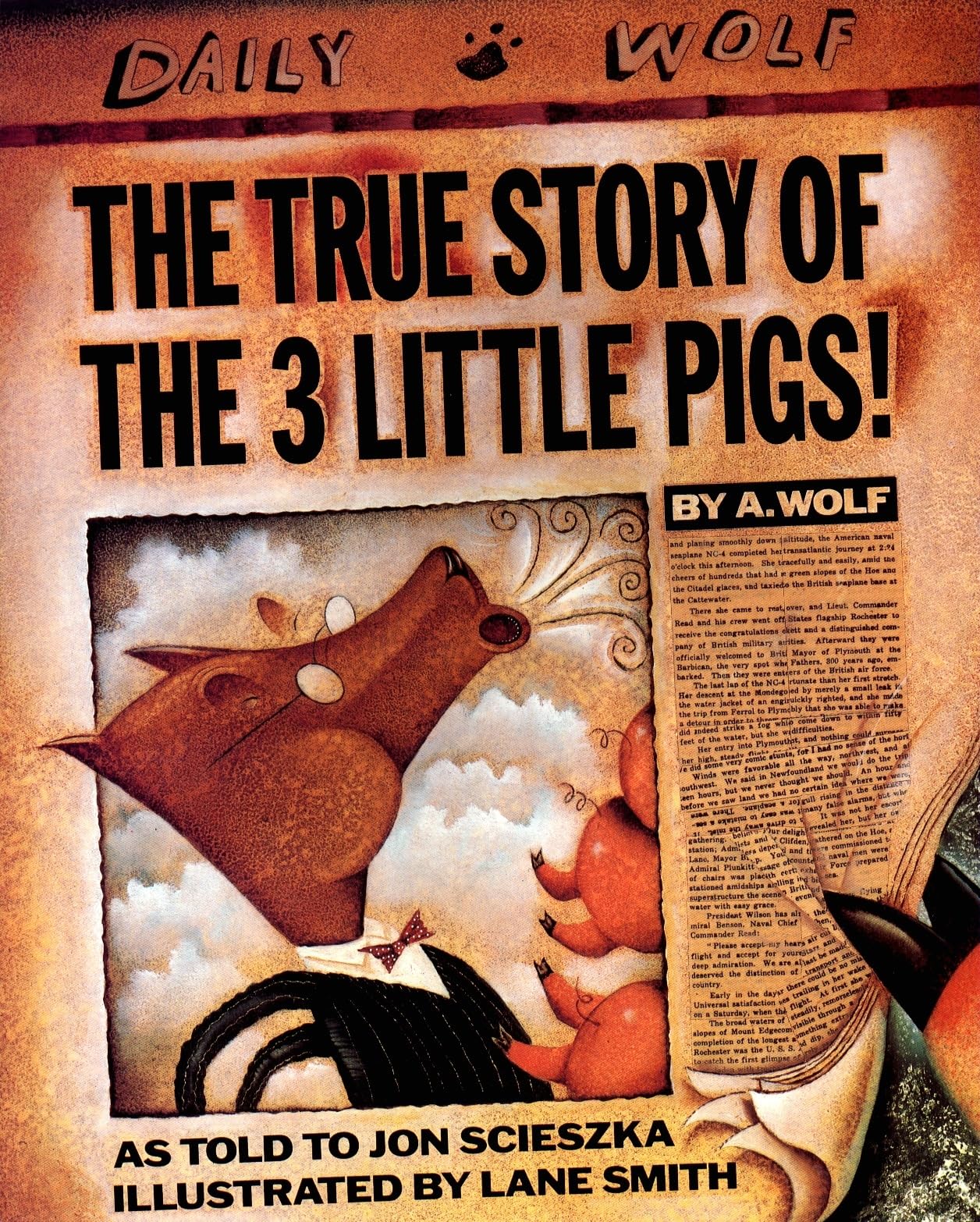



THE MODERN CLASSIC WITH OVER THREE MILLION COPIES SOLD • The Big Bad Wolf tells his side in this fractured fairy tale, brought to life with irreverent storytelling and artwork that “older kids (and adults) will find very funny” ( School Library Journal ). A New York Times Best Book of the Year • American Booksellers Association Picture Book Hall of Fame • Society of Illustrators Silver Medal • New York Public Library 100 Great Children’s Books for 100 Years • An American Library Association Notable Book You may think you know the story of the Three Little Pigs and the Big Bad Wolf—but only one person knows the real story. That person is A. Wolf. His tale starts with a birthday cake for his dear old granny, a bad head cold . . . and a bad reputation. It ends in the Big House: the Pig Pen. What really happened when A. Wolf was at the door? Was it an historic pig out or a Mother Goose frame-up? You read it. You decide. Jon Scieszka and Lane Smith combine their talents for droll tales and provocative reporting to bring the true story of this much maligned figure to the public. Big and Bad? Could be. Hilarious? Of course. Ages 6-9. Jon Scieszka's The True Story of the Three Little Pigs (1989) turned the favorite porkers' story upside-down by allowing the grossly misjudged wolf to tell his side of the story. Wiesner's latest is a post-modern fantasy for young readers that takes Scieszka's fragmentation a step further: it not only breaks apart and deliciously reinvents the pigs' tale, it invites readers to step beyond the boundaries of story and picture book altogether. The book begins predictably: the three pigs set out to seek their fortune, and when the first pig builds a house of straw, the wolf blows it down. Here's when the surprises start. The wolf blows the pig right out of the picture and out of the story itself. In the following frames, the story continues as expected: the wolf eats the pig and moves on to the other houses. But the pictures no longer match up. Frames show the bewildered wolf searching hungrily through the rubble as first one, then all the pigs escape the illustrations and caper out into open space with the loose pages of the wolf's tale swirling around them. After fashioning a paper airplane from a passing page, the emancipated pigs soar off on a sort of space flight through blank white spreads, ultimately discovering other picture-book "planets" along the way. Finally, the pigs wander through a near-city of illustrated pages, each suggesting its own story. Joined by the nursery rhyme Cat and Fiddle and a fairy-tale dragon, the pigs find and reassemble the pages to their own story and reenter to find the wolf still at the door. In the end, the story breaks down altogether, as the wolf flees, the text breaks apart, letters spill into a waiting basket, and the animals settle down to a bowl of . . . alphabet soup instead of wolf stew. Wiesner uses shifting, overlapping artistic styles to help young readers envision the pigs' fantastical voyage. The story begins in a traditional, flat, almost old-fashioned illustrative style. But once the first pig leaps from the picture's frame, he becomes more shaded, bristly with texture, closer to a photographic image. As the pigs travel and enter each new story world, they take on the style of their surroundings--the candy-colored nursery rhyme, the almost comic-book fairy tale--until, in the end, they appear as they did at the beginning. Chatty dialogue balloons also help guide children through the story, providing most of the text once the characters leave the conventional story frames, and much of the humor ("Let's get out of here!" yells one pig as he leaps from a particularly saccharine nursery world). Despite all these clues, children may need help understanding what's happening, particularly with the subtle, open-ended conclusion. But with their early exposure to the Internet and multimedia images, many kids will probably be comfortable shifting between frames and will follow along with delight. Wiesner has created a funny, wildly imagined tale that encourages kids to leap beyond the familiar, to think critically about conventional stories and illustration, and perhaps to flex their imaginations and create wonderfully subversive versions of their own stories. Carolyn Phelan Copyright © American Library Association. All rights reserved Jon Scieszka totally failed to spring A. Wolf free with this story, but he did go on to write scads of subversive bestselling books, including The Stinky Cheese Man and Other Fairly Stupid Tales . He also founded the literary initiative Guys Read and was appointed the first National Ambassador for Young People’s Literature. Lane Smith and his artwork did not help A. Wolf in his bid for freedom. If anything, that illustration of the dripping cheeseburger set back Mr. Wolf’s case. However, he did go on to accept a Carle Honor for Lifetime Achievement, two Caldecott Honor Medals, and four New