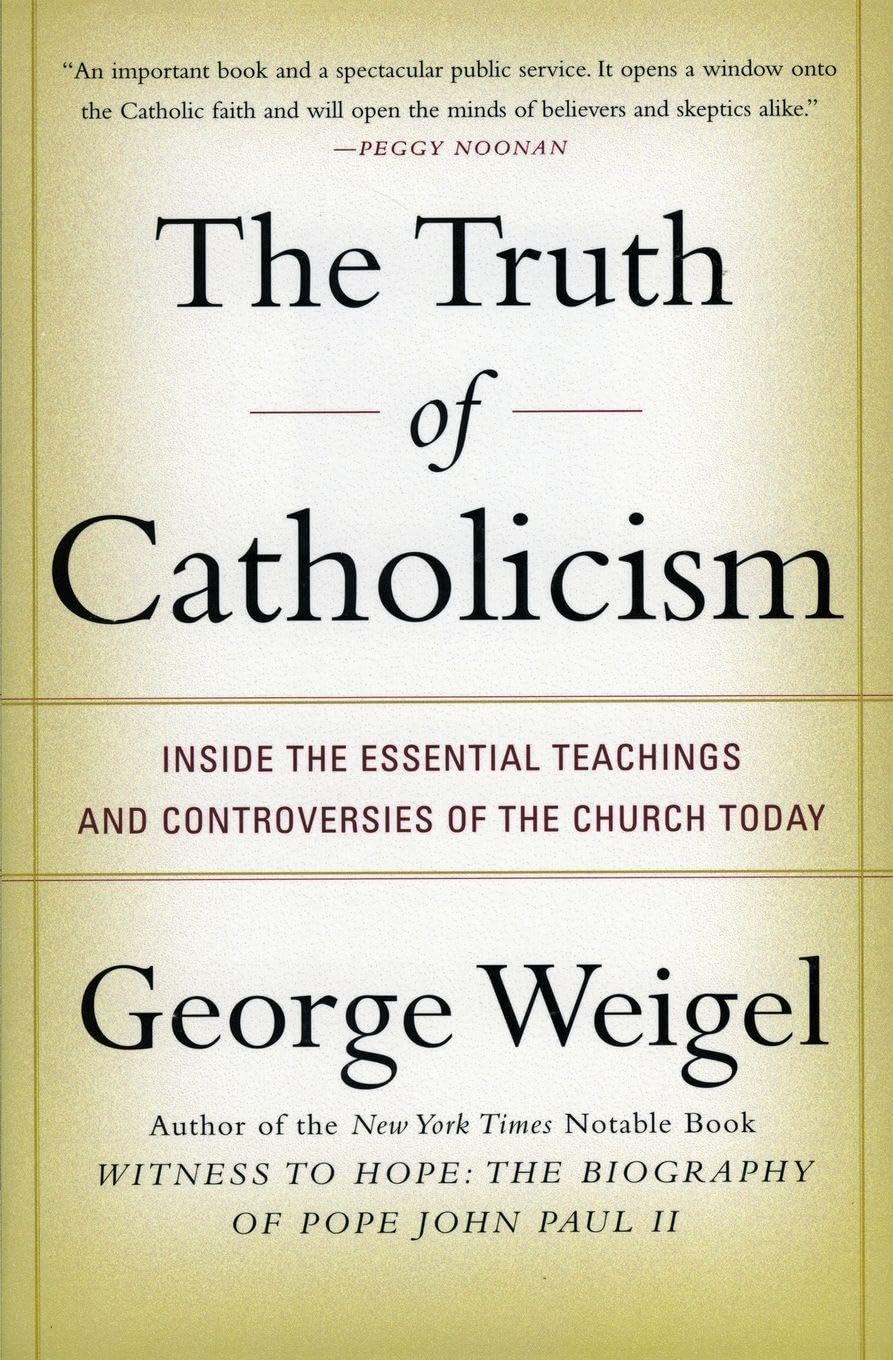
The Truth of Catholicism: Inside the Essential Teachings and Controversies of the Church Today – For Believers and Skeptics on the Moral Life and
$9.29
by George Weigel



“An important book and a spectacular public service. It opens a window onto the Catholic faith and will open the minds of believers and skeptics alike.” — Peggy Noonan The Catholic Church may be the most controversial institution in the world. Some find its teachings inexplicable, puzzling, even cruel. In this incisive new work, George Weigel suggests that we look at Catholicism and its controversies from “inside” the convictions that make those controversies not only possible, but necessary. The truths of Catholicism then come into clearer focus as affirmations and celebrations of human life and human love, even as they challenge us to imagine a daring future for humanity and for ourselves. Is Jesus uniquely the savior of the world? Is the moral life about rules or about happiness? Doesn’t suffering contradict the biblical claim that God is good? How does the Catholic Church think about other Christians and about other great world religions? In an engaging, accessible style, George Weigel leads us into the truth of Catholicism: the truth about a love that creates a vast, liberating terrain on which to live a fully human life. “Weigel is a passionate advocate, and a skilled one.” - Chicago Tribune The Catholic Church may be the most controversial institution in the world. Whether the question is the uniqueness of Jesus Christ, the relationship of Catholicism to other religious communities, the meaning of freedom, the use and abuse of sex, the dignity of human life from conception until natural death, or the role of women, the Catholic Church has taken challenging positions that some find inexplicable, even cruel. In The Truth of Catholicism, George Weigel, author of Witness to Hope: The Biography of Pope John Paul II, explores these perennial questions and more, showing Catholicism and its controversies from "inside" the convictions that make those controversies not only possible but necessary. The truths of Catholicism then come into clearer focus as affirmations and celebrations of human life and human love, even as they challenge us to imagine a daring future for humanity and for ourselves. George Weigel is one of the world's foremost authorities on the Catholic Church and the author of the New York Times bestseller Witness to Hope: The Biography of Pope John Paul II . He is a Senior Fellow of the Ethics and Public Policy Center in Washington, D.C., and a consultant on Vatican affairs for NBC News. The Truth of Catholicism Inside the Essential Teachings and Controversies of the Church Today By Weigel, George Perennial Copyright © 2004 George Weigel All right reserved. ISBN: 0060937580 Chapter One Is Jesus the Only Savior? Christ and the Conquest of Our Fears In September 2000, the Vatican's Congregation for the Doctrine of the Faith, often described as "the successor to the Inquisition," caused a global uproar by issuing a doctrinal declaration, Dominus Iesus [The Lord Jesus], which vigorously reasserted the classic Christian teaching that Jesus Christ is uniquely the savior of the world, for everyone everywhere. The ensuing controversy had some sharp edges. One American newspaper displayed a photo of Pope John Paul II, arms outstretched, with the caption "We're Number One!" More soberly but no less inaccurately, another major paper headlined the story "Vatican Declares Catholicism Sole Path to Salvation." According to most of the stories and commentaries that followed, the declaration had done serious and perhaps even fatal damage to thirty years of ecumenical and interreligious dialogue. As the common interpretation of Dominus Iesus had it, the Catholic Church was teaching that Catholics had a singular claim on salvation and that non-Catholic Christians were second-class Christians. As for Jews, Muslims, Buddhists, Hindus, and nonbelievers, well... None of this was, or is, true, but that is not an easy case to make in a climate in which a lot of people are not sure that anything is "true." ("It depends on what the meaning of the word 'is' is," as a prominent public figure once said.) In fact, Dominus Iesus taught nothing new, substantively. One distinguished Catholic commentator put the case for the defense succinctly: the declaration reiterated "the Church's faith that Jesus is, as he said of himself, the way, the truth, and the life. He is not one way among other ways or one truth among other truths." That faith in Jesus Christ leads to other convictions, also affirmed once again in Dominus Iesus. Because there is one God, who definitively revealed himself in his Son, Jesus Christ, there is one salvation history, centered on Christ. God gives everyone the grace necessary to be saved, including those who have never heard of Jesus Christ. Yet everyone who is saved is saved because of what God did for the world and for humanity in Jesus Christ. Before, during, and after the Dominus Iesus controversy, one had to wonder just what else the Catholic Church was su