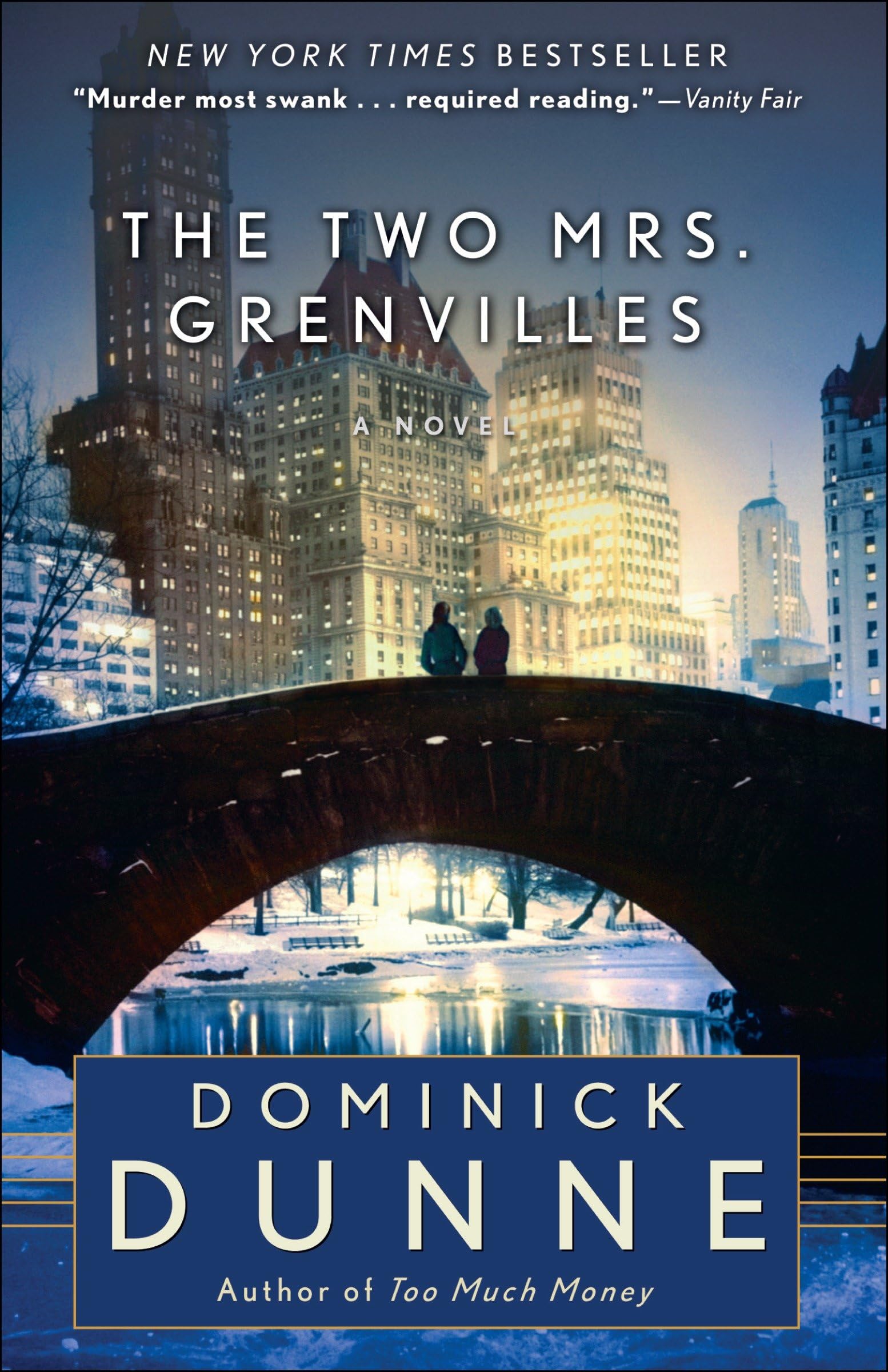



NEW YORK TIMES BESTSELLER • “Murder most swank . . . required reading.”— Vanity Fair When Navy ensign Billy Grenville, heir to a vast New York fortune, sees showgirl Ann Arden on the dance floor, it is love at first sight. And much to the horror of Alice Grenville—the indomitable family matriarch—he marries her. Ann wants desperately to be accepted by high society and become the well-bred woman of her fantasies. But a gunshot one rainy night propels Ann into a notorious spotlight—as the two Mrs. Grenvilles enter into a conspiracy of silence that will bind them together for as long as they live. . . . “This is a candy box of a book. . . . Composed of just the right measure of sex, glamour, [and] passion.”— Cosmopolitan "A LUSCIOUS NOVEL." --Cosmopolitan "STEAMY." --Newsday "COMPELLING." --Liz Smith New York Daily News "DIVERTING." --Glamour "SIZZLING." --Copley News Wire When Navy ensign Billy Grenville, heir to a vast New York fortune, sees showgirl Ann Arden on the dance floor, it is love at first sight. And much to the horror of Alice Grenville--the indomitable family matriarch--he marries her. Ann wants desperately to be accepted by high society and become the well-bred woman of her fantasies. But a gunshot one rainy night propels Ann into a notorious spotlight--as the two Mrs. Grenvilles enter into a conspiracy of silence that will bind them together for as long as they live. . . . Dominick Dunne is an internationally acclaimed journalist and the bestselling author of both fiction and nonfiction, including Another City, Not My Own; A Season in Purgatory; An Inconvenient Woman; People Like Us; and The Mansions of Limbo. The room was filled with the heady scent of roses past their prime. Pink petals fell from swollen blossoms in a Chinese bowl onto the polished surface of an ormolu escritoire. Although it was day, rose-shaded lamps were lit, and curtains of the same hue, drawn for the night in voluminous folds, remained closed. The bed had been rested upon, but not slept in, its rose-colored linens still pristine and uncreased. A vermeil clock, unwound too long, had ceased to tick; a radio, left on too long, had lost its tonal focus. Lying on the floor, face down on the rose border of an Aubusson rug, was a golden-haired woman in a satin-and-lace nightgown. She was dead. More than a day dead. Perhaps even two. Had she been alive, she would have told you, whether you asked her or not, that the Chinese bowl had once belonged to Magda Lupescu; that the escritoire had once belonged to Marie Antoinette; that the vermeil clock had been given to the Empress Elizabeth of Austria by the mad King Ludwig of Bavaria; that the Aubusson rug was a gift of the Belgian court to the Empress Carlotta of Mexico. That they were ill-fated women was of less consequence to the deceased than the sense of luster she acquired when repeating the history of her possessions. The dead woman’s name was Ann Grenville. Leaning against a wall of her bedroom was the infamous portrait by Salvador Dali that had so deeply offended her on its completion years before. Long gone from sight, surprisingly present now, it stared out from its canvas at the rose-hued tableau, its knife-slash repaired, its prophecy fulfilled. Carnage had it promised. Carnage had it delivered. Her obituary, when it appeared, was not impressive. If you had not been reading about the defeat of the German Chancellor on page one of Section A of the New York Times that continued over on the next-to-last page of Section D, after the business news and stock market quotations, you might have missed it, for that was where it appeared. There was her name, Ann Grenville, with the word “Dead” after it, and then a few paragraphs, all easily missable. On second thought, of course, the placement of Ann Grenville’s obituary was probably exactly where Old Alice Grenville wanted it to be, and if she had called whatever Sulzberger was in charge of the Times and requested exactly that remote a placement in the paper for her daughter-in-law’s obituary, no one who knew her would have been surprised. It would not have been her first call asking for considerations from the newspaper on behalf of her family. Exceedingly old, in her nineties, Alice Grenville, born one of the Pleydell triplets, was still running things in her family, and one thing she felt, and felt strongly about, was that her family had been far, far too much in the news. The obituary said Ann Grenville had been found dead in her apartment on Fifth Avenue. It said she was the widow of sportsman William Grenville, Junior, the mother of Diantha Grenville, the daughter-in-law of Alice Grenville, the philanthropist and social figure. It said she had a history of heart ailments. It said she was fifty-seven years old. It said she had been cleared in 1955 of slaying her husband. She wasn’t fifty-seven at all, and hadn’t been for three years, but her lie, if lie it could be called, was closer by