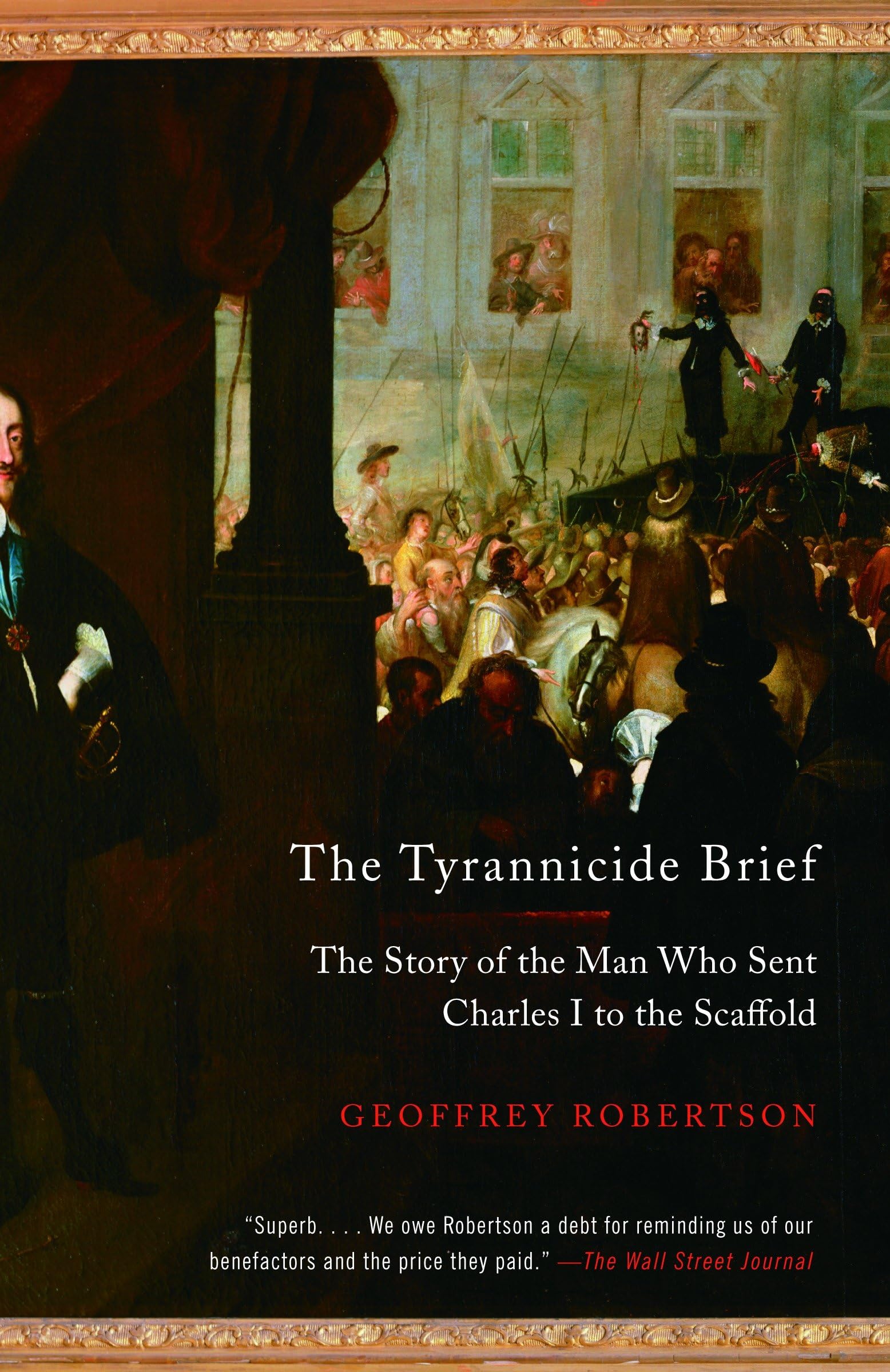
The Tyrannicide Brief: The Story of the Man Who Sent Charles I to the Scaffold
$18.49
by Geoffrey Robertson



Charles I waged civil wars that cost one in ten Englishmen their lives. But in 1649 Parliament was hard put to find a lawyer with the skill and daring to prosecute a king who claimed to be above the law. In the end, they chose the radical lawyer John Cooke, whose Puritan conscience, political vision, and love of civil liberties gave him the courage to bring the king to trial. As a result, Charles I was beheaded, but eleven years later Cooke himself was arrested, tried, and executed at the hands of Charles II. Geoffrey Robertson, a renowned human rights lawyer, provides a vivid new reading of the tumultuous Civil War years, exposing long-hidden truths: that the king was guilty, that his execution was necessary to establish the sovereignty of Parliament, that the regicide trials were rigged and their victims should be seen as national heroes. Cooke’s trial of Charles I, the first trial of a head of state for waging war on his own people, became a forerunner of the trials of Augusto Pinochet, Slobodan Milosevic, and Saddam Hussein. The Tyrannicide Brief is a superb work of history that casts a revelatory light on some of the most important issues of our time. “Superb. . . . We owe Robertson a debt for reminding us of our benefactors and the price they paid.” — The Wall Street Journal “Fascinating. . . . The best account of these events to date. . . . A very major book, a persuasive reminder of the ongoing need to defend human rights and civil liberties. . . . Historical writing and legal writing at its best.” — Houston Chronicle “Scholarly and gripping. . . . The Tyrannicide Brief is not only a compelling history and legal thriller, but also a telling commentary for today.” — New York Law Journal Magazine GEOFFREY ROBERTSON , a leading human rights lawyer and UN war-crimes judge, has won landmark rulings on civil liberty from the highest courts in Britain, Europe, and the Commonwealth. He was involved in the case against General Pinochet and in the training of judges who tried Saddam Hussein. His book Crimes Against Humanity has been an inspiration for the global justice movement. Robertson, who was born in Australia, now lives in London. The first recorded existence of John Cooke is in the register of All Saints church in the village of Husbands Bosworth, just south of Leicester. Here he was baptised on 18 September 1608, an indication that his birth had taken place a few days before. He came from poor but healthy farming stock: his father, Isaac Cooke, was twenty-five, and would live until the age of seventy-four. Isaac was one of twelve children of Abraham Cooke, who would die in 1620 at a similar age. If John could come through his early years, in this period when a third of all infants died before reaching five, he could be expected to live through all the seven ages of man predicted by Shakespeare, at this time writing his final plays for the London theatre. His family were God-fearing farmers, with allotments that dotted the countryside for twenty miles to the town of Burbage. Husbands Bosworth was named for all its husbandmen – tenant farmers whose smallholdings sustained their families but little else – and that would have been his parents’ expectation for baby John. What mattered most to Isaac and Elizabeth was that he would live an abstemious and pious life, his ability to do so being regarded as an outward sign that he was one of the ‘elect’ predestined for paradise when the Son of God returned to claim the earth. This mattered so much to these Puritan parents that for the baptism of their first-born they had travelled from their own farm, just outside Burbage, where the rector was a well-connected Anglican who obeyed the bishop, to Elizabeth’s austere family church. Its minister was willing to dispense with ‘impure’ rituals, like motioning the sign of the cross over the head of the baptised infant. That such a tiny gesture could become a major bone of contention between the bishops of the Church of England, who were sticklers for rituals and symbols, and those Puritan worshippers who wished to ‘purify’ the Church of all such distractions, was typical of the internecine squabbling that had rent the Anglican religion. Puritans like the Cookes were thick on the ground in the Midlands and the eastern counties and many local ministers were sympathetic to their preference for deritualised worship, which was anathema to King James and his bishops. James I had been invited from Scotland (where he ruled as James VI) to take the English throne on Elizabeth I’s death in 1603. The optimism among Puritans in England that a man from the austere Calvinist Kirk would look sympathetically on their similar form of worship had soon been dashed: James was obsessed with his God-given right to rule as an absolute prince, through a hierarchy supported by archbishops and bishops, alongside his councillors and favourite courtiers. From the outset of his reign he urged the Anglican authorities to discipline minis