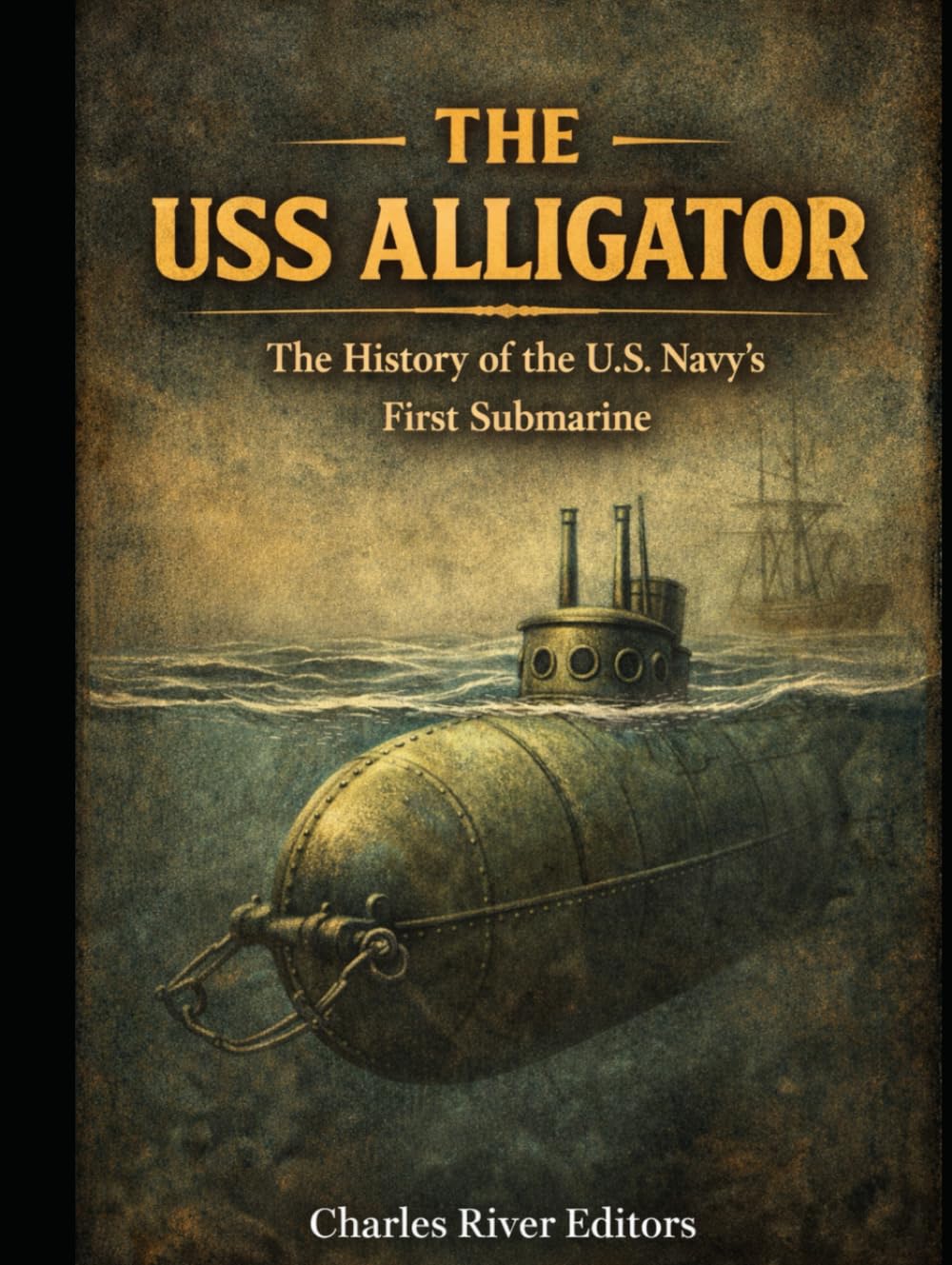
The USS Alligator: The History of the U.S. Navy’s First Submarine
$13.99
by Charles River Editors



The ability to remain and travel underwater for an extended period of time has long been a dream for a good portion of mankind, perhaps second only to that of flying. The first “submersible” may have been a kind of glass container made for Alexander the Great so that he could observe undersea life firsthand. Despite this early attempt, fate decreed the idea of traveling beneath the surface of the water would lie fallow for nearly another 2,000 years after this experiment in about 332 B.C. Alexander’s death the next year effectively squashed any further developments. While people often tend to think of submarines as a modern invention, inventors created several prototypes from 1580 onward, and they even attempted to use them. Some of the designs remained theoretical and never got off the drawing board, but as time went on, several Europeans built and tested primitive submarines. Most of these early subs were made of wood and often possessed an awkward shape, but a French priest first proposed the now familiar cylindrical layout in 1634. He determined that this shape would make it easier for the submarine to withstand water pressure, while likewise improving maneuverability. The potential for submarines to be used in warfare came to the fore very quickly. The “Rotterdam Boat” appears in history as the first submersible to be used for this purpose, built in 1634 for the express mission of attacking British vessels in the Thames. However, the mechanism intended to propel the boat proved so weak that it went nowhere at all, and merely sank. Propulsion proved a major obstacle for early submarines. David Bushnell encountered this problem when he built a submarine in 1776 with the intention of drilling holes in the hulls of British ships during the Revolutionary War. In order to approach the ships, however, the Turtle , as Bushnell dubbed it, had to be towed right up to the intended target ship by rowboats. However, these early efforts spurred others to persevere in the goal of underwater travel. During the French Revolution, another American named Robert Fulton wanted to construct “a Mechanical Nautilus. A Machine which flatters me with much hope of being Able to Annihilate their (the British) Navy.” This design actually met with some degree of success, and is probably best described as an upgrade to the original Turtle . The Civil War witnessed new designs and prototypes of submarines appearing on American naval drawing boards. These subs had the “cigar shape” familiar throughout history from that point forward. Most of them failed for one reason or another, but one, the CSS Hunley , actually succeeded in using a “spar torpedo” to sink the USS Housatonic . It was the first time a submarine successfully sank a ship, but as historic and groundbreaking as the Hunley and its mission was, all of that was overshadowed by the lingering debate over just what happened to the Confederate submarine, which never made it back to port after the attack. Although the Hunley remains the most famous submarine of the Civil War, the Union Navy attempted to create and use a submarine years before the Hunley embarked on its historic operation, and though it’s widely forgotten today, the first Union submarine, the Alligator , also had a fascinating history.