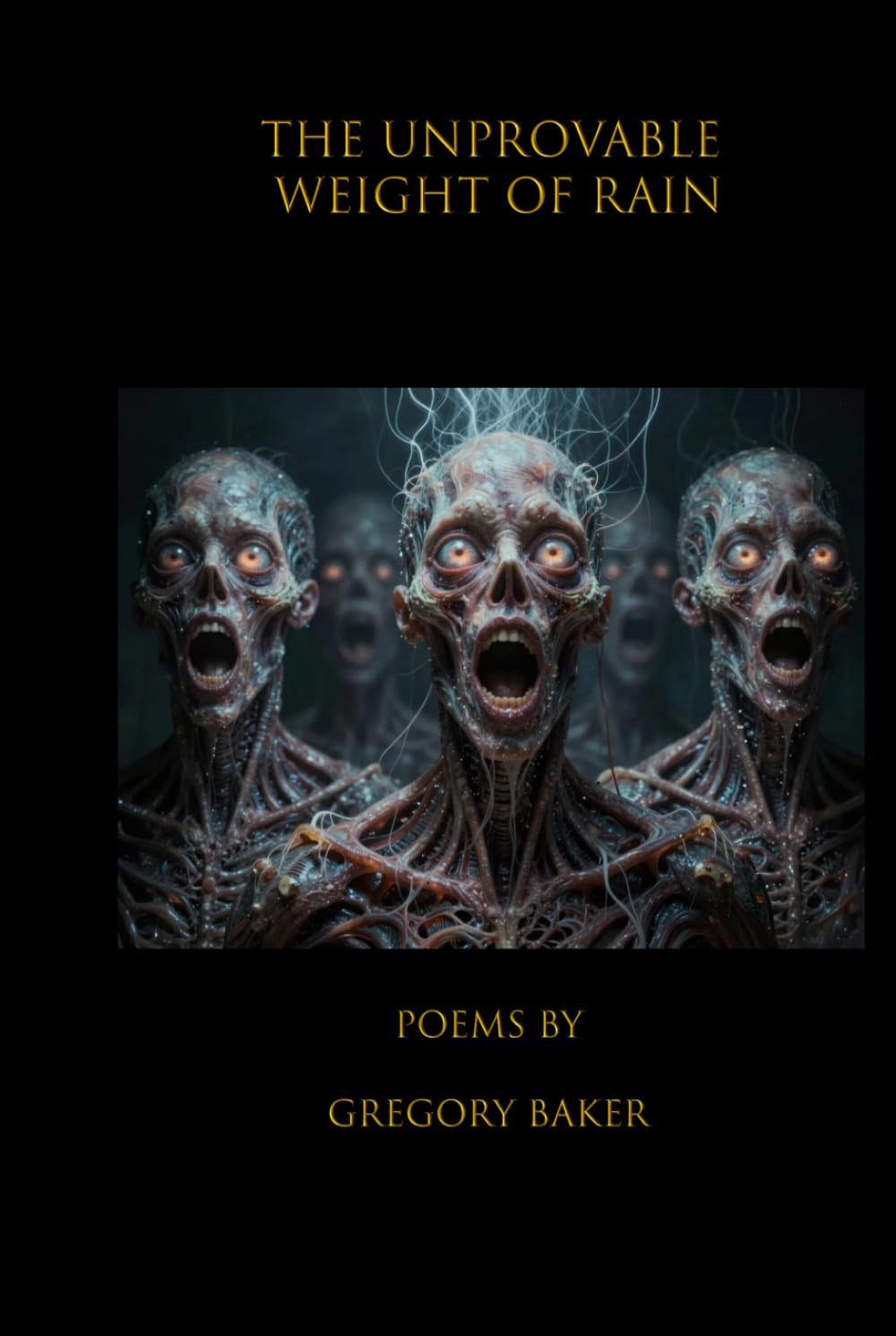



In the vast indifference of an expanding universe, what does it mean to feel? The Unknowable weight of Rain invites readers into a unique lyrical landscape where quantum physics collides with ancient myth, and the cold arithmetic of entropy meets the warm ache of human memory. Written by Gregory Baker, this collection is not merely a book of poems; it is a witness statement from the edge of the known world. Here, the cosmos is not a backdrop but a participant. In pieces like "Prose of Stars" and "Cosmic Cloud," the reader is guided through the birth of stars and the decay of galaxies, not with dry textbook precision, but with a haunting recognition that we are made of the same stardust destined to scatter. The constants of physics become the constants of grief: unprovable, undeniable, and deeply personal. The collection posits that we are islands of stability floating in an ocean of stretching void, and it is this asymmetry that makes cosmic history legible. The work weaves a complex tapestry of Greek mythology re imagined through the lens of modern logic and systems theory. In "The Unprovable Titans" and "The Incomplete Theorem of Thebes," gods like Kronos, Zeus, and Apollo are recast as axioms in a failing system. They represent the laws that bind us, the recursions of history, and the inevitable incompleteness of any story we tell ourselves about order and justice. Gödel's whisper echoes through these lines, reminding us that no system can prove its own consistency—neither the universe, nor the soul. The Titans speak not as monsters, but as the necessary gaps that keep truth alive. Yet, amidst the cosmic scale and mythic structures, the heart of the collection remains fiercely human. Poems such as "Damage Control," "Memory of Emotions," and "The Unknowable weight of Rain" tackle the raw intimacy of loss. They explore the recursion of mourning—the way memory layers upon memory until only the shape of the feeling remains. These verses acknowledge that while we cannot reclaim the past, the scar it leaves is proof of life. They offer a comforting truth: you are not failing at memory; you are succeeding at having lived. Social critique also pulses through the work. "The Black Box Theorem" and "Laestrygonians" confront the digital age, algorithmic control, and the commodification of human attention. They ask what happens when technology becomes the new mythology, and who pays the price when progress demands sacrifice. In an era of curated lights and soft apocalypses, these poems demand we step outside the feed and touch the sharp, true world. This is poetry for those who look up at the night sky and feel both small and significant. It is for readers who find comfort not in easy answers, but in the honesty of the question. Whether you are drawn by the allure of astrophysics, the depth of classical myth, or the universal experience of love and loss, these poems offer a sanctuary where science and spirit converge. Step into the void. Witness the stretching metric. Feel the weight of the rain. In a universe that does not care, these poems care enough to ask why. Prose of Stars is a testament to the breach where light is generated—a collection for anyone willing to stand in the tension between the bound and the unbound, and find meaning in the asking itself.