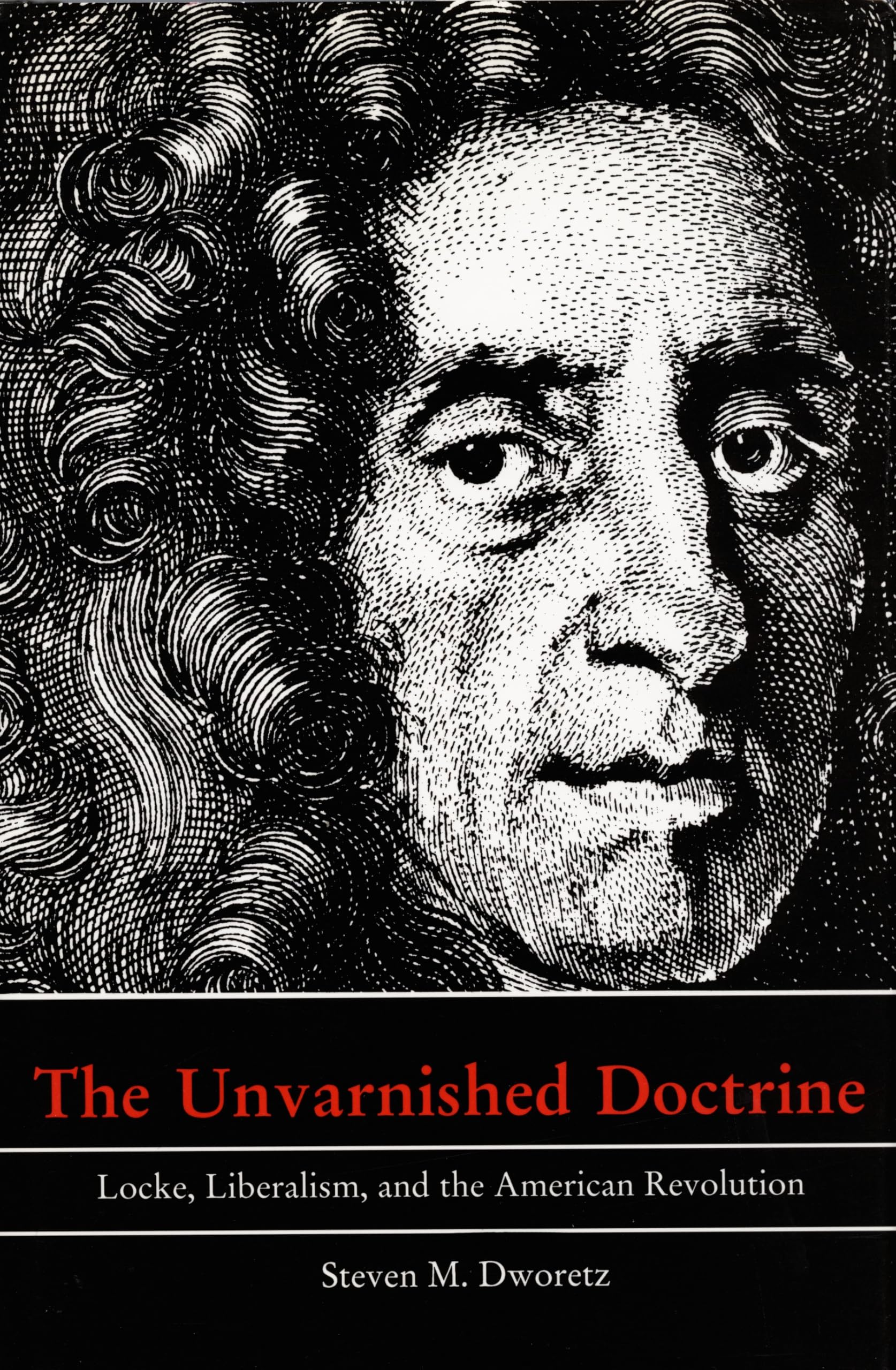
The Unvarnished Doctrine: Locke, Liberalism, and the American Revolution
$33.19
by Steven M. Dworetz



In The Unvarnished Doctrine , Steven M. Dworetz addresses two critical issues in contemporary thinking on the American Revolution—the ideological character of this event, and, more specifically, the relevance of "America’s Philosopher, the Great Mr. Locke," in this experience. Recent interpretations of the American revolution, particularly those of Bailyn and Pocock, have incorporated an understanding of Locke as the moral apologist of unlimited accumulation and the original ideological crusader for the "spirit of capitalism," a view based largely on the work of theorists Leo Strauss and C. B. Macpherson. Drawing on an examination of sermons and tracts of the New England clergy, Dworetz argues that the colonists themselves did not hold this conception of Locke. Moreover, these ministers found an affinity with the principles of Locke’s theistic liberalism and derived a moral justification for revolution from those principles. The connection between Locke and colonial clergy, Dworetz maintains, constitutes a significant, radicalizing force in American revolutionary thought. "Provocative and challenging, Dworetz’s argument is calculated to unsettle intellectual complacency and to prompt Americans to a new appreciation of the liberal philosophic foundations of liberal philosophy."—Wilson Carey McWilliams, Rutgers University "Provocative and challenging, Dworetz's argument is calculated to unsettle intellectual complacency and to prompt Americans to a new appreciation of the liberal philosophic foundations of liberal philosophy."--Wilson Carey McWilliams, Rutgers University Steven M. Dwortez is Associate Professor of Political Science at Wheaton College, Norton, Massachusetts. The Unvarnished Doctrine Locke, Liberalism, and the American Revolution By Steven M. Dworetz Duke University Press Copyright © 1990 Duke University Press All rights reserved. ISBN: 978-0-8223-1470-7 Contents Preface to the Paperback Edition, Acknowledgments, Dedication, 1 The Historiographie Revolution: The Rise of "Cato" and the Decline of Locke in American Revolutionary Thought, 2 A Discourse on Method, 3 The Lockean Response to British "Innovations", 4 Historiography and the Interpretation of Political Theory, 5 Theistic Liberalism in the Teaching of the New England Clergy, 6 History, Myth, and the Secular Salvation of American Liberalism, Notes, CHAPTER 1 The Historiographie Revolution: The Rise of "Cato" and the Decline of Locke in American Revolutionary Thought For any political society the interpretation of its founding ideology is of great significance. The more overtly ideological or theocratic regimes take no chances in this regard. They institutionalize the interpretation of founding doctrine in a high political office. In such systems tinkering with that doctrine is serious political business, never to be undertaken without official approval and supervision; and a fundamental reinterpretation, were it to occur at all, would undoubtedly be a politically revolutionary act. In contrast, regimes rooted in the liberal-democratic tradition do not appoint a "Secretary for Ideology" to guard, monopolize, and enforce the interpretation of the founding doctrine. In part, this is because liberal-democratic ideology itself includes toleration and free speech among its essential principles and thus precludes the cultivation and enforcement of ideological or religious purity by the state. In these systems, of which the United States is one, the founding doctrine is always, in principle, open to critical review by citizens. Moreover, a reinterpretation need not be the work of political revolutionaries; scholars could do it. But in these matters, even a scholarly revolution can have far-reaching political consequences. After all, a society's understanding of its founding doctrine is an integral part of its self-consciousness and the ultimate source of its sense of purpose and normative vision. The ideology of the founding furnishes the standards by which citizens evaluate contemporary events, practices, and arrangements. The dominant understanding of the founding doctrine thus reveals something of the political society's moral condition. It also contains prescriptive implications for public policy and constitutes the essential source of historical legitimacy for any general political program. The contenders in a political-ideological struggle, for example, often seek legitimacy for their agendas in the founding ideology and therefore, consciously or not, selectively interpret that ideology, or selectively appropriate from interpretations developed by others, to accommodate their specific partisan needs. So, while relatively "disinterested" or apolitical scholars may initiate changes in a society's understanding of its founding doctrine, political leaders, parties, and movements will make use of their work—perhaps in ways that the scholars themselves fail to anticipate. For these reasons a revolution i