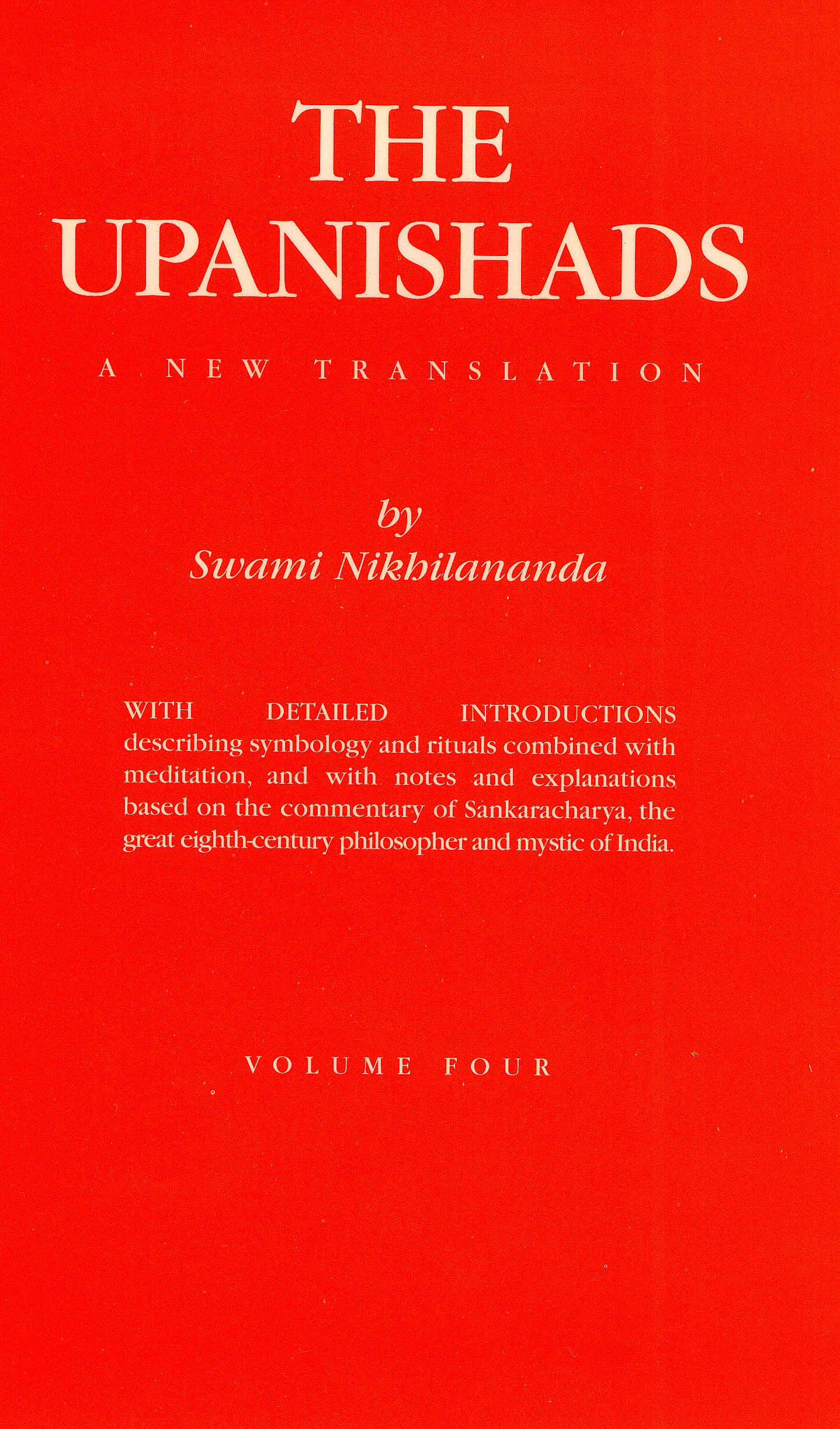



Swami Nikhilananda's English translation of two of the major Upanishads - Taittiriya and Chhandogya - offers a scholarly, yet readable version of these sacred texts of ancient India. The Upanishads form the foundation of the Hindu religion and describe the ultimate objective of life - the liberation of the soul from the bondage of the phenomenal world. Swami Nikhilananda's clear and insightful writing combined with notes and explanation based on the commentary of Sankaracharya, the great eighth-century philosopher and mystic of India, will help the spiritual seeker delve into the meaning of these spiritual treasures. This fourth volume also contains introductions to the two Upanishads describing rituals and contemplative worship as steps leading to the knowledge of God A remarkably felicitous and spiritual translation which will go far toward making the great literature of the Hindu philosophical scriptures both accessible and intelligible to thoughtful occidentals. -- Edgar S. Brightman A scholarly and highly illuminating work. At a time when we are all seeking to understand the soul of India and to interpret the religious heritage of the deeply spiritual people, [these volumes] ought to be carefully studied and properly digested in . . . -- Edward J. Jurji Anyone who is seriously interested in the religious and philosophical thought of India would be anxious to have this, as well as the preceding volumes of Upanishads in translation by Swami Nikhilananda. -- Pitirim A. Sorokin His translation of the original Sanskrit is literal but fresh and vigorous; to this he has added succinct, brilliantly written notes. It is difficult to over-estimate the value of Swami Nikhilananda's project for those who are interested in the spiritual life. Will add incomparable riches to any which contemplates it. -- Thomas Sugrue, New York Times Book Review Swami Nikhilananda's line by line commentary on The Upanishads is a most welcome addition to our knowledge and understanding of the country and culture which perhaps more than any other is now taking on a position of primary importance in the Oriental world. -- F.S.C. Northrop Swami Nikhilananda's volumes of The Upanishads are valuable contributions to the study of The Upanishads and can be confidently recommended to those who want to acquaint themselves with these treasures of Indo-Arayan wisdom . . . they often shed new light on old concepts and bring out their significance in the perspective of modern Western thought. -- Philosophy East and West The special value of this translation lies in the infusion of the author's dual quality - that of a practised mystic and religious scholar . . . The use of Sankara's commentaries makes as it were for another dimension - as of a vastly competent Thomas Aquinas winnowing the scriptural chaff from the kernel of Reality. -- J. G. Hitrec This is by far the most satisfactory and readable translation of The Upanishads I have seen. -- Herbert W. Schneider The Upanishads - Volume I through IV are published by The Ramakrishna-Vivekananda Center of New York which bases it teachings on the principles of Vedanta, or Hinduism. Hinduism teaches that every soul is potentially divine, and that its divinity may be manifested through worship, contemplation, unselfish work, and philosophical discrimination. According to Hinduism, Truth is universal and all humankind and all existence are one. It preaches the unity of the Godhead, or ultimate Reality, and accepts every faith as a valid means for its own followers to realize the Truth. The Upanishads form the concluding portion and contain the essence of the Vedas, which are the Scriptures of the Hindu faith. They record the direct and immediate spiritual experience of the rishis, the seers of truth, and have been passed down orally through a succession of illumined teachers. They treat of the origin and destiny of the soul, the nature of the universe, and the nature of ultimate reality. What are often presented as theological dogmas are in this new translation considered living experiences available to all. The divinity of the soul, the oneness of humanity, and the indivisibility of the Godhead are discussed not as articles of faith, but as truths of spiritual experiences. Schopenhauer once said: " The Upanishads are the most rewarding and elevating reading possible in the world: they have been the solace of my life and will be that of my death." This new translation is both literal and graceful. It has the dignity and flavor of the original. Swami Nikhilananda has based his notes and explanations on the commentaries of Sankaracharya, the great eighth-century philosopher and mystic. Volume IV contains the Taittiriya and Chhandogya Upanishads with an introduction discussing rituals and contemplative worship as steps leading to the knowledge of Brahman. Swami Nikhilananda, a direct disciple of Holy Mother Sri Sarada Devi, was born in a small Indian village in 1895 an