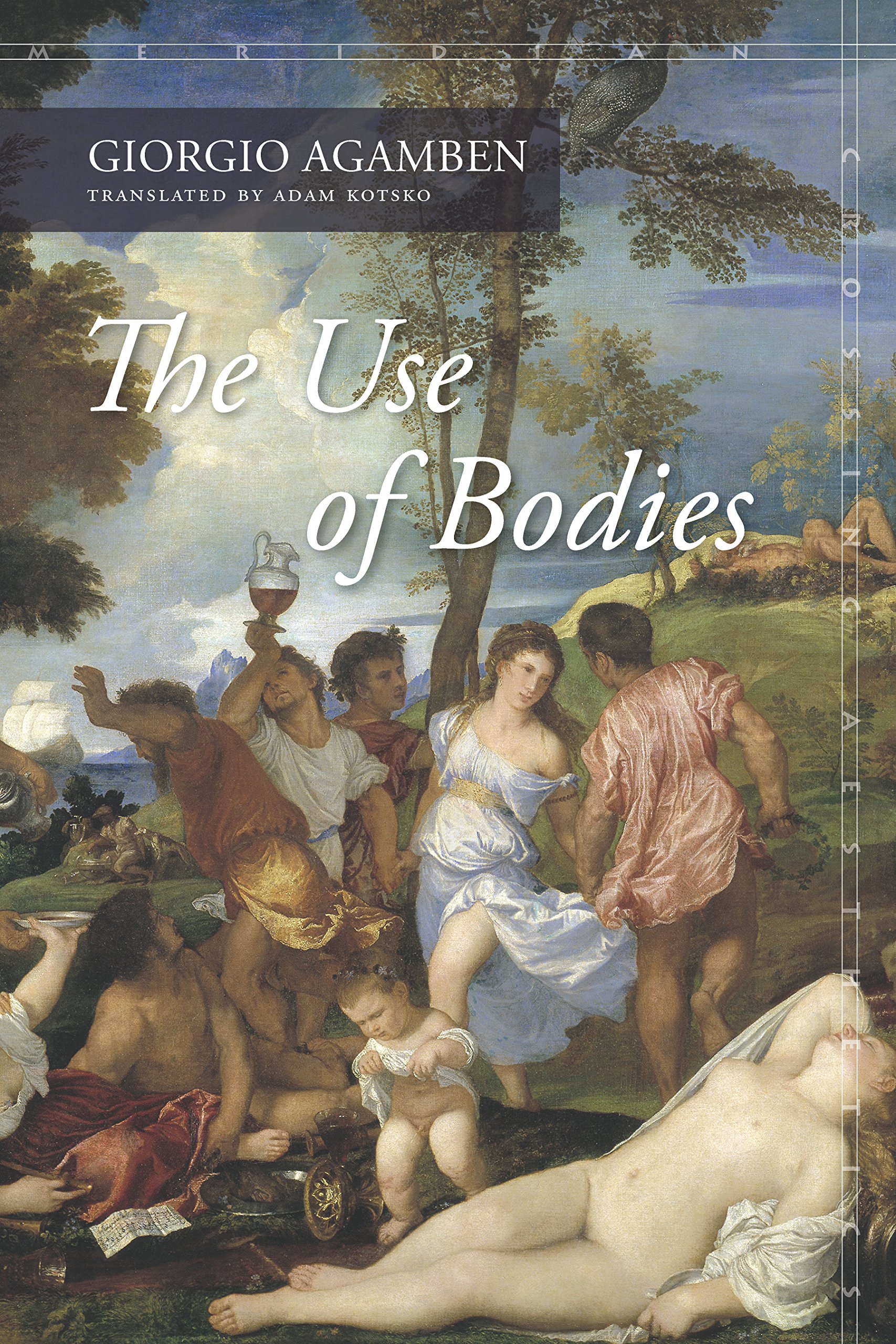



Giorgio Agamben's Homo Sacer was one of the seminal works of political philosophy in recent decades. It was also the beginning of a series of interconnected investigations of staggering ambition and scope, investigating the deepest foundations of Western politics and thought. The Use of Bodies represents the ninth and final volume in this twenty-year undertaking, breaking considerable new ground while clarifying the stakes and implications of the project as a whole. It comprises three major sections. The first uses Aristotle's discussion of slavery as a starting point for radically rethinking notions of selfhood; the second calls for a complete reworking of Western ontology; and the third explores the enigmatic concept of "form-of-life," which is in many ways the motivating force behind the entire Homo Sacer project. Interwoven between these major sections are shorter reflections on individual thinkers (Debord, Foucault, and Heidegger), while the epilogue pushes toward a new approach to political life that breaks with the destructive deadlocks of Western thought. The Use of Bodies represents a true masterwork by one of our greatest living philosophers. "Among the most important features of Agamben's work, evident in this volume as much as in the whole series, is his attention to theological categories, and his realization that secular political philosophy roots its concepts in them...This is an important book. It can be read by itself, with profit, as a version of the arguments Agamben has been offering for more than three decades."―Paul J. Griffiths , Horizons: The Journal of the College Theology "In The Use of Bodies , Agamben...takes up again the topic of life, giving us perhaps the most complete genealogy of the philosophical concept of life ever to appear. In particular, Agamben wants to think a conception of life that cannot be separated from its form, a life that cannot be rendered bare. Herein, we are finally treated with Agamben's full conception of the form-of-life, long awaited in his work."―A.J. Smith, Anglican Theological Review " The Use of Bodies completes its task as set out―Agamben draws together lines of inquiry [and] sets the stage for destituent potential as an inspiration for the coming politics....This work is an essential read for any followers of Agamben's work, as well as one of the more accessible works in his Homo Sacer project."―Michael P.A. Murphy, Reading Religion Giorgio Agamben is a contemporary Italian philosopher and political theorist whose works have been translated into numerous languages. His most recent title with Stanford University Press is Stasis (2015). The Use of Bodies Homo Sacer IV, 2 By Giorgio Agamben, Werner Hamacher, Adam Kotsko STANFORD UNIVERSITY PRESS Copyright © 2014 Neri Pozza Editore, Vicenza All rights reserved. ISBN: 978-0-8047-9840-2 Contents Translator's Note, Prefatory Note, Prologue, I. THE USE OF BODIES, 1. The Human Being without Work, 2. Chresis, 3. Use and Care, 4. The Use of the World, 5. Use-of-Oneself, 6. Habitual Use, 7. The Animate Instrument and Technology, 8. The Inappropriable, Intermezzo I, II. AN ARCHEOLOGY OF ONTOLOGY, 1. Ontological Apparatus, 2. Theory of Hypostases, 3. Toward a Modal Ontology, Intermezzo II, III. FORM-OF-LIFE, 1. Life Divided, 2. A Life Inseparable from Its Form, 3. Living Contemplation, 4. Life Is a Form Generated by Living, 5. Toward an Ontology of Style, 6. Exile of One Alone with One Alone, 7. "That's How We Do It", 8. Work and Inoperativity, 9. The Myth of Er, Epilogue: Toward a Theory of Destituent Potential, Bibliography, CHAPTER 1 The Human Being without Work 1.1. The expression "the use of the body" ( he tou somatos chresis ) is found at the beginning of Aristotle's Politics (1254b 18), at the point where it is a question of defining the nature of the slave. Aristotle has just affirmed that the city is composed of families or households ( oikiai ) and that the family, in its perfect form, is composed of slaves and free people ( ek doulon kai eleutheron — the slaves are mentioned before the free; 1253b 3–5). Three types of relations define the family: the despotic ( despotikè ) relation between the master ( despotes ) and the slaves, the matrimonial ( gamikè ) relation between the husband and wife, and the parental ( technopoietikè ) relation between the father and the children (7–11). That the master/slave relation is in some way, if not the most important, at least the most evident is suggested — aside from its being named first — by the fact that Aristotle specifies that the latter two relations are "nameless," lacking a proper name (which seems to imply that the adjectives gamikè and technopoietikè are only improper denominations devised by Aristotle, while everyone knows what a "despotic" relation is). In any case, the analysis of the first relation, which immediately follows, in some way constitutes the intro