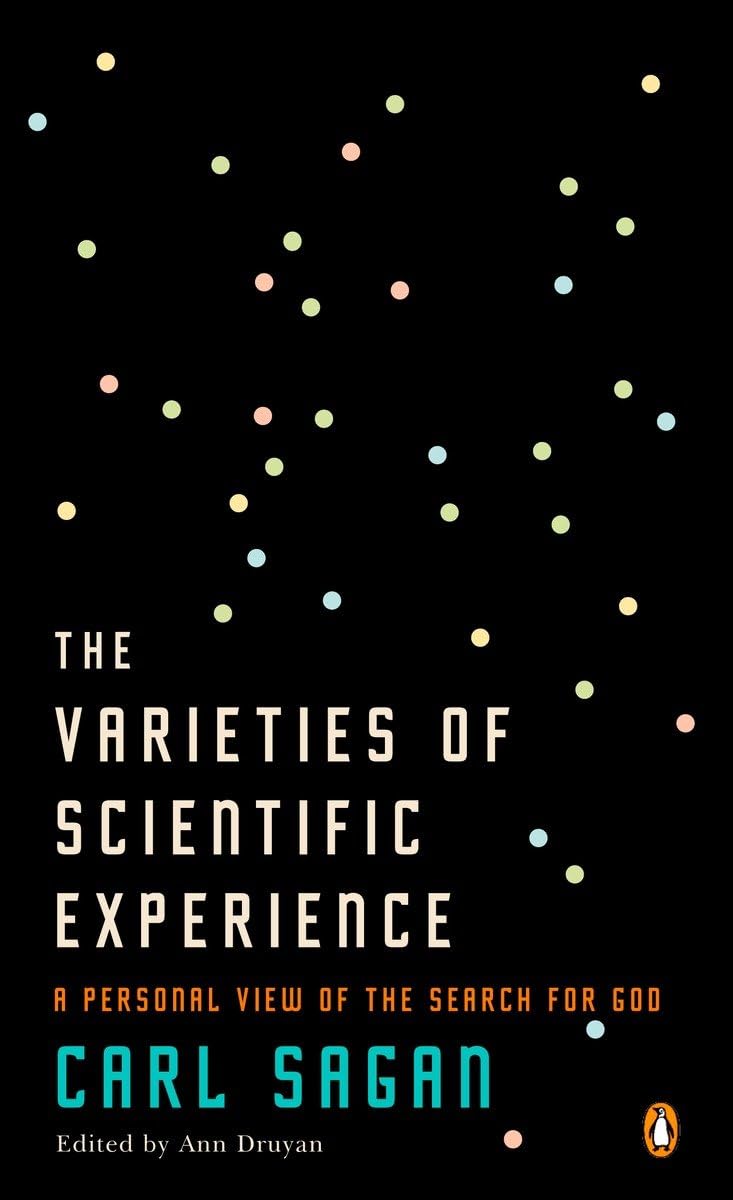
The Varieties of Scientific Experience: A Personal View of the Search for God
$13.10
by Carl Sagan



“Ann Druyan has unearthed a treasure. It is a treasure of reason, compassion, and scientific awe. It should be the next book you read. ” — Sam Harris, author of The End of Faith “A stunningly valuable legacy left to all of us by a great human being. I miss him so. ” — Kurt Vonnegut Carl Sagan's prophetic vision of the tragic resurgence of fundamentalism and the hope-filled potential of the next great development in human spirituality The late great astronomer and astrophysicist describes his personal search to understand the nature of the sacred in the vastness of the cosmos. Exhibiting a breadth of intellect nothing short of astounding, Sagan presents his views on a wide range of topics, including the likelihood of intelligent life on other planets, creationism and so-called intelligent design, and a new concept of science as "informed worship." Originally presented at the centennial celebration of the famous Gifford Lectures in Scotland in 1985 but never published, this book offers a unique encounter with one of the most remarkable minds of the twentieth century. “Ann Druyan has unearthed a treasure. It is a treasure of reason, compassion, and scientific awe. It should be the next book you read. ” — Sam Harris, author of The End of Faith “A stunningly valuable legacy left to all of us by a great human being. I miss him so. ” — Kurt Vonnegut Carl Sagan was Professor of Astronomy and Space Sciences and Director of the Laboratory for Planetary Studies at Cornell University. He played a leading role in the Mariner, Viking, and Voyager spacecraft expeditions to the planets, for which he received the NASA medals for Exceptional Scientific Achievement. Dr. Sagan received the Pulitzer Prize and the highest awards of both the National Academy of Sciences and the National Science Foundation, and many other awards, for his contributions to science, literature, education, and the preservation of the environment. His book Cosmos (accompanying his Emmy- and Peabody Award-winning television series of the same name) was the bestselling science book ever published in the English language, and his bestselling novel, Contact , was turned into a major motion picture. PENGUIN BOOKS THE VARIETIES OF SCIENTIFIC EXPERIENCE Carl Sagan (November 9, 1934–December 20, 1996) was professor of astronomy and space sciences and director of the Laboratory for Planetary Studies at Cornell University. He played a leading role in the Mariner, Viking, and Voyager spacecraft expeditions to the planets, for which he twice received the NASA Medals for Exceptional Scientific Achievement. Dr. Sagan received the Pulitzer Prize and the highest awards of both the National Academy of Sciences and the National Science Foundation and many other awards for his contributions to science, literature, education, and the preservation of the environment. His book Cosmos (accompanying his Emmy and Peabody Award–winning television series of the same name) was the bestselling science book ever published in the English language, and his bestselling novel Contact was turned into a major motion picture. Dr. Sagan was among the first to alert the public to the danger of global warming and the potential climatic consequences of nuclear war. In the 1980s he initiated the campaign to forge an alliance between religion and science to protect the environment. THE VARIETIES of SCIENTIFIC EXPERIENCE A Personal View of the Search for God CARL SAGAN Edited by ANN DRUYAN Illustrations Editor and Scientific Consultant Steven Soter Editor’s Introduction Author’s Introduction 1. NATURE AND WONDER: A RECONNAISSANCE OF HEAVEN 2. THE RETREAT FROM COPERNICUS: A MODERN LOSS OF NERVE 3. THE ORGANIC UNIVERSE 4. EXTRATERRESTRIAL INTELLIGENCE 5. EXTRATERRESTRIAL FOLKLORE: IMPLICATIONS FOR THE EVOLUTION OF RELIGION 6. THE GOD HYPOTHESIS 7. THE RELIGIOUS EXPERIENCE 8. CRIMES AGAINST CREATION 9. THE SEARCH SELECTED Q & A Acknowledgments Figure Captions Index Editor’s Introduction Carl Sagan was a scientist, but he had some qualities that I associate with the Old Testament. When he came up against a wall—the wall of jargon that mystifies science and withholds its treasures from the rest of us, for example, or the wall around our souls that keeps us from taking the revelations of science to heart—when he came up against one of those topless old walls, he would, like some latter-day Joshua, use all of his many strengths to bring it down. As a child in Brooklyn, he had recited the Hebrew V’Ahavta prayer from Deuteronomy at temple services: “And you shall love the Lord your God with all your heart, with all your soul, with all your might.” He knew it by heart, and it may have been the inspiration for him to first ask, What is love without understanding? And what greater might do we possess as human beings than our capacity to question and to learn? The more Carl learned about nature, about the vastness of the universe and the awesome timescales o