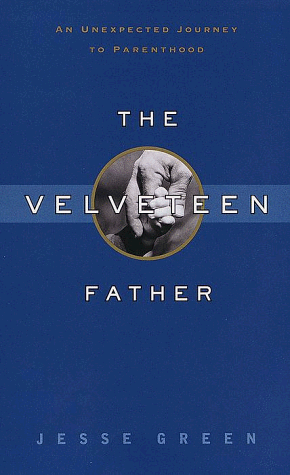



Everything conspires against the single, childless man. Each new living thing in the world each day says: You are alone, and not getting younger. At the age of thirty-seven, the journalist and novelist Jesse Green found his life dramatically changing when he met and fell in love with a man who had recently adopted a baby boy. Having long since made peace with his choice not to be a parent, Green now faced the shock and the responsibility of a fatherhood he had never imagined. The Velveteen Father is his candid, heartfelt, and often hilarious account of the formation and flourishing of a family. In intimate, graceful prose, Green describes his partner's journey from the hedonistic eighties to the realization that he wanted to have a child; his own concurrent journey to find a way to become an adult without having a child; and their journey together to become good parents in a society whose reactions to unconventional families can be both funny and frightening. In the classic bedtime story, a velveteen rabbit is made real at last by a child's true love. The Velveteen FatherM is a moving record of the transformative effect parenthood can have on people who least expect to become parents, of how we are repeatedly made anew by the love of children who need us. But this transformation is not just the province of parents, Green writes; only by addressing, in some way, the generations that come before and after us can we face the task of becoming real. The Velveteen Father will therefore interest anyone who has considered--or would consider--having a child. Journalist Jesse Green's delightful memoir makes it quite clear that the pleasures and perils of parenting are always the same--even for a gay 37-year-old man who stumbles into it by falling in love with a person who has an adopted son. As Green puts it in a typically well-turned phrase, "fatherhood trumps gayness," which is to say that heterosexual parents at the playground sometimes find it easier to relate to Green, his boyfriend, Andy, and son, Erez (soon joined by baby brother Lucas), than do the well-buffed, perennially youthful male guests at a Fire Island party--they flinch at the sight of diapers and baby bags. As the author searchingly and intelligently considers what it means to gay people to become parents, and the ways in which it does and does not pull them closer into the mainstream, his narrative is often extremely funny. (Joking about Erez's apparently heterosexual inclinations, Green deadpans, "We tried our best: We played him Judy Garland records and showed him tapes of West Side Story .") A very moving examination of identity and the making of a meaningful adult life that resonates profoundly for people of every sexual orientation. --Wendy Smith A gay fathers memoir, stranger and more powerful reading than the authors fictional work. The remarkable contents here suggest years of artistic and personal growth. Greenan award-winning journalist who contributes to numerous periodicals, from the New York Times Magazine to Out, and the author of the 1992 novel O Beautifulis a single Manhattan gay male, a successful writer with supportive Jewish parents, whose life turns around when he finds the love of his life, an older Brooklyn school guidance counselor. Andy is also Jewish but unlike the author is an ``imperfectionist'' and the son of a ``brownstone-belt Queen Lear.'' His greatest distinction is that he is one of the first single gay men to adopt a child. The baby boy, Erez, is a rambunctious Mexican whose birth mother was never met. The responsibilities overwhelm and transform Green, who now feels somewhat alienated from those ``gay men who remain single [and] make a kind of lifes work out of adolescence, their days filled with gossip, crushes, self-beautification.'' Many back in the Village or the Hamptons dont know why he didnt get a Chihuahua. The book is full of insightful, eloquent, and clever passages about parenthood, sexuality, and the ``blood libels'' of the homophobic political right. Only on religion do these well-turned lines, often turned upside down for effect, sound shallow. Despite the playful response ``after this, I want your tubes tied,'' Green agrees to adopt another child (another Mexican baby boy). With this son, Lucas, the author takes on even more of the physical and emotional responsibilities of parenthood than he earlier shared with his partner. To drastically finalize his commitment, Green moves to the Brooklyn neighborhood of his new future and family. A standout comment on the eternal and contemporary implications of family emerges from this enjoyable story that is far too good not to be true. -- Copyright ©1999, Kirkus Associates, LP. All rights reserved. "A tender, intelligent book, Jesse Green's very intimate reflection on what it means to be a father illuminates all families with eloquence, wit, and insight." --Cathleen Schine "I totally love this book--at once sweet and delicious and tou