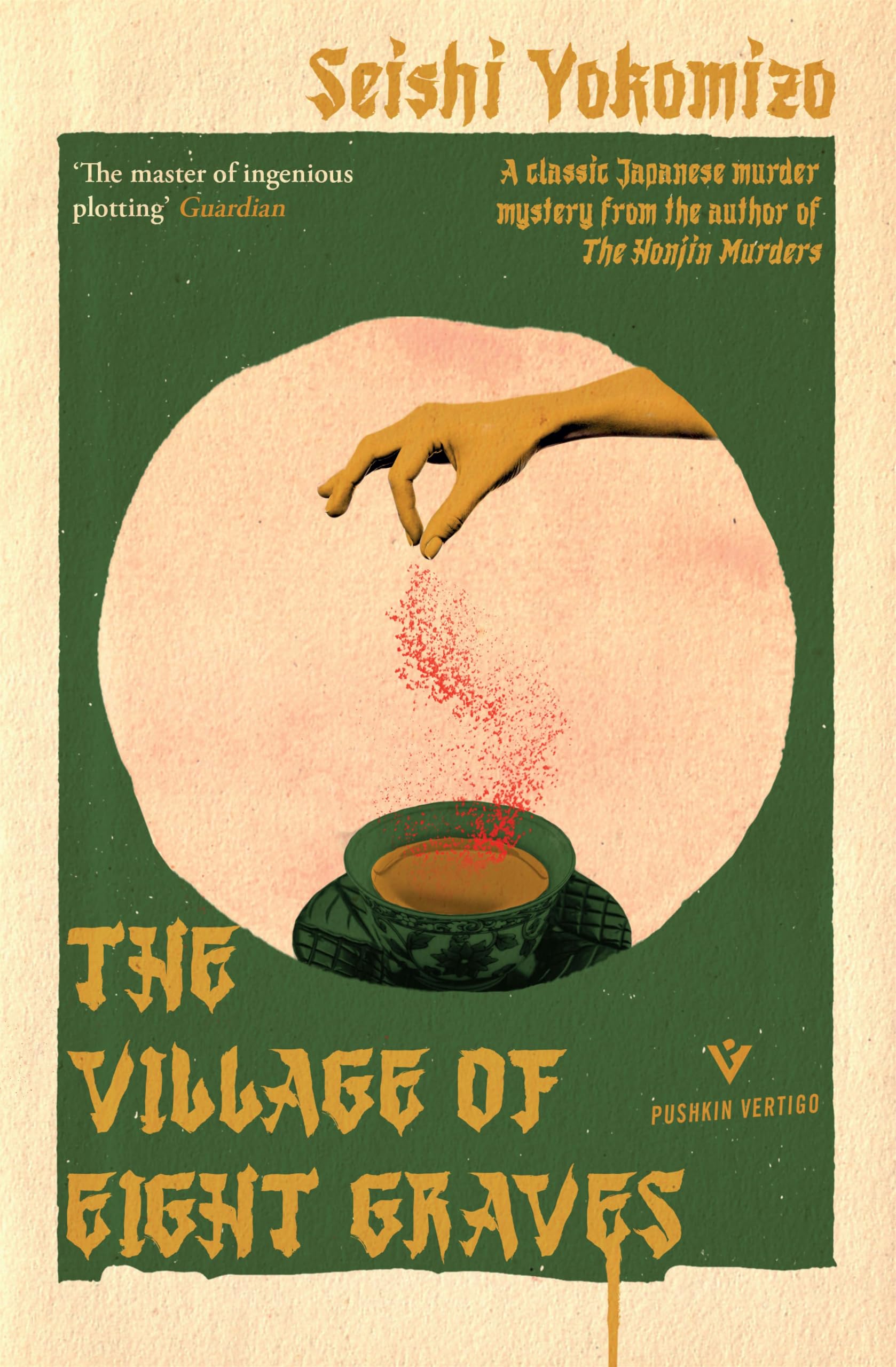



The 3rd stand-alone in Japan's most popular murder mystery series—after The Honjin Murders and The Inugami Curse —is another fiendish classic featuring investigator Kosuke Kindaichi Translated into English for the first time Nestled deep in the mist-shrouded mountains, The Village of Eight Graves takes its name from a bloody legend: in the Sixteenth Century eight samurais, who had taken refuge there along with a secret treasure, were murdered by the inhabitants, bringing a terrible curse down upon their village. Centuries later a mysterious young man named Tatsuya arrives in town, bringing a spate of deadly poisonings in his wake. The inimitably scruffy and brilliant Kosuke Kindaichi investigates. Yokomizo is perhaps the most popular and feted crime writer in his country’s history. His richly atmospheric classic mysteries are a treat for any fan of Golden Age whodunits, taking the reader all over post-war Japan, from remote mountain villages to pirate-plagued islands and the bustling streets of Tokyo. Yokomizo loved to craft ingenious puzzle plots, inspired by the greats of British and American crime, such as John Dickson Carr or Agatha Christie, while his detective, Kosuke Kindaichi, is everything a reader could want from a sleuth: brilliant, eccentric, charming, and unassuming enough to be fatally underestimated by many a murderer. . . "Kosuke Kindaichi, the scruffy investigating detective, bears more than a passing resemblance to Columbo who made his TV debut in 1971 — which, coincidentally, is when this amusing novel was first published in Japan." -- The Sunday Times Crime Club (UK) "This taut mystery provides an original variation on The Hound of the Baskervilles… Kosuke Kindaichi, Yokomizo’s Columbo-like sleuth, arrives to sort through the tangled puzzle and provide a satisfying solution. Fans of gothic-tinged fair play will be enthralled" -- Publishers Weekly (starred review) "Wickedly rich and worth every minute... Halfway through, I was already recommending it to my mother, grandfather, basically anyone who loves a good murder mystery!" —Abstract AF! blog Seishi Yokomizo (1902-81) was one of Japan's most famous and best-loved mystery writers. He was born in Kobe and spent his childhood reading detective stories, before beginning to write stories of his own, the first of which was published in 1921. He went on to become an extremely prolific and popular author, best known for his Kosuke Kindaichi series, which ran to 77 books, selling more than 55 million copies and spawning many stage and television adaptations. The Honjin Murders is the first Kosuke Kindaichi story, and regarded as one of Japan's great mystery novels. It won the first Mystery Writers of Japan Award in 1948 but has never been translated into English, until now. Seishi Yokomizo's The Inugami Curse is also available from Pushkin Vertigo, while Gokumon Island is forthcoming. PROLOGUE The village of Eight Graves is perched amid the desolate mountains on the border of Tottori and Okayama prefectures. Naturally, arable land is scarce in these parts, and of what little there is, most is given over to a small handful of rice paddies dotted around, each measuring only ten or, at most, twenty tsubo, or about seven hundred square feet. The inhospitable climate makes for a meagre harvest, and no matter the calls to increase production, the rice paddies yield barely enough to feed the villagers. Nevertheless, owing to a wealth of other resources, the inhabitants there live in relative comfort. Charcoal-making and cattle-rearing are the main industries in Eight Graves. The latter is a recent phenomenon, but the former has been the villagers’ chief livelihood for generations. The mountains that envelop the village stretch all the way to Tottori and are blanketed in various species of oak—blue, sawtooth and jolcham. They grow in such abundance that the region has long been famed for its charcoal throughout the whole of Kansai. In more recent times, however, it is cattle-rearing that has become the village’s main source of revenue: the local breed, the chiya-ushi, serves just as well for working as it does for eating, and the cattle market at neighbouring Niimi attracts traders from far and wide. Each household in the village is charged with raising ve or six head of cattle: they aren’t the property of the village farmers, but that of the landowners who give the farmers the calves and sell them on when they are fully grown. The proceeds of the sale are then shared between the farmer and the landowner at a xed rate. Thus, as in any agricultural village, the owners and the sharefarmers are pitted against one another: in such a modest settlement as this, there are stark dierences in fortune. In Eight Graves, there are two wealthy houses: the Tajimis and the Nomuras. Since the Tajimi family is situated in the east of the village, they are known as “The House of the East”, while, by the same stroke of reasoning, the Nomura