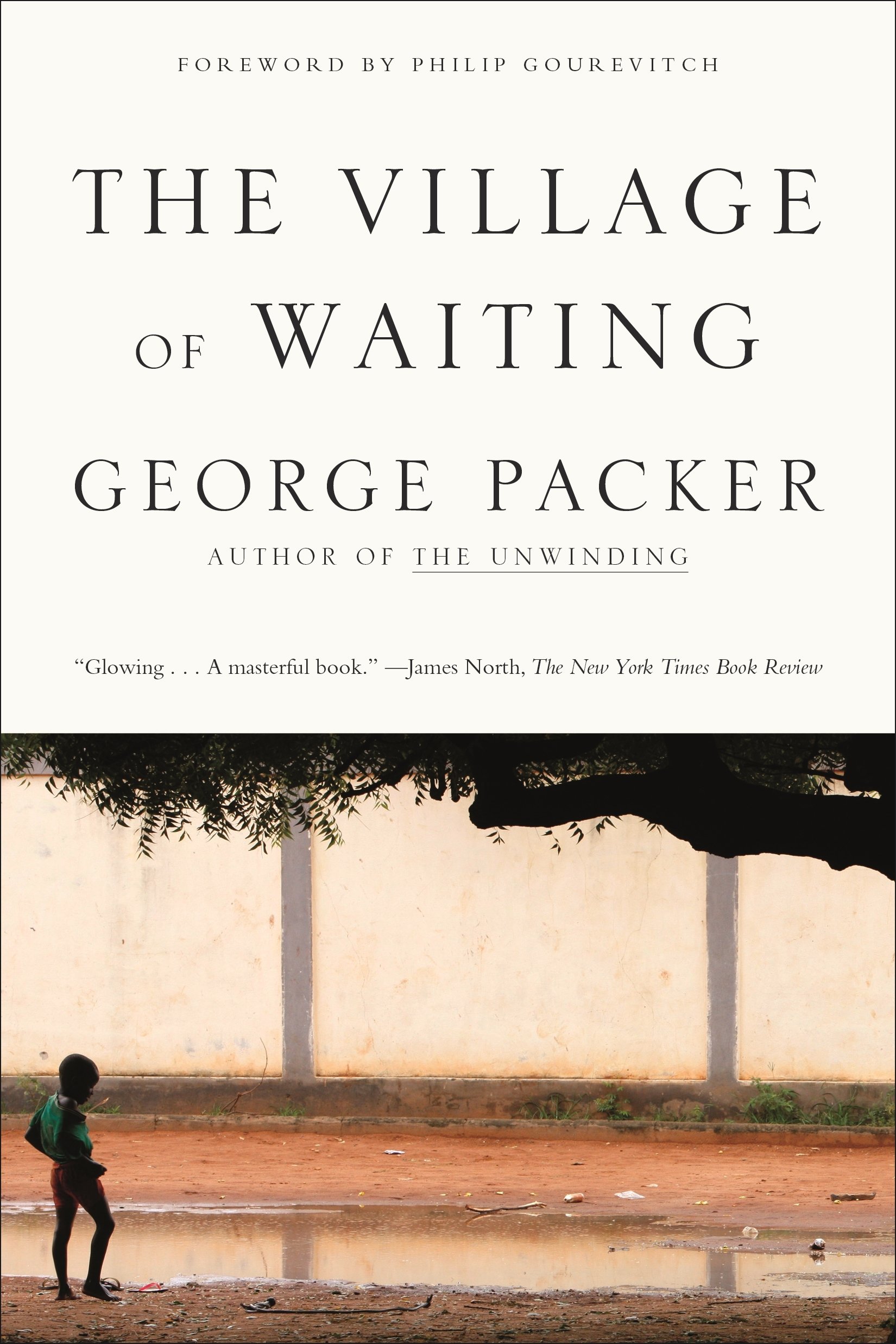



Back in print, the "masterful" ( The New York Times Book Review ) account of an American in West Africa Now restored to print with a new Foreword by Philip Gourevitch and an Afterword by the author, The Village of Waiting is a frank, moving, and vivid account of contemporary life in West Africa. Stationed as a Peace Corps instructor in the village of Lavié (the name means "wait a little more") in tiny and underdeveloped Togo, George Packer reveals his own schooling at the hands of an unforgettable array of townspeople―peasants, chiefs, charlatans, children, market women, cripples, crazies, and those who, having lost or given up much of their traditional identity and fastened their hopes on "development," find themselves trapped between the familiar repetitions of rural life and the chafing monotony of waiting for change. “Lovely in its feeling for the people and realistic in its assessment of the African situations, this is a first-rate piece of social reportage.”―Irving Howe “[A] fond and angry account...An impressively unself-righteous and questioning work of intimate introduction, in which each dislocation of hope and breakdown of sense matters. Truthful throughout.”― The New Yorker “Glowing...A masterful book.”― The New York Times Book Review George Packer is an award-winning author and staff writer at The Atlantic . His books include The Unwinding: An Inner History of the New America (winner of the National Book Award), The Assassins’ Gate: America in Iraq , and Our Man: Richard Holbrooke and the End of the American Century (winner of the Hitchens Prize and the Los Angeles Times Book Prize for biography). He is also the author of two novels and a play, and the editor of a two-volume edition of the essays of George Orwell. The Village of Waiting By George Packer Farrar, Straus and Giroux Copyright © 2001 George Packer All rights reserved. ISBN: 978-0-374-52780-8 Contents Title Page, Copyright Notice, Dedication, Epigraphs, Acknowledgments, Map, Foreword, Introduction, 1. Lost in Lomé, 2. Manioc, 3. Khaki and Goatskin, 4. Yovos and Other Fous, 5. Authenticity, 6. Footprints, 7. You Get Up, You Work, You Sleep, 8. Three Africas, Ouagadougou, A Boulangerie in Lagos, On Safari, 9. Hypochondria, 10. The Kiss Is European, 11. Wait a Little More, 12. The New Chief, 13. Cicada Philosophy, 14. Barcelona, Afterword, About the Author, Also by George Packer, Copyright, CHAPTER 1 Lost in Lomé I arrived in Lavié already sick of Togo, sick of Africa, wanting out. When Peace Corps notified me at Yale in the spring of 1982 that I would be leaving for Togo in three months, I had to go to the library to consult an atlas. The country was still labeled with its colonial name, Togoland — a sliver squeezed into the West African coast among a crazy patchwork of borders. Over the following months, amid the distractions of getting my degree and saying good-byes, a sense of the place formed in my mind — startlingly clear, hopelessly abstract. The dozen species of venomous snakes Togo was famous for; the bit of wire I would hook to my shortwave antenna for better reception; the Camusian ex-colonials I'd find hanging around waterfront bars, muttering into their whiskeys about freedom and death. And farther out still, I imagined a young country that would be more vital than the money-and success-worshiping one I'd grown up in, struggling with life-and-death issues, forging a new literature that might put to shame our breakfast-table realism. And then I pictured the tropical cliché. Endless miles of low green bush, with me somewhere in the middle of it, on a cot in a room where light and heat poured in, swatting at mosquitoes and drinking from a canteen. I had grown up in one university, then spent four years in another. I had done well; the future seemed secure enough. But I wanted to leave the path for a while. My reasons for going were not more idealistic or more defined than these. In fact, a few days before leaving I discovered I had no real reasons at all, and, briefly, I panicked. * * * It turned out there were no French existentialists hanging on in Lomé, just officials of the cotton company and their tight-lipped wives and stylish children who attended the Ecole Française up the street from the Peace Corps office. A few lime-green vipers flashed across my path. I saw no evidence of political or literary ferment at all. Politics, in the first weeks, seemed to consist of the banners stretched across Lomé's intersections, in Togolese red, yellow, and green, saluting the peace and unity of the rule of His Excellency President Gnassingbé Eyadema. Literature was the twelve-page government daily tabloid, saluting the same thing. I spent my first three months in training at the junction town of Atakpamé, 120 kilometers north of the capital and 80 kilometers up the road from Lavié. It was a hilly, overcrowded place teeming with battered Renault taxis and women