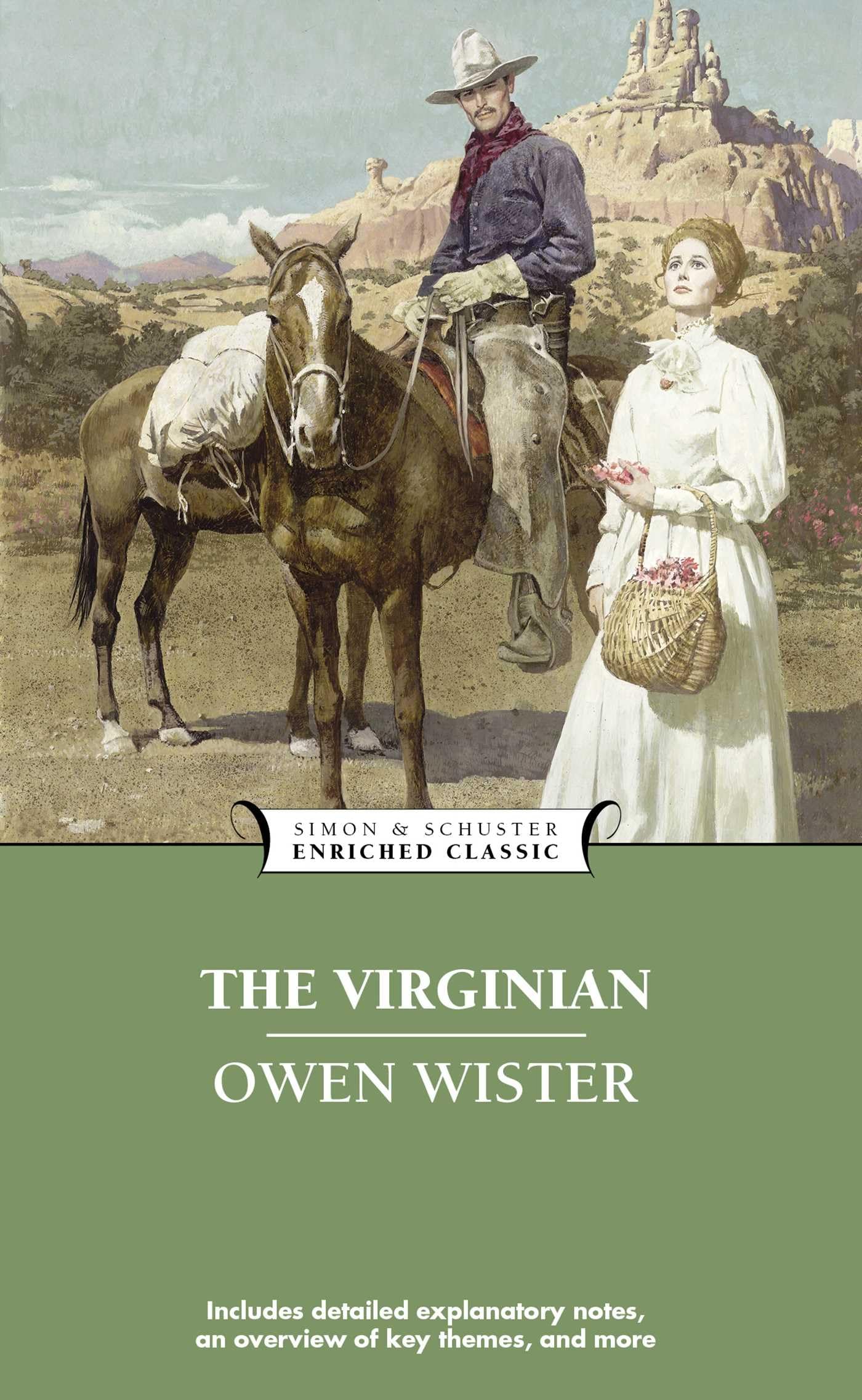



Still as exciting and meaningful as when it was written in 1902, Owen Wister's epic tale of one man's journey into the untamed territory of Wyoming, where he is caught between his love for a woman and his quest for justice, has exemplified one of the most significant and enduring themes in all of American culture. With remarkable character depth and vivid descriptive passages, The Virginian stands not only as the first great novel of American Western literature, but as a testament to the eternal struggle between good and evil in humanity and a revealing study of the forces that guide the combatants on both sides. This edition of The Virginian has been prepared by Gary Scharnhorst, professor of English at the University of New Mexico. It includes his introduction, notes, a selection of critical excerpts, and suggestions for further reading, as well as a unique visual essay of period illustrations and photographs. Owen Wister was born in Philadelphia to Owen Jones Wister, a physician, and Sarah (Butler) Wister, daughter of the actress Fanny Kemble. After graduating from Harvard in 1882, Wister spent some time in the West and documented his experiences in a series of diaries. In 1891, after a conversation in which Wister and his former Harvard classmate Theodore Roosevelt discussed the literary potential of Wister's impressions of Western life, Wister began writing stories of America's last frontier, which paved the way for The Virginian. Wister's stories helped establish the cowboy as an archetypal, individualist hero, and The Virginian is widely recognized as the first true Cowboy novel. Chapter One Enter the Man Some notable sight was drawing the passengers, both men and women, to the window; and therefore I rose and crossed the car to see what it was. I saw near the track an enclosure, and round it some laughing men, and inside it some whirling dust, and amid the dust some horses, plunging, huddling, and dodging. They were cow ponies in a corral, and one of them would not be caught, no matter who threw the rope. We had plenty of time to watch this sport, for our train had stopped that the engine might take water at the tank before it pulled us up beside the station platform of Medicine Bow.1 We were also six hours late, and starving for entertainment. The pony in the corral was wise, and rapid of limb. Have you seen a skilful boxer watch his antagonist with a quiet, incessant eye? Such an eye as this did the pony keep upon whatever man took the rope. The man might pretend to look at the weather, which was fine; or he might affect earnest conversation with a bystander: it was bootless. The pony saw through it. No feint hoodwinked him. This animal was thoroughly a man of the world. His undistracted eye stayed fixed upon the dissembling foe, and the gravity of his horse-expression made the matter one of high comedy. Then the rope would sail out at him, but he was already elsewhere; and if horses laugh, gayety must have abounded in that corral. Sometimes the pony took a turn alone; next he had slid in a flash among his brothers, and the whole of them like a school of playful fish whipped round the corral, kicking up the fine dust, and (I take it) roaring with laughter. Through the window-glass of our Pullman2 the thud of their mischievous hoofs reached us, and the strong, humorous curses of the cow-boys. Then for the first time I noticed a man who sat on the high gate of the corral, looking on. For he now climbed down with the undulations of a tiger, smooth and easy, as if his muscles flowed beneath his skin. The others had all visibly whirled the rope, some of them even shoulder high. I did not see his arm lift or move. He appeared to hold the rope down low, by his leg. But like a sudden snake I saw the noose go out its length and fall true; and the thing was done. As the captured pony walked in with a sweet, church-door expression, our train moved slowly on to the station, and a passenger remarked, "That man knows his business." But the passenger's dissertation upon roping I was obliged to lose, for Medicine Bow was my station. I bade my fellow-travellers good-by, and descended, a stranger, into the great cattle land. And here in less than ten minutes I learned news which made me feel a stranger indeed. My baggage was lost; it had not come on my train; it was adrift somewhere back in the two thousand miles that lay behind me. And by way of comfort, the baggage-man remarked that passengers often got astray from their trunks, but the trunks mostly found them after a while. Having offered me this encouragement, he turned whistling to his affairs and left me planted in the baggage-room at Medicine Bow. I stood deserted among crates and boxes, blankly holding my check, furious and forlorn. I stared out through the door at the sky and the plains; but I did not see the antelope shining among the sage-brush, nor the great sunset light of Wyoming. Annoyance blinded my eyes to all things save my gr