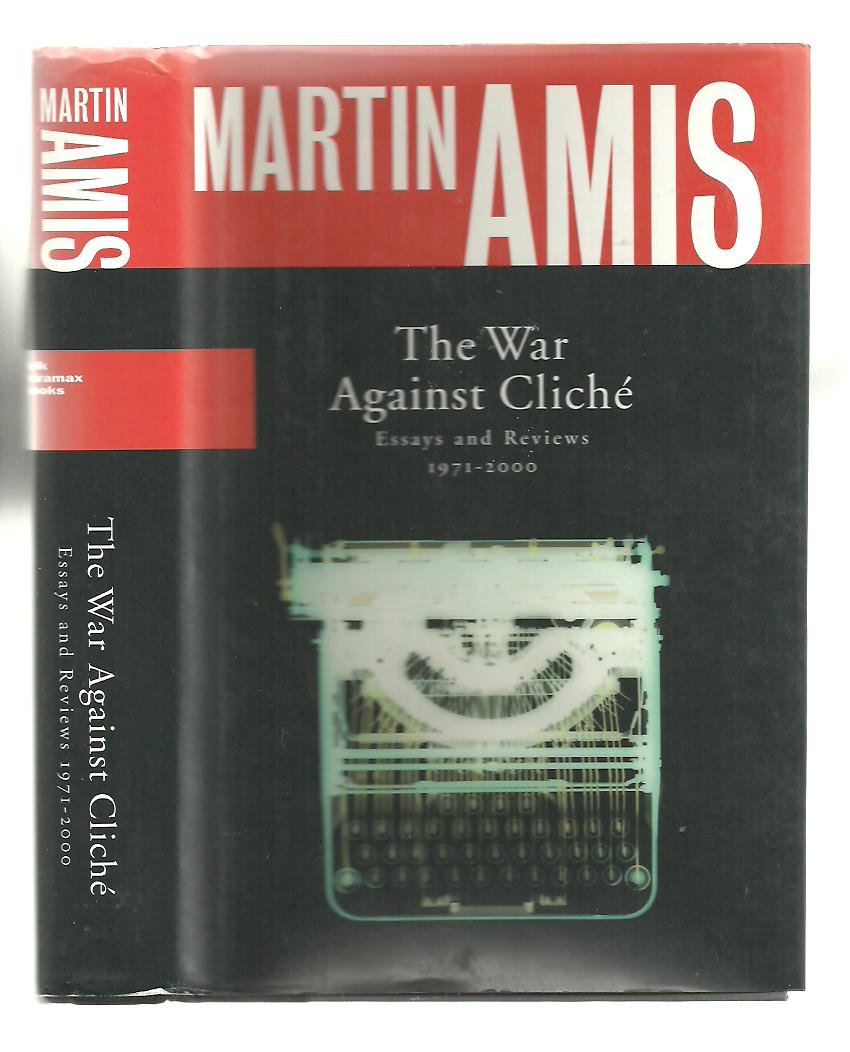



Compiles essays discussing, and in some cases condemning, such people and topics as movie violence, Margaret Thatcher, Charles Dickens, Michael Crichton, Vladimir Nabokov, Gore Vidal, poker, and world literature. In Martin Amis's War Against Cliché , a selection of critical essays and reviews published between 1971 and 2000, he establishes himself as one of the fiercest critics and commentators on the literature and culture of the late 20th century. (He has already established himself as one of the most controversial and original novelists writing in English with novels such as Money and Time's Arrow .) In his foreword to the book Amis ruefully admits that his earlier reviews reveal a rather humorless attitude towards the "Literature and Society" debate of the time. Yet this only adds to the fascination of the collection, as Amis gradually finds his critical voice in the 1980s, confirming his passionate belief that "all writing is a campaign against cliché." In the subsequent sections of the book, this war leads to some wonderfully cutting and amusing responses to whatever crosses his path, from books on chess and nuclear proliferation to Cervantes' Don Quixote and the novels of his hero Vladimir Nabokov. Praise for his literary heroes is often fulsome: J.G. Ballard's High-Rise "is an intense and vivid bestiary, which lingers in the mind and chronically disquiets it." But his literary wrath is also devastating in its incisiveness: Thomas Harris's Hannibal is dismissed as "a novel of such profound and virtuoso vulgarity," while John Fowles is attacked because "he sweetens the pill: but the pill was saccharine all along." Often frank in its reappraisals (Amis concedes to being too hard on Ballard's Crash when reviewing the film many years later), some of the best writing is reserved for his journalism on sex manuals, chess, and his beloved football. The War Against Cliché will provoke strong reactions, but that only seems to confirm, rather than deny, the value of Amis's writing. --Jerry Brotton, Amazon.co.uk Amis's critiques cover wide-ranging topics and are well worth reading, particularly when the erudition on display is liberated by humor, regarding not only the subject under examination but often the examiner himself. Amis, best known for his novels (e.g., London Fields, The Information), recognizes an authorial foible, then pounces on it not without grace, not without vigor. His evaluations are lively, scholarly, and, on rare occasion, numbing though probably less so for those few who know as much about literature as Amis. Requiring less literary background are his essays on poker or chess, Elvis Presley, or the sexual allure of Margaret Thatcher. The Amis view is at its best or at least at its most readable when he is chatting up such standards as Don Quixote, Pride and Prejudice, Ulysses, and Lolita. His lengthy commentary on Nabokov, Larkin, and Updike certainly informs, as do shorter pieces on Roth, Burroughs, Capote, Burgess, and Vidal. To paraphrase Vidal, the best writing allows the reader to participate. Without question, Amis appreciates this concept and puts it into practice in his most accomplished criticisms. Recommended for academic libraries. Robert L. Kelly, Fort Wayne Community Schs., IN Copyright 2001 Reed Business Information, Inc. What makes a literary critic great? A deep involvement with literature, a genuine respect for writers, and the knowledge and confidence that enable the critic to take both micro and macro views of any given book. A vigorous, graceful, and witty prose style is essential, as is the piece de resistance, imagination. Amis, a literary journalist for nearly 30 years, possesses all these qualities, as well as a healthy eclecticism, and to top it off, he's British. Some of the shrewdest and funniest of his incisive reviews skewer American presumptions and naivete, starting with a hilarious takedown of Robert Bly's Iron John. Amis has a keen historical sense, writing brilliant assessments of books about nuclear weapons in which he savagely debunked the SDI fantasy in 1988. But the lion's share of this animated volume, a great feast for serious readers, is his book-after-book reviews of the work of Murdoch, Burgess, and Ballard; his penetrating essays on Nabokov and Larkin; his piquant appraisals of Elmore Leonard and Tom Wolfe; and his annoyance that Roth writes so well. Donna Seaman Copyright © American Library Association. All rights reserved "A delicious book...Amis sets such a high standard." -- San Jose Mercury News "A man of enormous wit, blinding intelligence, and instructive passion." -- Ft. Lauderdale Sun Sentinel "Amis amassed a collection of material so sharp that it reminds you of why he was invited to the party." -- Newsday "Amis' talent is to write books and book reviews, and to do both very well." -- Rocky Mountain News "His arguments inject charm and energy...Amis's prose combines a liveliness and vulnerability that'