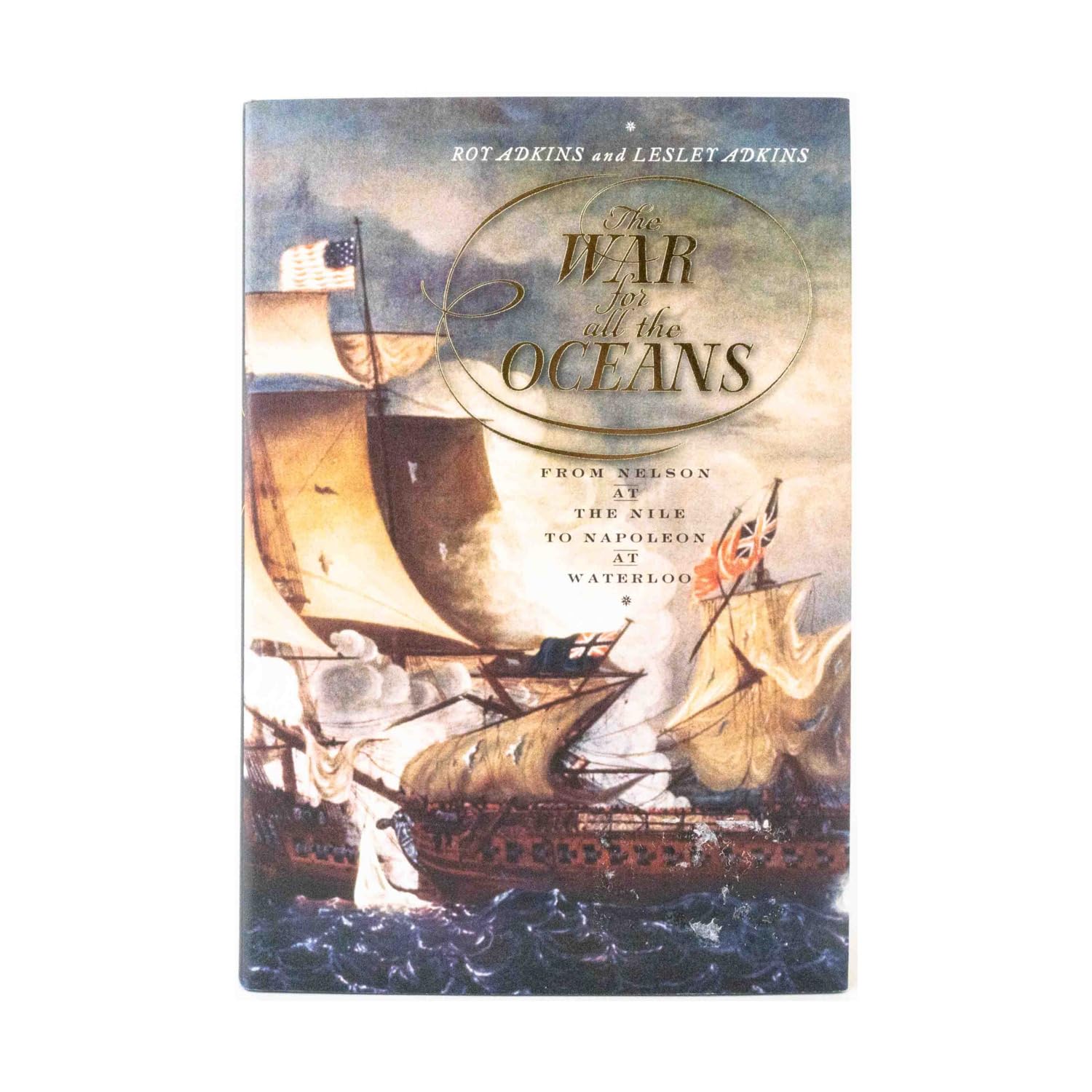
The War for All the Oceans: From Nelson at the Nile to Napoleon at Waterloo
$21.41
by Roy Adkins



A dramatic account of the Napoleonic War as it was fought on the naval front between 1798 and 1815 draws on eyewitness records to offer insight into its battles as well as the experiences of period sailors. By the author of the best-selling Nelson's Trafalgar. In the nineteenth century, the British created the greatest maritime-based empire in world history. That empire was made possible by the domination of the Royal Navy, which was forged in the late-eighteenth and early-nineteenth centuries in the fires of the Napoleonic Wars. The Adkins, who are both historians and archaeologists, have written a narrative history of British naval conflicts from 1798 to 1815. In that span, the Royal Navy engaged almost every major naval power, including France, Spain, Holland, and even the U.S. Naturally, the Adkins describe the exploits of naval icons, including Nelson and Hood, but their account is most engrossing when they utilize eyewitness accounts of ordinary seamen to capture the intensity of battle as well as the grind of day-to-day life aboard a warship. The Adkins display such superb technological knowledge of their subject that they can be excused for their occasional delving into "Britannica Rules the Waves" enthusiasm. A superior work of maritime history that both scholars and general readers should enjoy. Freeman, Jay In the nineteenth century, the British created the greatest maritime-based empire in world history. That empire was made possible by the domination of the Royal Navy, which was forged in the late-eighteenth and early-nineteenth centuries in the fires of the Napoleonic Wars. The Adkins, who are both historians and archaeologists, have written a narrative history of British naval conflicts from 1798 to 1815. In that span, the Royal Navy engaged almost every major naval power, including France, Spain, Holland, and even the U.S. Naturally, the Adkins describe the exploits of naval icons, including Nelson and Hood, but their account is most engrossing when they utilize eyewitness accounts of ordinary seamen to capture the intensity of battle as well as the grind of day-to-day life aboard a warship. The Adkins display such superb technological knowledge of their subject that they can be excused for their occasional delving into "Britannica Rules the Waves" enthusiasm. A superior work of maritime history that both scholars and general readers should enjoy. -- Booklist Sumptuous storytelling recreates the first worldwide war. Known as "The Great War" until World War I, the Napoleonic Wars embroiled Britain and other nations in conflict with France for a decade (1804 15), as Napoleon Bonaparte sought to create an empire in Europe. In this vivid history, husband-and-wife historians Roy (Nelson's Trafalgar, 2005) and Lesley (Empires of the Plain, 2004) take us from the audacious, supposedly invincible Napoleon's disastrous effort to conquer Egypt to his complete military defeat at Waterloo and England's rise as supreme naval power. Besides recounting major sea battles (involving Spain, Denmark, Russia, Turkey and other nations), the authors illuminate aspects of life at war and on the home fronts, quoting from diaries, letters and journals. We see Britain wild over Horatio Nelson after his defeat of the French at Trafalgar ("Joy, joy, joy to you, brave, gallant, immortalized Nelson!" wrote Countess Spencer in London); sailors suffering from lack of food and water and the scourges of smallpox and yellow fever; the brutal recruiting (impressments) of seamen to build the British navy; and the imprisonment of more than 100,000 captured Frenchmen in cramped British hulks that became tourist attractions. In that low-tech era, information about the enemy was hard to come by, communication difficult (even within one's own fleet) and hysteria rampant: Many British wondered whether the relentless Napoleon (seen only in drawings) was a creature from hell. American inventor Robert Fulton figures in the story, working for the British under the code name "Mr. Francis" to devise torpedo bombs used against anchored French ships. While charting the bitter rivalry between Britain and France, the Adkins also show how British trade restrictions plunged the young United States into the War of 1812, which destroyed Washington, D.C., but ranked as a mere sideshow for England. This real-life action will delight fans of fictional heroes from the same war Horatio Hornblower (C.S. Forester) and Richard Sharpe (Bernard Cornwell). -- Kirkus Roy and Lesley Adkins are husband-and-wife historians and archaeologists and the bestselling authors of Nelson���s Trafalgar, Jack Tar, and T he Keys of Egypt, among other books. They live in Devon, England. Roy and Lesley Adkins are husband-and-wife historians and archaeologists and the bestselling authors of Nelson���s Trafalgar, Jack Tar, and T he Keys of Egypt, among other books. They live in Devon, England. Used Book in Good Condition