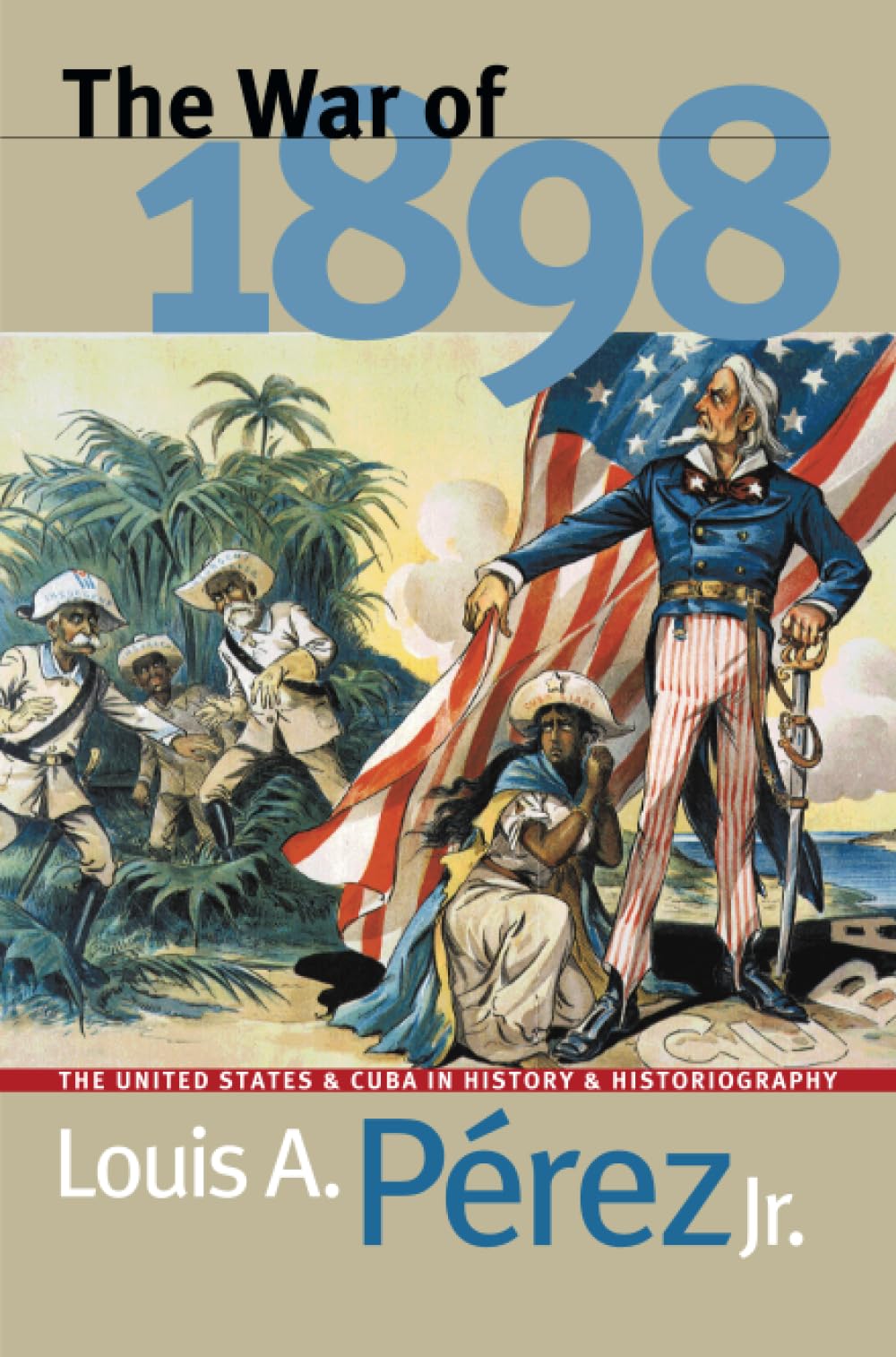
The War of 1898: The United States and Cuba in History and Historiography
$20.44
by Louis A. Jr. Perez



A century after the Cuban war for independence was fought, Louis Pérez examines the meaning of the war of 1898 as represented in one hundred years of American historical writing. Offering both a critique of the conventional historiography and an alternate history of the war informed by Cuban sources, Pérez explores the assumptions that have shaped our understanding of the "Spanish-American War" -- a construct, he argues, that denies the Cubans' participation in their own struggle for liberation from Spanish rule. Pérez examines historical accounts of the destruction of the battleship Maine , the representation of public opinion as a precipitant of war, and the treatment of the military campaign in Cuba. Equally important, he shows how historical narratives have helped sustain notions of America's national purpose and policy, many of which were first articulated in 1898. Cuba insinuated itself into one of the most important chapters of U.S. history, and what happened on the island in the final decade of the nineteenth century -- and the way in which what happened was subsequently represented -- has had far-reaching implications, many of which continue to resonate today. "[A] tightly-written examination of the import of the Spanish-Cuban-United States War of 1898. . . . We have indeed been well served both professionally and publicly by Pérez's critical reappraisal of 1898 and its significations."-- The Americas "[This] short, clearly argued volume is an analysis of the relationship between Cuba and the United States . . . in both 'history and historiography.' Drawing from his vast and detailed knowledge of both primary and secondary sources, Pérez narrates both the way the war progressed in Cuba and the way it has been interpreted in the United States."-- Historian "A provocative reinterpretation that will undoubtedly influence subsequent writing about the war."-- Latin American Research Review "Elegantly written and crammed with the ideas and insights of a master historian. It provides an extremely thorough and perceptive critique of the historical literature on the war that will be stimulating and required reading for anyone who writes on or teaches this particular topic. . . . An excellent study which will certainly accelerate the historiographical trend."-- Latin American Studies "Louis A. Pérez, Jr., who brings extensive research, thought, and writing to this task, renders a probing and provocative critique of the North American historiographical treatment of the conflict. . . . In this exhaustively researched, lucidly argued essay, Pérez contributes significantly to an understanding of both the history and the historiography of the War of 1898."-- Pacific Historical Review "One hundred years after the conflict, the publication of Pérez's work forms another significant contribution to Cuban history. It is comprehensive in its review of historical writing on the war and well balanced on the main aspects of the conflict. Scholars of both American and Caribbean history will no doubt find the text refreshing and stimulating."-- Journal of Caribbean History "Pérez has hit on the soft underbelly of U.S. policy in 1898, which U.S. historians have often tended to repress."-- New York Review of Books "Pérez sets the record straight."-- International History Review "Pérez's study is a refreshing and balanced addition to the literature. Focusing not only on 1898 but also on its place in history, he performs the admirable task of exploring and analyzing the events in their greater context. The book is lucid, well documented, and balanced. . . . This is a model study in a handsome edition that is unusually attractive in its graphic layout."-- CHOICE "The incomparable Louis A. Pérez, Jr. has written a stimulating perspective on U.S.-Cuban relationships based on nineteenth-century perspectives and historiographical literature. . . . This work is recommended for students of Cuban history and the general reader."-- Colonial Latin American Historical Review At the crossroads of U.S.-Cuba relations Focusing on the War of 1898, Louis Perez presents both a critique of the conventional historiography and an alternate history of the war that is informed by Cuban sources. Focusing on the War of 1898, Louis Perez presents both a critique of the conventional historiography and an alternate history of the war that is informed by Cuban sources. Louis A. Pérez Jr. is J. Carlyle Sitterson Professor of History at the University of North Carolina at Chapel Hill. His books include Cuba: Between Reform and Revolution .