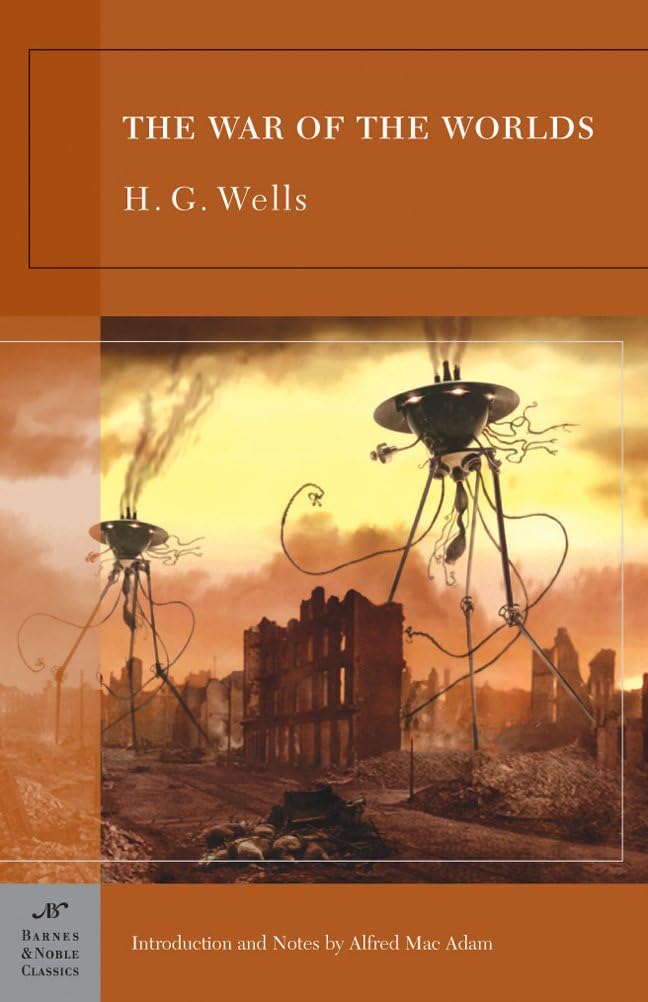



The War of the Worlds , by H. G. Wells , is part of the Barnes & Noble Classics series, which offers quality editions at affordable prices to the student and the general reader, including new scholarship, thoughtful design, and pages of carefully crafted extras. Here are some of the remarkable features of Barnes & Noble Classics : New introductions commissioned from today's top writers and scholars - Biographies of the authors - Chronologies of contemporary historical, biographical, and cultural events - Footnotes and endnotes - Selective discussions of imitations, parodies, poems, books, plays, paintings, operas, statuary, and films inspired by the work - Comments by other famous authors - Study questions to challenge the reader's viewpoints and expectations - Bibliographies for further reading - Indices & Glossaries, when appropriate All editions are beautifully designed and are printed to superior specifications; some include illustrations of historical interest. Barnes & Noble Classics pulls together a constellation of influencesbiographical, historical, and literaryto enrich each reader's understanding of these enduring works. On October 30, 1938, Orson Welles terrified American radio listeners by describing a Martian invasion of Earth in a broadcast that became legendary. Forty years earlier, H. G. Wells had first penned the story: The War of the Worlds , a science-fiction classic that endures in our collective subconscious. Deeply concerned with the welfare of contemporary society, Wells wrote his novel of interplanetary conflict in anticipation of war in Europe, and in it he predicted the technological savagery of twentieth century warfare. Playing expertly on worldwide security fears, The War of the Worlds grips readers with its conviction that invasion can happen anytime, anywhereeven in our own backyard. Alfred Mac Adam teaches literature at Barnard College-Columbia University. He is a translator and art critic. He also wrote the notes and introduction to the Barnes & Noble Classics edition of Wells’s The Time Machine and The Invisible Man . Alfred Mac Adam teaches literature at Barnard College-Columbia University. He is a translator and art critic. He also wrote the notes and introduction to the Barnes & Noble Classics edition of Wellss The Time Machine and The Invisible Man . From Alfred Mac Adam's Introduction to War of the Worlds The Martians also reflect Wells himself. Just as the bicycle liberated Wells from the limitations of a weak body, the machines used by the Martians, who are weighed down because the pull of gravity is stronger on Earth than it is on Mars, enable them to move swiftly and attack without warning. The machine is an extension of a body, a kind of prosthetic device that supplies an ability the body lacks. The Martian sitting on top of a huge, three-legged fighting machine striding across Surrey toward London resembles nothing so much as Wells piloting his bicycle around the countryside. And the Martians, like Wells, tend to work alone. That is, while they are involved in a collective activitythe invasion and conquest of England, which is, by extension, the worldthey work alone in their fighting machines or their aluminum manufacturing devices. Except for their time in the space capsule, they are rarely together. Wells's first problem was to decide how to tell such a tale. He could use an external, omniscient narrator, but that would cut down on the immediacy of the action and make it seem much more like history. A single first-person narrator would be possible, but that person would have to travel long distances at almost superhuman speed in order to see everything involved in the Martian invasion. Wells opts for a device Robert Louis Stevenson (1850-1894) uses in Treasure Island (1883), having a first-person narrative become two first-person narratives by introducing a second character who tells us about what happened elsewhere. This is, admittedly, an awkward device because the two charactersbrothers in The War of the Worlds are not in communication with each other. Their separate stories become a single story because the primary narrator takes control of his brother's tale, treating him in the same way an omniscient narrator would treat a character. The primary narrator, then, is both witness and author, a modification of the narrator of The Time Machine , who transcribes the story of the Time Traveller. The personality of this narrator is a vexing matter, and it is here Wells departs from traditional novelistic practice. Wells clearly had many options in this situation: He could make his nondescript, suburban science writer into a hero by having him either subdue the Martians or lay the foundations for an organized defense. That solution does not suit Wells's hidden intention, which is to warn those people capable of understanding that their world is rotten and will fall at the first blow from an outside force. Wells does wh