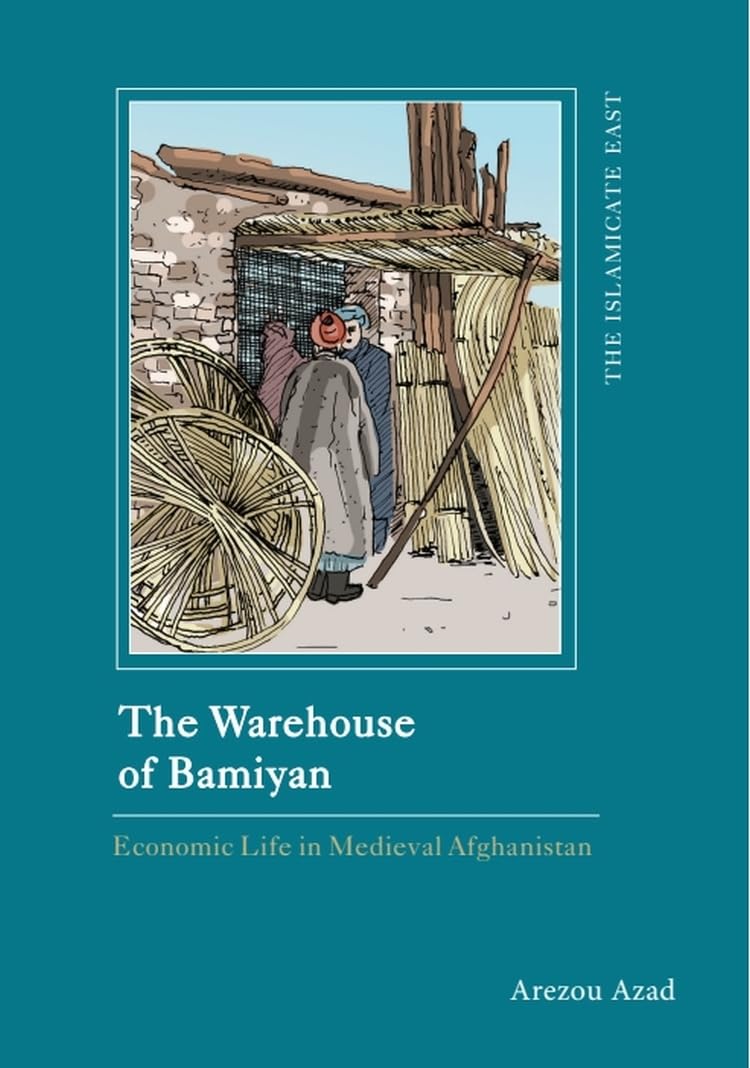
The Warehouse of Bamiyan: Economic Life in Medieval Afghanistan (The Islamicate East: New Approaches to Texts and History)
$121.05
by Arezou Azad



Bamiyan, in present-day Afghanistan, is famous for its giant Buddhas, but what was life like for its rural inhabitants 500 years after the Muslim conquest? The Warehouse of Bamiyan uncovers the untold history of the region’s warehouse, revealing the lives of farmers, landholders, the taxes they paid, and their role in the economy. Based on newly discovered documents studied since the late 2010s, Arezou Azad details the reconstruction of the archive and the scholarly methods used behind the scenes to read medieval documents ‘against the grain.’ The book offers a fresh perspective on the medieval eastern Islamicate lands through the lens of medieval Bamiyan, highlighting the significance of agricultural societies and shedding light on the diverse roles of rural communities often overlooked in royal narratives. A pioneering work. Never before has the social history of rural places in the Iran-Afghanistan region been written in such granular detail. Nor could it have been: new sources, documents from administrative practice, allow for a new level of precision. A first step into a fascinating new field of investigation. -- Jürgen Paul, University of Hamburg The remarkable discovery of the Bamiyan Papers sheds proper light on pre-Mongol Persianate society and the economy for the first time. This is a crucial book for all those interested in medieval Asian history. -- Chris Wickham, Chichele Professor of Medieval History emeritus The Warehouse of Bamiyan encourages us to rethink the history of the Persianate world from the ground up, highlighting a period when Khurasan was a melting pot of cultural exchanges shaping Islam (11th to 13th centuries). The authors demonstrate remarkable originality and skill through their transcription, translation, and analysis of newly discovered Persian documents from Afghanistan, making this an engaging and essential read. It is highly recommended for those interested in Persianate, Afghan, Islamic, or economic history. -- Mohamad Tavakoli-Targhi, Elahé Omidyar Mir-Djalali Institute of Iranian Studies The Warehouse of Bamiyan … opens an entirely new chapter in the economic, social and linguistic history of Khurasan in the heyday of the Mediaeval age. It is a first and … elaborate attempt at analyzing the Persian part of the "Bamiyan Papers". … The features of rural economy and local tax system, in a region remote from the great urban centres which had monopolized the attention of chroniclers and, consequently, of modern historiography, are elucidated with a degree of precision unequalled in any part of the Iranian world of that time. Far from enduring stereotypes, we discover a society where rural communities manage to build strategies to circumvent tax oppression, where women sometimes manage farms, and where ongoing religious diversity can be suspected, at least in the case of the Jews whose great impact in the pre-Islamic period is more and more documented by a variety of sources … For us archaeologists, this area of the central Hindukush had long been associated with the now lost Buddhas of Bamiyan and the fossilized landscape of mountain castles. It now returns to real life. -- Frantz Grenet, College de France, Paris Arezou Azad is Senior Research Fellow and Director of the Invisible East programme at the Department of Continuing Education at the University of Oxford. She is also Professor and Chair of the Arts and Heritage of Afghanistan at the Institut national des langues et civilisations orientales (Inalco) in Paris. She has authored four other peer-reviewed books: The Rise and Fall of the Barmakids (Edinburgh University Press, 2026), The Warehouse of Bamiyan: Economic Life in Medieval Afghanistan (Edinburgh University Press, 2025), Fa ḍ ā ʾ il-i Balkh or “The Merits of Balkh” , an annotated translation of a 13th-century history of Balkh (Edinburgh University Press, 2021) and Sacred Landscape in Medieval Afghanistan (Oxford University Press, 2013). Pejman Firoozbakhsh is a Research Associate at the University of Hamburg and a former member of the Invisible East programme at the University of Oxford. He is a linguist interested in the formation and development of early New Persian, West Iranian dialects, Persian codicology and textual criticism. Pejman Firoozbakhsh’s recent publications include “Manuscript of a Persian Qaṣīda from about the Year 400/1007”, in Bi yād-i Īraj Afshār , edited by Jawād Basharī (vol. 2. Tehran: Duktur Maḥmūd Afshār, 1402/2024, 661–72) (In Persian) and ‘The Story of Rustam and Suhrāb,’ by Abu al-Qāsim Firdawsī, edited by Jalal Khaleqi Motlaq (Tehran: Sokhan 2014; rev. 2020). He has also contributed to a book by Arezou Azad The Warehouse of Bamiyan: Economic Life in Medieval Afghanistan (Edinburgh University Press, 2025).