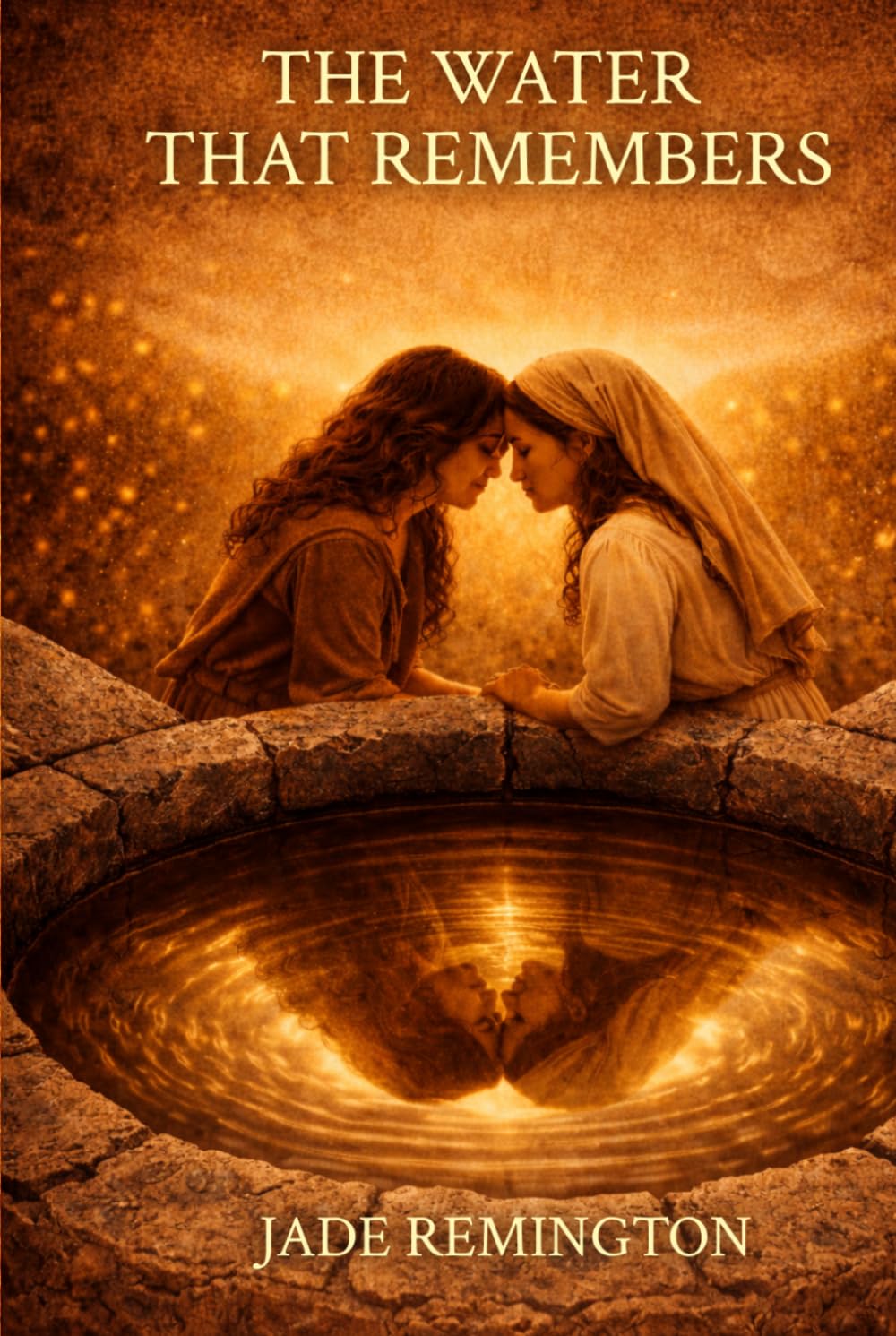
The Water that Remembers: The woman at the well (The First Rebellion)
$26.99
by Jade Remington



She went to the well at midday — when no other woman would be there. That was not recklessness. That was strategy. Leah has learned how to disappear. After five marriages and five funerals, after years of whispers that followed her through the village like a second shadow, she has perfected the art of taking up as little space as possible. She goes to Jacob's Well at the wrong hour so she won't have to feel the eyes of women who have decided what her life means. She has stopped arguing with their conclusions. She has stopped wanting much of anything. But she has not stopped thinking about Miriam. Water That Remembers is the story of the unnamed Samaritan woman at the center of John 4 — reimagined not as a cautionary tale, but as a survivor. A woman of intelligence, theological courage, and devastating grief. A woman whose real story Scripture hints at but never tells: the love she buried, the silence she learned, the numbness she chose because it was the only thing that kept her standing. Before the well, there was a life. This novel unfolds in deep, unhurried layers — tracing Leah backward through everything that brought her to that stone rim at that impossible hour. Her first marriage, built on hope and ended by illness. The grief that followed — raw, public, and immediately weaponized by a community that needed an explanation for death. The slow, careful way she rebuilt herself after the second loss. And then the third. And the fourth. And woven through all of it — the relationship the village could never categorize and therefore could not forgive. Her connection with Miriam is tender, dangerous, and deeply human: two women finding each other in the narrow margins of a world that had no place for what they were to each other. Their love does not announce itself. It builds in stolen moments, in hands that linger a beat too long, in a kind of knowing that exists beneath language. It is the truest thing in Leah's life — and the most impossible. Then a Jewish stranger asks her for water. Set against the dust and heat of first-century Samaria — a world shaped by Roman occupation, patriarchal law, ethnic tension between Samaritans and Jews, and the fragile arithmetic of women's survival — Water That Remembers is historical fiction rooted in scholarship and alive with emotional truth. It does not rush toward resolution or reach for easy hope. It allows grief to move at grief's pace. It allows love to surface the way it does after profound loss: cautiously, improbably, at great cost. The encounter at Jacob's Well does not fix Leah. It does not save her in any simple sense. What it does is crack open something she had sealed shut — the possibility that her story is not yet over. That the woman who has survived everything might, against all probability, deserve more than survival. This is Book One of a trilogy. The questions this novel raises are not resolved on the final page. They deepen. They complicate. They lead into terrain that healing rarely reaches all at once. Readers who enter this story should bring patience, curiosity, and the willingness to sit with a woman whose life has never been simple — and whose love has never been safe. For readers of slow-burn LGBTQ historical romance, feminist retellings of Scripture, and literary fiction that takes women seriously — their minds, their grief, their desire, and their defiant, fragile hope. Part of the First Rebellion Universe — an ecosystem of historically grounded, progressive, and LGBTQ-affirming stories set in the ancient world. Genre: LGBTQ Romance Historical Fiction Women's Fiction Inspirational Fiction Series: The Water That Remembers Trilogy, Book 1 Publisher: Rebel Rev Press © 2025 Jade Remington & Rebel Rev Press