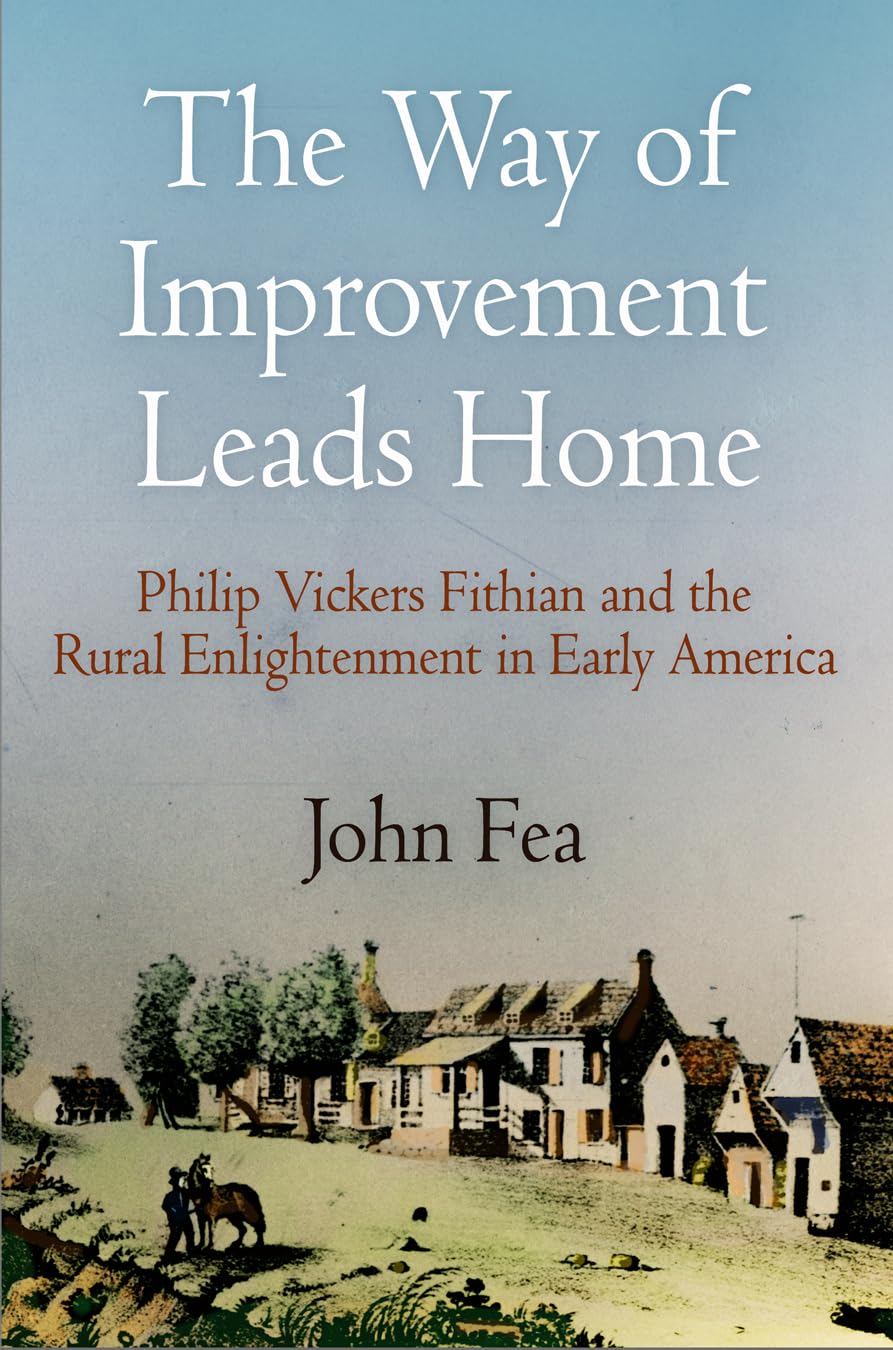



The Way of Improvement Leads Home traces the short but fascinating life of Philip Vickers Fithian, one of the most prolific diarists in early America. Born to Presbyterian grain-growers in rural New Jersey, he was never quite satisfied with the agricultural life he seemed destined to inherit. Fithian longed for something more—to improve himself in a revolutionary world that was making upward mobility possible. While Fithian is best known for the diary that he wrote in 1773-74 while working as a tutor at Nomini Hall, the Virginia plantation of Robert Carter, this first full biography moves beyond his experience in the Old Dominion to examine his inner life, his experience in the early American backcountry, his love affair with Elizabeth Beatty, and his role as a Revolutionary War chaplain. From the villages of New Jersey, Fithian was able to participate indirectly in the eighteenth-century republic of letters—a transatlantic intellectual community sustained through sociability, print, and the pursuit of mutual improvement. The republic of letters was above all else a rational republic, with little tolerance for those unable to rid themselves of parochial passions. Participation required a commitment to self-improvement that demanded a belief in the Enlightenment values of human potential and social progress. Although Fithian was deeply committed to these values, he constantly struggled to reconcile his quest for a cosmopolitan life with his love of home. As John Fea argues, it was the people, the religious culture, and the very landscape of his "native sod" that continued to hold Fithian's affections and enabled him to live a life worthy of a man of letters. "Many historians of Revolutionary America have plundered the diaries of Philip Vickers Fithian, but until now no one has satisfactorily told the life story of this great diarist. John Fea's insightful book does just that-and yet more. By showing how Fithian pursued the values of a cosmopolitan Enlightenment, in concert with the values of Presbyterian Christianity and American patriotism, his study reveals much about an enduring American tradition." ― Mark Noll, University of Notre Dame "John Fea has given readers . . . a gift in this delightful biography of diarist Philip Fithian. . . . Fea has captured a multifaceted world that teachers of American history should rush to share with their students." ― Dallett Hemphill, author of Bowing to Necessities: A History of Manners in America "In this absorbing and elegantly written biography, John Fea . . . shows how seismic philosophical upheavals profoundly shaped the life of an ordinary man far from the epicenter. Perhaps Fea's signal contribution is his nuanced reading of the relationship between the Enlightenment and Christianity." ― Books & Culture "A wonderfully teachable volume in undergraduate classrooms. However, it is also a book for specialists . . . for its simultaneously clear and complex explanation of the social an intellectual climate of middling participants in the American Revolution." ― Journal of the Early Republic John Fea is Associate Professor of History at Messiah College in Grantham, Pennsylvania. Introduction On the morning of Friday, July 16, 1773, Philip Vickers Fithian awoke early and traveled from his Greenwich, New Jersey, house across the Cohansey River to Fairfield. There he spent several days with William Hollingshead, who would soon be installed as minister of the Fairfield Presbyterian church. Together they dined, drank tea, and exchanged the "Usual Civilities" with other friends and relations. The two passed their time together conversing on topics including "the State of Affairs in Philadelphia," Philip's candidacy for Presbyterian ordination, Hollingshead's upcoming sermon "States of Man," and the "useful & well-chosen Books" in the minister's personal library. Philip and Hollingshead ate breakfast on Monday with Jonathan Elmer, their representative in the New Jersey Assembly. Later that day this gregarious duo traveled back to Greenwich, where Philip observed a "long Confabulation" between Hollingshead and Andrew Hunter, minister of the Greenwich Presbyterian church, on the subject of "whether there is Scripture Authority for Diocesan Bishops" (which was decided "in the negative"). Here they also encountered Richard Howell, one of Philip's former classmates at the local Presbyterian academy, who shared with them news of his legal studies in New Castle, Delaware. Philip lamented that although Howell was a "young Gentleman of considerable Genius, & has made good Proficiency in his Studies . . . he is remarkably profane in his Principles, & loose in his Behaviour!" After calling on several more friends, Philip returned home late Monday afternoon, "Drank Tea with several Neighbors," and "Went to bed about ten." By examining Philip's journal over this four-day period, one can learn much about what the young Presbyterian deemed important. His entries reveal the mu