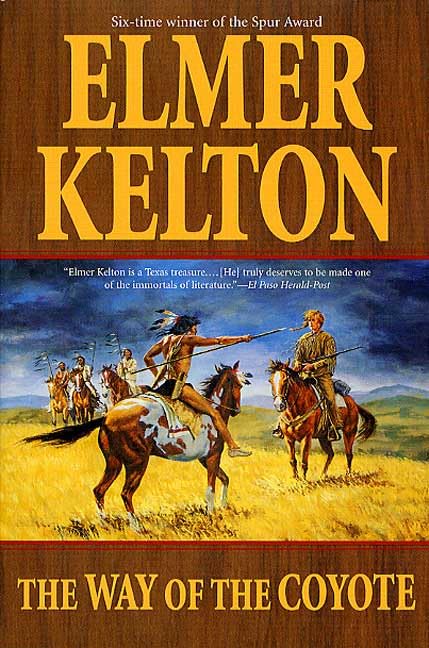



The Civil War has ended, and Union soldiers and federal officials have taken control of Texas as Rusty Shannon rides to his home on the Colorado River. As a child he was a captive of the Comanche, as a young man a proud member of a ranging company protecting settlers from Indian raids. Shannon's fate is intertwined with the young man accompanying him: Andy Pickard, himself but recently rescued from Comanche captivity and known by his captors as Badger Boy. Texas is in turmoil, overrun with murderous outlaws, lawmen exacting penalties from suspected former Confederates, nightriders, and the ever-dangerous Comanche bands. In this tempestuous time and place, Rusty tries desperately to resume his prewar life. His friend Shanty, a freed slave, is burned out of his home by the Ku Klux Klan; his own homestead is confiscated by his special nemesis, the murderous Oldham brothers; and the son of a girl he once loved is kidnapped by Comanches. Elmer Kelton, a master of novelist of the American West, literature, has crafted a satisfying and remarkably accurate tale of Texas life at the end of the Civil War. Elmer Kelton, most honored of all Western writers, writes of the formative years of the Texas Rangers with the knowledge of a native Texan and the skill of a master storyteller. In Rusty Shannon, tough and smart--necessary survival attributes on the 1860s Texas frontier--Kelton has created one of the most memorable characters in modern Western fiction. *Starred Review* Texas is reeling from the aftershocks of the Civil War. The state is run by a corrupt, usurious carpetbag government. Loyalties are suspect as veterans of both sides eye each other suspiciously, and the occasional Comanche war party wreaks havoc on the ranchers. Rusty Shannon, who was kidnapped by the Comanche as a child, rescues 10-year-old Andy Pinkard from the same fate. Andy's memories are all Comanche, and he struggles to adjust to the white life. Meanwhile, the young son of a woman Rusty once loved is kidnapped by the Comanche, and two rivals from Rusty's Texas Ranger days arrive as representatives from the corrupt state government and twist the law to confiscate Rusty's ranch. Kelton, who's been producing award-winning novels for 40 years, continues his tradition of compassionate, character-driven, historically correct fiction. In this probing examination of conflicted loyalties, the heroes are those who recognize the conflicts and struggle to minimize them, and the villains are those who exacerbate tensions in an effort to benefit personally. No one does it better than Kelton; his latest is a must for any western collection. Wes Lukowsky Copyright © American Library Association. All rights reserved “Elmer Kelton is a Texas treasure. . . . [He] truly deserves to be made one of the immortals of literature.”-- El Paso Herald-Post “Elmer Kelton’s Westerns are not filled with larger-than-life gunfighters who can shoot spurs off a cowboy’s boots at a hundred yards. They are filled with the kind of characters that no doubt made up the West. . . . They are ordinary people with ordinary problems, but Kelton makes us care about them.” — The Oklahoman Elmer Kelton, author of more than forty novels, grew up on a ranch near Crane, Texas, and earned a journalism degree from the University of Texas. His first novel, Hot Iron , was published in 1956. For forty-two years he had a parallel career in agricultural journalism. Among his awards have been seven Spurs from Western Writers of America and four Western Heritage awards from the National Cowboy Hall of Fame. Among his best-known works have been The Time It Never Rained and The Good Old Boys , the latter made into a television film starring Tommy Lee Jones. He served in the infantry in World War II. He and his wife, Ann, a native of Austria, live in San Angelo, Texas. They have three children, four grandchildren and five great-grandchildren. 1 An old arrow wound in Rusty Shannon’s leg had been aching all day, but the sudden appearance of Indians made the pain fall away. “Them damned Comanches,” he declared to the boy. “They don’t ever give up.” Sitting on his black horse, Alamo, he squinted anxiously over the edge of a dry ravine toward half a dozen horsemen three hundred yards away. They milled about, studying the tracks marking the way Rusty and young Andy Pickard had come. An afternoon sun glared upon the summer-curing grass. Open prairie stretched to the uneven horizon like a wind-rippled sea. To run would be futile, for both horses had come a long way and were as tired as their riders. This ravine was the only place to hide, though it seemed more likely to be a trap than a refuge. “They’re comin’ on,” he said. He drew the rifle from its scabbard beneath his leg. Dread was in the boy’s eyes. “It is for me they come, not you. I go to them.” “Hell no! I didn’t bring you this far…” He did not finish, for the boy drummed moccasined heels against his horse’s ribs and put it up out of t