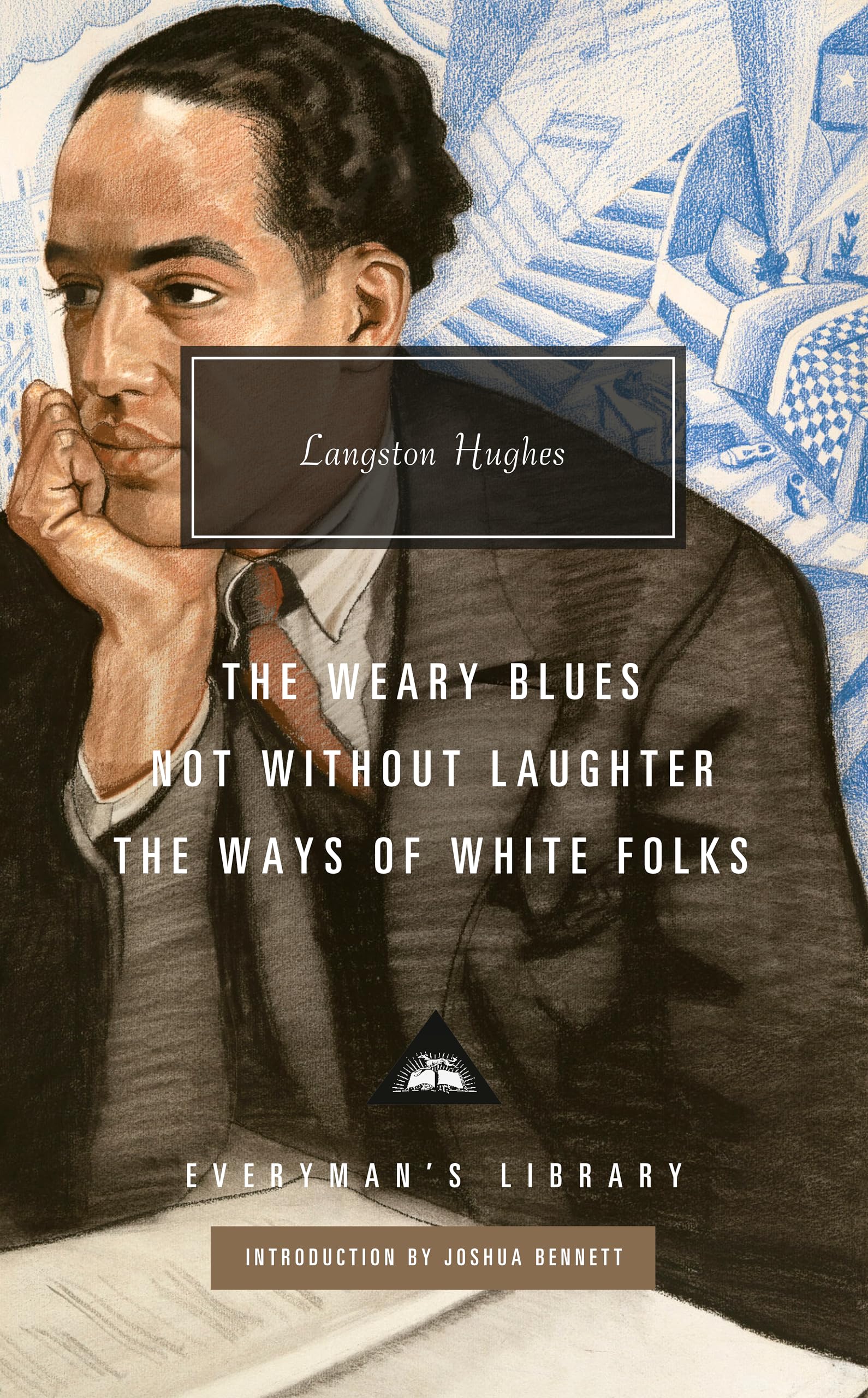
The Weary Blues; Not Without Laughter; The Ways of White Folks (Everyman's Library Contemporary Classics Series)
$26.30
by Langston Hughes



A major hardcover compendium of poetry and fiction by the legendary Black American poet of the Harlem Renaissance One of the most important writers to emerge from the Harlem Renaissance, Langston Hughes may be best known as a poet, but he was also a brilliant storyteller, blending elements of blues and jazz, speech and song, into a triumphant and wholly original idiom. Perhaps more than any other writer, Langston Hughes made the white America of the 1920s and 1930s aware of the Black culture thriving in its midst. Hughes's poetry and fiction works are messages from that America, sharply etched vignettes of its daily life, cruelly accurate portrayals of Black and white collisions. This Everyman's Library compendium comprises Hughes's debut poetry collection, The Weary Blues , which catapulted him into literary stardom at just twenty-four years old; his award-winning debut novel, Not Without Laughter , published in 1930 to critical raves; and his 1933 collection of short stories The Ways of White Folks , currently only available in Vintage Classics trade paperback. Everyman's Library pursues the highest production standards, printing on acid-free paper, with full-cloth cases with two-color foil stamping, decorative endpapers, silk ribbon markers, European-style half-round spines, and a full-color illustrated jacket. “Langston Hughes is a titanic figure in 20th-century American literature . . . A powerful interpreter of the American experience.” — The Philadelphia Inquirer “[Hughes] is sumptuous and sharp, playful and sparse, grounded in an earthy music.” — The Boston Globe “[Hughes’s] poetry has a pulse, a beauty and familiar kindness. . . . Much of it delights, even dazzles. His best work sticks with you—forever.” — Cleveland Plain Dealer Langston Hughes (1902-1967), one of the great poets of the Harlem Renaissance, was born in Joplin, Missouri, and spent much of his childhood in Kansas before moving to Harlem. He wrote poetry, short stories, novels, an autobiography, songs, essays, and plays. Among his numerous awards and honors were a Guggenheim Fellowship in 1935, a Rosenwald Fellowship in 1940, and an American Academy of Arts and Letters Grant in 1947. About the Introducer: Dr. Joshua Bennett is a poet and scholar who has won numerous awards for his work on the classics of Black American literature. As both a teacher and student of Langston Hughes's work, as well as the work of his contemporaries, we're thrilled to have him on board to write this introduction. Dr. Bennett is the author of The Sobbing School (Penguin, 2016)—which was a National Poetry Series selection and a finalist for an NAACP Image Award. He is also the author of Being Property Once Myself (Harvard University Press, 2020), Owed (Penguin, 2020), The Study of Human Life (Penguin, 2022) and Spoken Word: A Cultural History (Knopf, 2023). He has received fellowships and awards from the Guggenheim Foundation, the Whiting Foundation, the National Endowment for the Arts, and the Society of Fellows at Harvard University. He is a Professor of Literature and Distinguished Chair of the Humanities at MIT. 1 STORM Aunt Hager Williams stood in her doorway and looked out at the sun. The western sky was a sulphurous yellow and the sun a red ball dropping slowly behind the trees and house-tops. Its setting left the rest of the heavens grey with clouds. “Huh! A storm’s comin’,” said Aunt Hager aloud. A pullet ran across the back yard and into a square-cut hole in an unpainted piano-box which served as the roosting-house. An old hen clucked her brood together and, with the tiny chicks, went into a small box beside the large one. The air was very still. Not a leaf stirred on the green apple-tree. Not a single closed flower of the morning-glories trembled on the back fence. The air was very still and yellow. Something sultry and oppressive made a small boy in the doorway stand closer to his grandmother, clutching her apron with his brown hands. “Sho is a storm comin’,” said Aunt Hager. “I hope mama gets home ’fore it rains,” remarked the brown child holding to the old woman’s apron. “Hope she gets home.” “I does, too,” said Aunt Hager. “But I’s skeared she won’t.” Just then great drops of water began to fall heavily into the back yard, pounding up little clouds of dust where each drop struck the earth. For a few moments they pattered violently on the roof like a series of hammer-strokes; then suddenly they ceased. “Come in, chile,” said Aunt Hager. She closed the door as the green apple-tree began to sway in the wind and a small hard apple fell, rolling rapidly down the top of the piano-box that sheltered the chickens. Inside the kitchen it was almost dark. While Aunt Hager lighted an oil-lamp, the child climbed to a chair and peered through the square window into the yard. The leaves and flowers of the morning-glory vines on the back fence were bending with the rising wind. And across the alley at the big house, Mrs. K