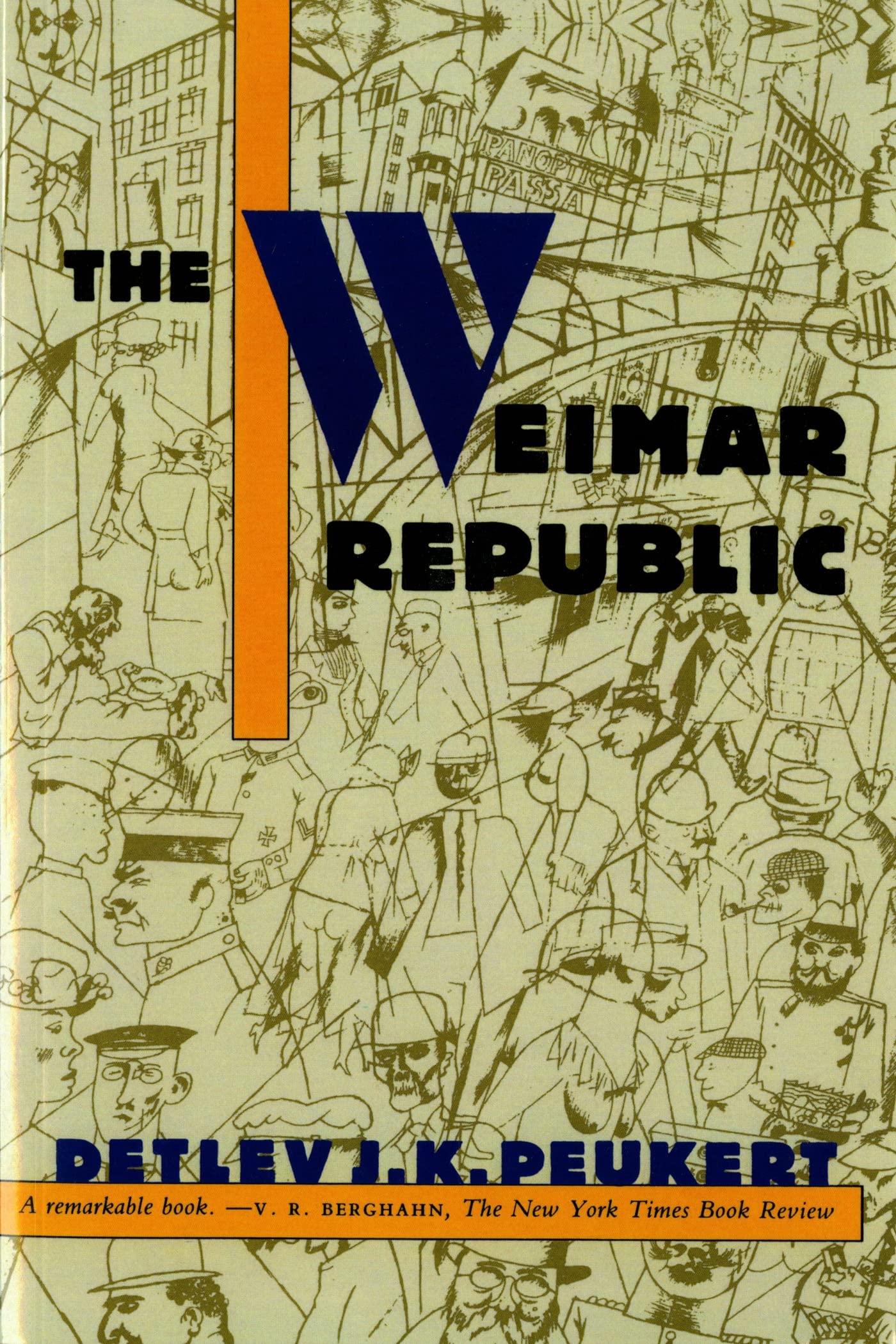



The nature of Weimar's terminal crisis - how a politically liberal and culturally progressive society could succomb to fascism - remains one of the central historical questions of our century. In this major work, Detlev J.K. Peukert offers a stimulating interpretation that not only places Weimar in the history of twentieth-century Germany but also reveals it as an archetype of the ambivalences and pathologies of advanced industrial society. “Taking the reaction to modernity as his central theme, Detlev Peukert has written a book on Weimar so densely packed with insights as to feel almost monumental in scope. Written formidable Teutonic density and weight, it is a study of trends, not people and events. Specialists will find it a richly rewarding tour d'horizon . . . Peukert has not only an encyclopedic knowledge of the period, but a mind bristling with fresh and unexpected observations.” ― Ron Chernow, Los Angeles Times Book Review “The late Detlev Peukert was one of the most innovative historians of twentieth-century Germany. I know of no other single work that so concisely presents the Weimar Republic in all its jagged openhandedness and contradictory aspirations.” ― Charles S. Maier, Harvard University “A most informative and provocative study, The Weimar Republic is simultaneously a much needed English overview of this pivotal period of German history, an introduction to the most exciting new historical work on it, and an original challenge to traditional interpretations.” ― Mary Nolan, New York University “This rich, imaginative, and challenging account of the Weimar Republic reminds us if how much German history will miss Detlev Peukert's analytic skills and intellectual energy. The Weimar Republic places the crisis of German democracy in the context of a larger European crisis and thus forces us to rethink the historical meaning of the republic's failure.” ― James J. Sheehan, Stanford University Detlev J. K. Peukert is the author of Inside Nazi Germany: Conformity, Opposition, and Racism in Everyday Life , a highly accaimed study of daily life in the Third Reich. Former professor of modern history at the University of Essen and director of the Research Institute for the History of the Nazi Period, he died in 1990 at the age of thirty-nine. The Weimar Republic By Detlev J. K. Peukert Hill and Wang Copyright © 1993 Detlev J. K. Peukert All right reserved. ISBN: 9780809015566 The Weimar Republic I. INTRODUCTION An age is always a farrago of different ages. Whole parts of it are unleavened and undercooked; it contains the husks of old forces, and the seeds of new ones.Alfred Döblin, 1924 1. THE WEIMAR REPUBLIC AND THE CONTINUITY OF GERMAN HISTORY To define a phenomenon is to specify its boundaries. But it is an indication of the problems that the Weimar Republic poses for historians that even its temporal boundaries are open to dispute. The demarcation of a period of history necessarily rests on a particular conception of the period, explicitly underpinned to a greater or lesser extent by theoretical analysis. What different dates, then, can be proposed for the beginning and end of the Weimar Republic, and what analytical conceptions of the period are implicit in these different datings? POLITICAL TURNING-POINTS Some accounts of Weimar actually begin with the Imperial monarchy:1 to be precise, with the October reforms of 1918, which, as military defeat loomed, introduced parliamentary democracy into the constitution of the Reich and brought to power the governing coalition of Social Democrats, Catholic Centre and liberals that was later to usher in the Weimar constitution of 1919. In such an account, the continuity represented by the socialist-liberal-Catholic settlement takes centre stage, and the November revolution appears as a false trail.On the other hand, to take the revolutionary proclamation of the Republic in Berlin on 9 November 1918 as a starting-point2 is to emphasize the break with the imperial monarchy and to highlight the role of the mass revolutionary movement. This approach was adopted early on by the political right, with the Dolchstoßlegende (the legend ofthe 'stab in the back') and the Nazis' vilification of the 'November criminals'. The left, on the other hand, has been faced with the dilemma whether or not to define the period by reference to a revolution which the Weimar Republic itself was responsible for terminating.3Similarly, for those who view the creation of the Weimar Republic as the result of a verdict in favour of bourgeois parliamentary democracy and against Bolshevik dictatorship,4 the crucial event of the new era is the election of the National Constituent Assembly on 19 January 1919 (or perhaps even the promulgation of the Weimar constitution of the Reich on 14 August 1919).Historians who deny that this was the only choice and whose interest is in the untapped potential for democratization that was present during the early