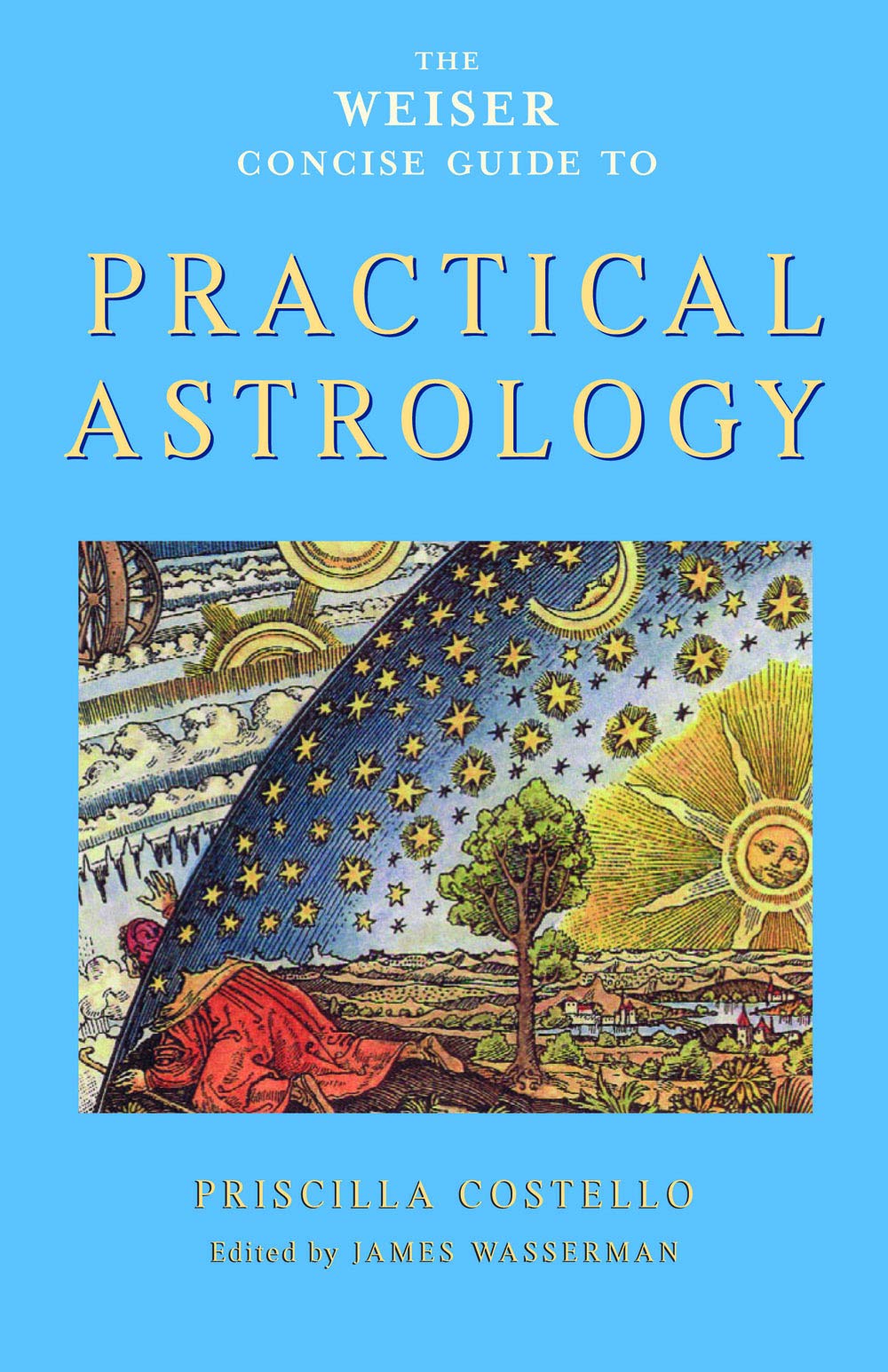
The Weiser Concise Guide to Practical Astrology (Weiser Concise Guides)
$16.95
by Priscilla Costello



In The Weiser Concise Guide to Practical Astrology , Priscilla Costello introduces the reader to the basic principles of modern astrology and unveils the secrets of this elegantly developed language of symbols. Costello shares with the reader both the philosophical and esoteric world view of astrology, while exploring the meanings of signs, planets, houses, and aspects on many levels, as well as its connection to psychology, religion and spirituality, and related esoteric studies. The Weiser Concise Guide to Practical Astrology serves as both a primer for the new student of astrology and a handy reference for the more seasoned practitioner. As complete as it is concise, this course of study delves deeply into the history and true spirit of astrology, making it accessible to all. Priscilla Costello is a teacher, writer, and counseling astrologer based in Toronto. She frequently travels to the U.S. to see clients and lecture. She has been instrumental in the organization of Canadian astrology and currently serves on the Advisory Board of NCGR. Her Master's thesis on Gnosticism and Jungian psychology (1993) won the Master's Scholar Award from the NE Association of Graduate Schools. She is founder and Director of the New Alexandria, a center for spiritual and esoteric studies. James Wasserman is a lifelong student of esotericism. His writings include The Mystery Traditions: Secret Symbols and Sacred Art , and Aleister Crowley and the Practice of the Magical Diary . His Chronicle Books edition of The Egyptian Book of the Dead: The Book of Going Forth by Day features the fullcolor Papyrus of Ani with integrated English translation. The Templars and the Assassins: The Militia of Heaven has thus far been published in six languages. His controversial The Slaves Shall Serve: Meditations on Liberty defines political freedom as a spiritual value. His newest book is An Illustrated History of the Knights Templar . He is currently editing a series on Western occultism known as The Weiser Concise Guides. You can find him online at www.studio31.com. He lives in New York City with his wife Nancy. The Weiser Concise Guide to PRACTICAL ASTROLOGY By Priscilla Costello Red Wheel/Weiser, LLC Copyright © 2008 Priscilla Costello All rights reserved. ISBN: 978-1-57863-423-1 Contents AcknowledgmentsIntroduction by James WassermanA Brief OverviewPart One: The Theory of Astrology1) The Planets: The First Piece2) The Signs: The Second Piece3) The Houses: The Third Piece4) Aspects: The Fourth PiecePart Two: The Practical Application5) Understanding a Chart6) Example: Oprah Winfrey's ChartConclusionBibliographyIllustrationsTables CHAPTER 1 The Planets: The First Piece Astrology consists of groups of symbols, all having numerological andphilosophical, as well as psychological and literal, meanings. The sevenclassical planets, plus the three more recently discovered Uranus, Neptune, andPluto, are the main letters of the astrological alphabet. (The word "planets" isused throughout to apply to the Sun and Moon, though technically the Sun is aminor star and the Moon a satellite of Earth. To indicate that the Sun and Moonare considered as astrological archetypes, they are capitalized.) Planets arethe factors that transmit energy in steps from the Godhead into the createdworld. Each is named for a Roman god or goddess whose character and history islargely borrowed from the Greek mythological tradition. In psychological terms, the planets are carriers of psychic energy, responsiblefor the uniqueness and dynamism of each individual. They are motivators,impelling you to seek experiences and passively attracting them. Inpsychological language, they are equivalent to "needs" or "drives." The number seven may be considered sacred precisely because there wereoriginally believed to be seven planets (including Sun and Moon). The seven-dayweek was created with each day corresponding to one of them. A host of otherassociations also arose—metals, colors, rocks and precious gems, perfumes andincense, herbs, trees and plants, animals, emblems, and deities of variouscultures. Whatever idea was associated with a planet was thought to have anaffinity with its nature, on its own particular level. Astrological correlationsderive in part from specific observations of physical reality. Because physicalreality reflects inner essence, shape, appearance, taste, and behavior, allreveal planetary connections. Birthstones linked to the months of the year are asimplified example of astrological correspondence. Given the archetypal nature of astrological symbols, the traditional way tolearn about them is to memorize and ponder lists of key words. But you cannotgrasp their significance with the intellect alone. You must circles the symbols,musing on a cluster of associated concepts to penetrate their essence. This isthe method I use in the sections that follow: a circumambulation of each symbolthat explores the concepts a