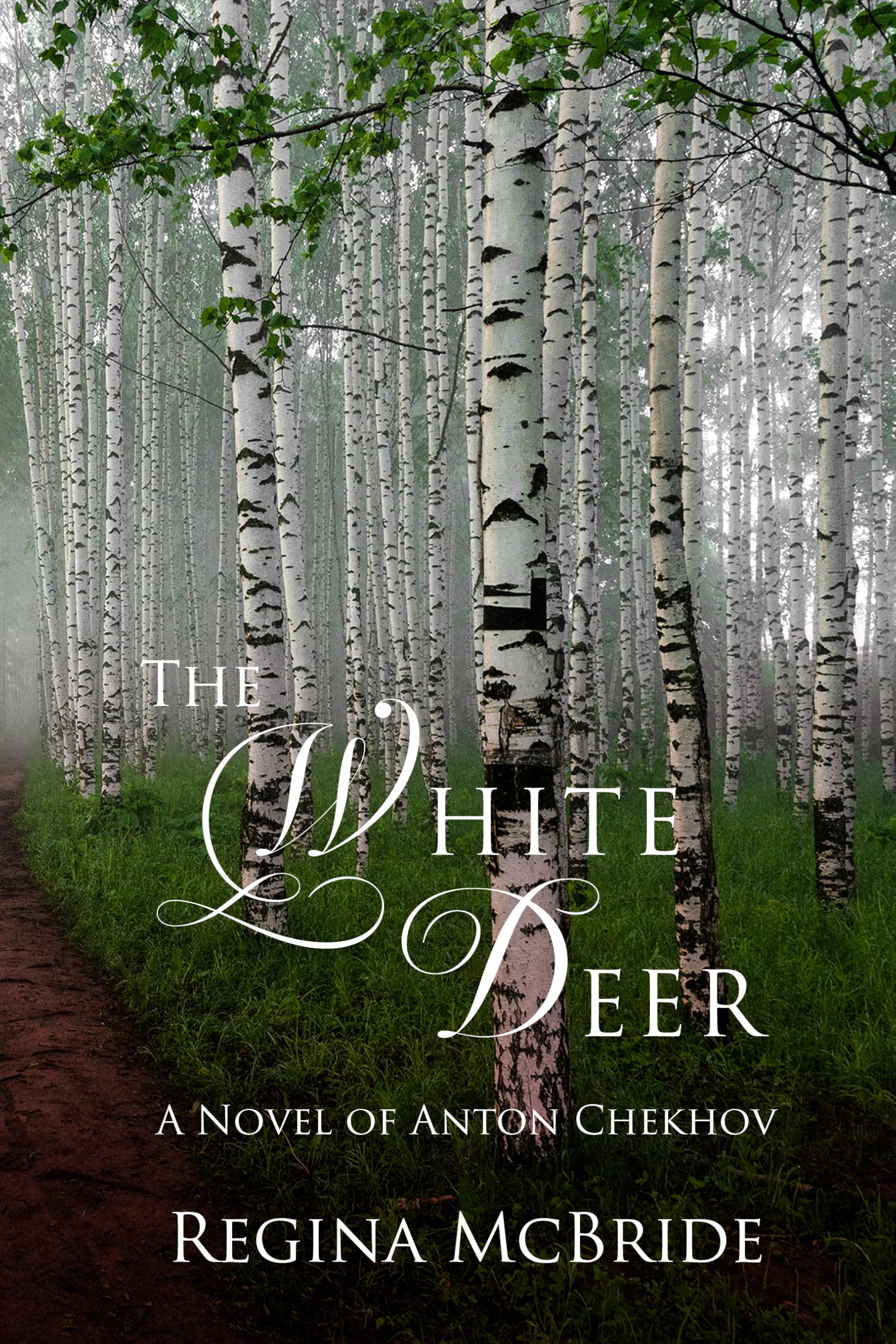



In the summer of 1879, on his way to Moscow to study medicine, 19-year-old Anton Chekhov, from a bankrupt merchant class family, stops to spend a restful few weeks in the Ukrainian countryside, staying with his friend, Dr. Mitrofan, who is worried about Anton’s lingering bronchitis. It is here that Anton meets Vera Denisova, also 19, a budding actress, the daughter of theater aristocrats from Volkhov, a neighboring estate. The two spend much of their time wandering Volkhov’s vast property, hoping for a glimpse of a white deer that has been spotted in the back acreage. As they grow closer, Vera confides in Anton about her secret romance and heartbreak over Petya, a servant her age who was gifted at drawing and who she helped to acquire an apprenticeship as a draughtsman in order to leave servitude for good. Anton is fascinated by her obsession, and a triangle forms between Vera, Anton, and the absent Petya. Anton, too, shares his secrets with her, his conflicted relationship with his indigent family and his frustrated wish to publish stories. Surreptitiously through Anton, Vera learns the truth about her family’s declining financial situation and the impending loss of her beloved childhood estate. Together in the long, extended light of summer days, Vera and Anton struggle to come to terms with their feelings for each other and the new profoundly changed world that is waiting for each of them at summer’s end. The final section of the novel charts the correspondence between Vera and Anton over the next two decades. Vera has become a successful actress and Anton, a doctor who treats peasants for free, has more than realized his ambition as a writer. In a final letter to Vera before his death at 44 of tuberculosis, Anton reveals that his play, The Cherry Orchard, was inspired by his time with her at Volkhov. Regina McBride’s new book evokes a loving nostalgia for a place we’ve never known—Chekhov’s Russia. Set in the summer of young Anton’s twentieth year, the novel centers on a young woman whose family is losing financial control of their estate—an estate famous for its orchards. Anton is the guest of a neighboring doctor, and the two young people become entwined in a romantic friendship—une amitiée amoureuse. McBride’s story comes at Chekhov’s from the side, presenting us not only with the family’s eccentric and complicated history, but the vision of the author himself, as a character in the work. A beautiful and eloquent rendering of a place and time we somehow feel is ours. —Roxana Robinson, author of Leaving , NYT Editors’ Choice McBride has always been a gifted and lyrical storyteller, but never more so than in this gorgeously written novel of 19th century Ukraine and Russia, in which she brings a young Anton Chekhov to life. The story will remain with you long after you’ve turned the final page. Superb. —Gabriel Byrne, author of Walking with Ghosts This gentle but profound novel takes you on a quietly magical journey through nineteenth century Ukraine, mixing the Chekhovian sensibility with contemporary spirit to create the effect of delightful immersion. —Lara Vapnyar, author of Divide Me by Zero This restrained and beautiful book utterly transported me to summer in Russia in the late 19th century: to a lovely old estate with a neglected peach orchard. McBride beautifully suggests how shards of the daily material of life can be picked up by an extraordinary writer and transformed into art. I never wanted to leave the enchanted, doomed world she conjured. —Rachel Pastan, author of We’re So Lucky to Live Here This transportive novel sweeps the reader up into a vivid, melancholic dream set on a nineteenth century Russian estate. Regina McBride creates her own Chekhovian tragi-comedy that delights as it captures a lost world frozen in time. The White Deer is a gripping must-read for anyone who loves literature and a love story gone awry. —Virginia Pye, author of Marriage and Other Monuments The White Deer is Regina McBride’s sixth novel. She is also the author of a book of poetry and, most recently, a memoir, Ghost Songs . Her novel, The Nature of Water and Air , was a Booksense pick (Independent Book Stores selection), a Barnes and Noble Discover Great New Writers book, and a Borders Original Voices choice. It was optioned for a film. A recipient of fellowships from the National Endowment for the Arts and the New York Foundation for the Arts, she lives in New York City where she teaches creative writing and fiction writing at Hunter College.