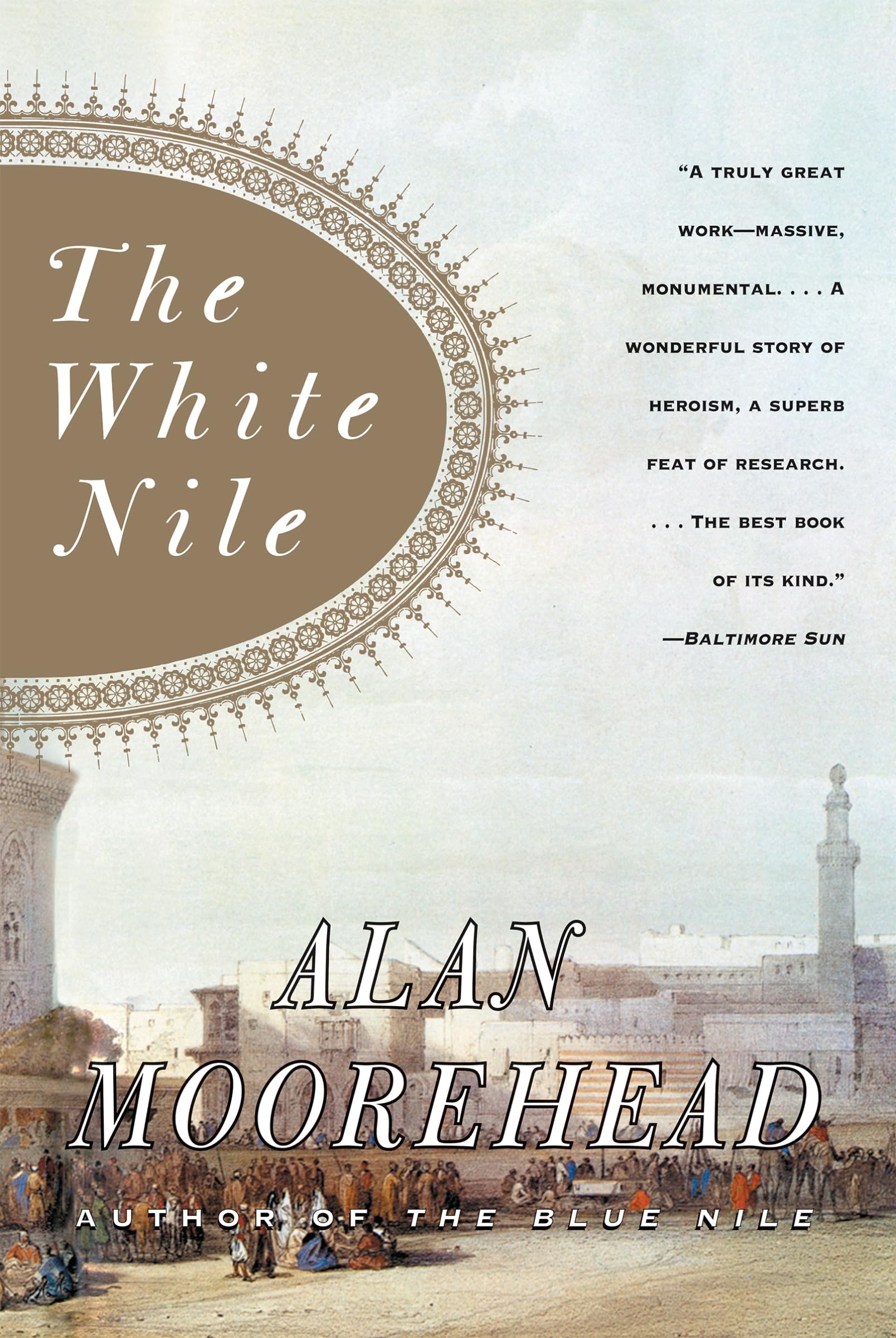
The White Nile: The Classic Bestseller―A Dramatic History of 19th Century Nile Exploration and African Discovery
$11.58
by Alan Moorehead



"A truly great work—massive, monumental. . . . A wonderful story of heroism, a superb feat of research. . . . The best book of its kind." — Baltimore Sun Relive all the thrills and adventure of Alan Moorehead's classic bestseller The White Nile —the daring exploration of the Nile River in the second half of the nineteenth century, which was at that time the most mysterious and impenetrable region on earth. Capturing in breathtaking prose the larger-than-life personalities of such notable figures as Stanley, Livingstone, Burton and many others, The White Nile remains a seminal work in tales of discovery and escapade, filled with incredible historical detail and compelling stories of heroism and drama. "A noble book about the mightiest river on earth." - Saturday Review "A vivid chronicle, stirring, exciting, important. . . endlessly fascinating. A superb drama of adventurers whose like can never again be seen." - New York Herald Tribune "Extraordinary, compelling." - New York Times Relive all the thrills and adventure of Alan Moorehead's classic bestseller The White Nile -- the daring exploration of the Nile River in the second half of the nineteenth century, which was at that time the most mysterious and impenetrable region on earth. Capturing in breathtaking prose the larger-than-life personalities of such notable figures as Stanley, Livingstone, Burton and many others, The White Nile remains a seminal work in tales of discovery and escapade, filled with incredible historical detail and compelling stories of heroism and drama. Alan Moorehead (1910-1983) was a foreign correspondent for the London Daily Express, where he won an international reputation for his coverage of World War II campaigns, and also served as the chief public relations officer in the Ministry of Defense. He is also the author of many other notable books, including Gallipoli and Darwin and the Beagle. The White Nile By Moorehead, Alan Perennial Copyright © 2004 Alan Moorehead All right reserved. ISBN: 0060956399 Chapter One Zanzibar 1856 The Zanzibar that Burton and Speke first saw at the end of 1856 was a much more important place than it is today; indeed, it was almost the only centre of overseas commerce worth the name along the whole East African seaboard. The attempts of the Portuguese to found an empire on the mainland opposite the island had long since come to nothing, and all the country inland, the territories we now know as Tanganyika, Kenya, Uganda, South Sudan and the Congo, was very largely an unmapped, unknown void. In a vague and general way the Sultans of Zanzibar laid claim to a part at least of this vast area, but in point of fact their power was restricted to the coastline and was not really effective even there. During the dry seasons slave and ivory caravans found their way into the wilderness that lay beyond and were gone for a year or more, perhaps for ever, but that was all one ever heard of Central Africa. It was almost as remote and strange as outer space is today. The island of Zanzibar, however, was something of a name in the world, a regular port of call for the sailing vessels plying the Indian Ocean; and it was in one of these, a British sloop, that Burton and Speke came in on the northeast monsoon from Bombay on December, 1856. Their first view of the island cannot have been so very different from the scene one sees at the present time. Then, as now, a whiff of cloves and tropical spices came out to greet the traveller from the shore, and on the shore itself a slow, oily sea of marvellous blue washed up on to white coral beaches. The jungle that began at the water's edge was green with a hectic greenness, and although occasional rainstorms and even tornadoes swept the island it was oppressed throughout the year by a deep soporific heat. Seen from the sea Zanzibar port was an uneven silhouette of earthen hovels and large four-square buildings made of greyish coral, the only building stone on the island. One described very easily the palace of the Sultan, the houses of the consuls and the merchants, and then the minarets rising from the mosques in the town beyond. It was to one of these houses, close to the foreshore, that of Lieutenant-Colonel Atkins Hamerton, the British Agent, that Burton and Speke proposed to make their way. The anchorage before the town was much congested. Burton counted upwards of sixty Arab dhows which, like his own sloop, had been blown across the Indian Ocean by the monsoon, and they were similar to those one sees in Zanzibar now, solid wooden hulls of anything between 50 and 500 tons with a single mast, a great lateen sail and a bowsprit that projected so far it almost doubled the vessel's length. In addition there were half a dozen square-rigged merchantmen in port, Americans from Salem, Frenchmen and Hamburgers that had sailed round the Cape from Europe. AH these had come to pick up cargoes of copal, coconuts, ivory, hides, tortoise-she