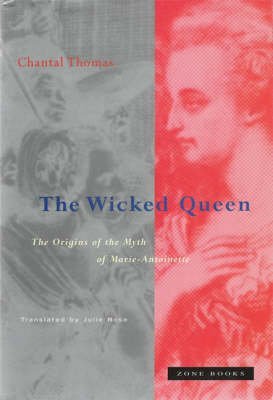



The Wicked Queen is not a biography of one of the most infamous queens in history. Rather, Chantal Thomas presents the history of the verbal and visual representations of Marie-Antoinette, the history of her mythification. Almost as soon as Marie-Antoinette, archduchess of Austria, was brought to France in 1771 as the bride of Louis XVI, she was smothered in images. In a monarchy increasingly under assault, the charm and horror of her feminine body and her destructive political power as a foreign intruder turned Marie-Antoinette into an alien other ― the bestial “arch-tigress of Austria.” Working as a historian and writing like a novelist, Thomas reveals how Marie-Antoinette came to symbolize the marginalization and negation of women in French society before the French Revolution. In a series of pamphlets written between the 1770s and her death in 1793, Marie-Antoinette was portrayed as a frivolous and extravagant spendthrift and lesbian, an incestuous and bloodthirsty libertine, a poisoner and infant murderess. “Through her wickedness,” writes Thomas, “she caused the Revolution.” In her analyses of these anonymous pamphlets, seven of which are included here in translation for the first time, Thomas reconstructs how the pamphleteers’ mounting hallucinatory and libelous discourse culminated in the inevitable and physical destruction of what had become the counterrevolutionary symbol par excellence. The Wicked Queen exposes the complex and complicated history and power of an image, the elaborate process by which the myth of Marie-Antoinette emerged as a crucial element in the successful staging of the French Revolution. Ignore the subtitle at your peril! This is strictly a study of the portrayal of Marie-Antoinette in contemporary propaganda pamphlets, particularly those emphasizing her supposed sexual proclivities. This unique approach produces some thought-provoking points. Whether the subject warrants a book-length study is, however, questionable. Thomas, the author of two studies of libertinage published in France, argues that these pamphlets do not reflect the reality of the queen's conduct. This is self-evident in our sophisticated age and was probably fairly apparent even in the 18th century. The book is filled out with digressions, a useful chronology of Marie-Antoinette's life, an annotated cast of characters, and reprints of seven of the pamphlets. The tone is uneven, mixing obscure sociological jargon with the crudest street language. Recommended only for the largest academic or research libraries collecting in French history or propaganda.AJean E.S. Storrs, Enoch Pratt Free Lib., Baltimore Copyright 1999 Reed Business Information, Inc. Revolutionary agitation is always most effective when outrage can be concentrated on an individual or one class of people. Our Declaration of Independence demonized George III, though the colonists' real dispute was with a faction of Parliament. As a foreigner with a knack for putting her foot in her mouth, French queen Marie-Antoinette was an inviting target for agitators. Thomas, who has specialized in examining the mass culture of eighteenth-century France, does not attempt to find the "real" Marie-Antoinette. Rather, her target is the queen's detractors, who carried on a campaign of vilification and distortion, primarily via pamphlets, which contributed substantially to the undermining of the monarchy. The campaign began soon after Marie-Antoinette's arrival in France and continued with increasing intensity until her execution. She was variously accused of nymphomania, lesbianism, incest, and insensitive frivolity. This is an unusual and interesting examination of a primitive but quite effective effort at mass political indoctrination. Jay Freeman " The Wicked Queen …makes the excellent and essential point that no attempt should be made, as was sometimes done in the past, to link these [pornographic pamphlets] with their real-life subject, either as ‘outrageous slander’ or as her ‘just deserts.’" ― New York Review of Books "…lively and imaginative examination of the public personae of the French Queen." ― London Review of Books “Chantal Thomas offers a brilliant and provocative analysis of the techniques of scurrilous pamphleteering and shows how ever aspect of Marie-Antoinette’s life - from her hairdos to her choice of female friends - became fodder for the pornographic imagination. A lively and original book, The Wicked Queen opens a window onto a timely and always controversial issue: the uses of pornography to undermine a political regime.” ―Lynn Hunt, author of The Invention of Pornography Chantal Thomas is a researcher at Centre National de la Recherche Scientifique. She is the author of Marquis de Sade: L'Oeil de la lettre (1978) and Casanova: Un Voyage libertin (1985). Used Book in Good Condition