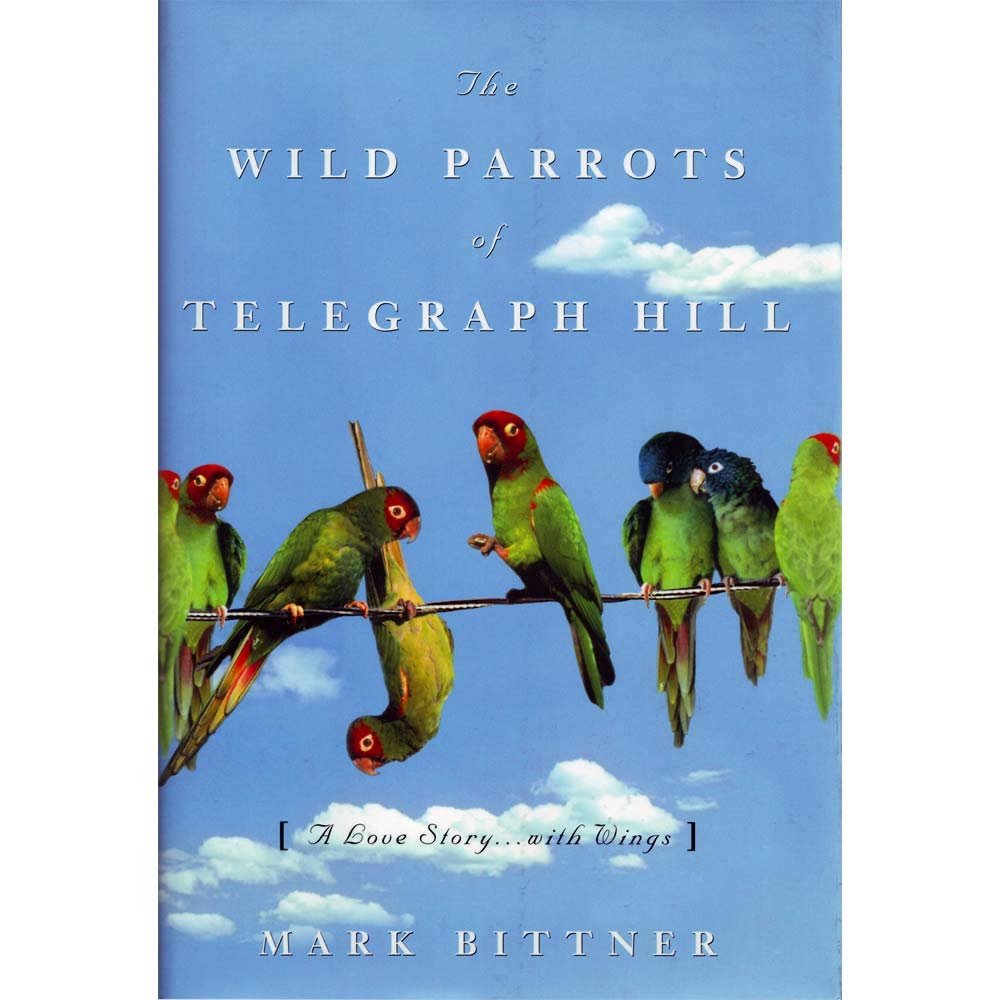



The Wild Parrots of Telegraph Hill is the inspiring story of how one man found his life’s work—and true love—among a gang of wild parrots roosting in one of America’s most picturesque urban settings. Mark Bittner was down on his luck. He’d gone to San Francisco at the age of twenty-one to take a stab at a music career, but he hadn’t had much success. After many years as an odd-jobber in the area, he accepted work as a housekeeper for an elderly woman. The gig came with a rent-free studio apartment on the city’s famed Telegraph Hill, which had somehow become home to a flock of brilliantly colored wild parrots. In this unforgettable story, Bittner recounts how he became fascinated by the birds and made up his mind to get to know them and gain their trust. He succeeds to such a degree that he becomes the local wild parrot expert and a tourist attraction. People can’t help gawking at the man who, during daily feedings, stands with parrots perched along both arms and atop his head. When a documentary filmmaker comes along to capture the phenomenon on film, the story takes a surprising turn, and Bittner’s life truly takes flight. Bittner moved to San Francisco in search of himself. Like many in the early '70s, he tried many pathways--Taoism, the Beats--and lived hand to mouth working odd jobs. A period of homelessness came to an end when he was hired to help an elderly woman. With the job came an apartment, a garden, and parrots. Cherry-headed and blue-headed conures (small South American parrots) formed a wild flock of some 20 birds that lived in the neighborhood. As Bittner became more and more fascinated with the parrots, he began to feed them, and this growing intimacy led to naming the birds and following their relationships. The birds eventually learned to trust him, and his involvement with them led to minor fame in the neighborhood. When a documentary filmmaker arrived to do a story on the Birdman of Telegraph Hill, romance bloomed. This lovely book on finding one's way through interacting with parrots will be very popular among animal-loving readers. Nancy Bent Copyright © American Library Association. All rights reserved The Wild Parrots of Telegraph Hill is the inspiring story of how one man found his life’s work―and true love―among a gang of wild parrots roosting in one of America’s most picturesque urban settings. Mark Bittner was down on his luck. He’d gone to San Francisco at the age of twenty-one to take a stab at a music career, but he hadn’t had much success. After many years as an odd-jobber in the area, he accepted work as a housekeeper for an elderly woman. The gig came with a rent-free studio apartment on the city’s famed Telegraph Hill, which had somehow become home to a flock of brilliantly colored wild parrots. In this unforgettable story, Bittner recounts how he became fascinated by the birds and made up his mind to get to know them and gain their trust. He succeeds to such a degree that he becomes the local wild parrot expert and a tourist attraction. People can’t help gawking at the man who, during daily feedings, stands with parrots perched along both arms and atop his head. When a documentary filmmaker comes along to capture the phenomenon on film, the story takes a surprising turn, and Bittner’s life truly takes flight. MARK BITTNER is the subject of a documentary film, also titled The Wild Parrots of Telegraph Hill , directed by Judy Irving. The film qualified for consideration in the “Best Feature Documentary” category in the 2003 Academy Awards. Mark still lives in San Francisco on Telegraph Hill. Visit the book’s website at www.wildparrotsbook.com and the film’s at www.pelicanmedia.org. Introduction I'm standing on the front deck of an old cottage on San Francisco's Telegraph Hill. The cottage, vine-covered and frail, is nestled within the immense and chaotically lush gardens that tumble down the hill's steep eastern face. Just to my right is a large cage containing three lime-green parrots with cherry-red heads. On top of the cage, another parrot prowls at liberty. In my left hand, I'm holding a cup filled with sunflower seeds. Clinging to the cup's rim are two more parrots who are making quick and expert work of the seeds. There are parrots on my right hand, on my shoulders, and on my head. In front of me, on the limbs of a tall shrub, are another dozen or so. They watch me with eager eyes as I pass around a handful of seeds. One of them, determined to get my attention, flaps his wings furiously, causing the thin branch he's perched on to bounce up and down. Five more parrots eat from a small pile of seeds on the deck railing. To my far right, a gang of fifteen crowds around a large, seed-filled dish that sits on the thick growth of ivy climbing over the railing corner. Another ten sit on the power lines above me. In all, I'm surrounded by more than fifty parrots. The birds on the lines start up an insistent, staccato squawking that grows louder and more anxi