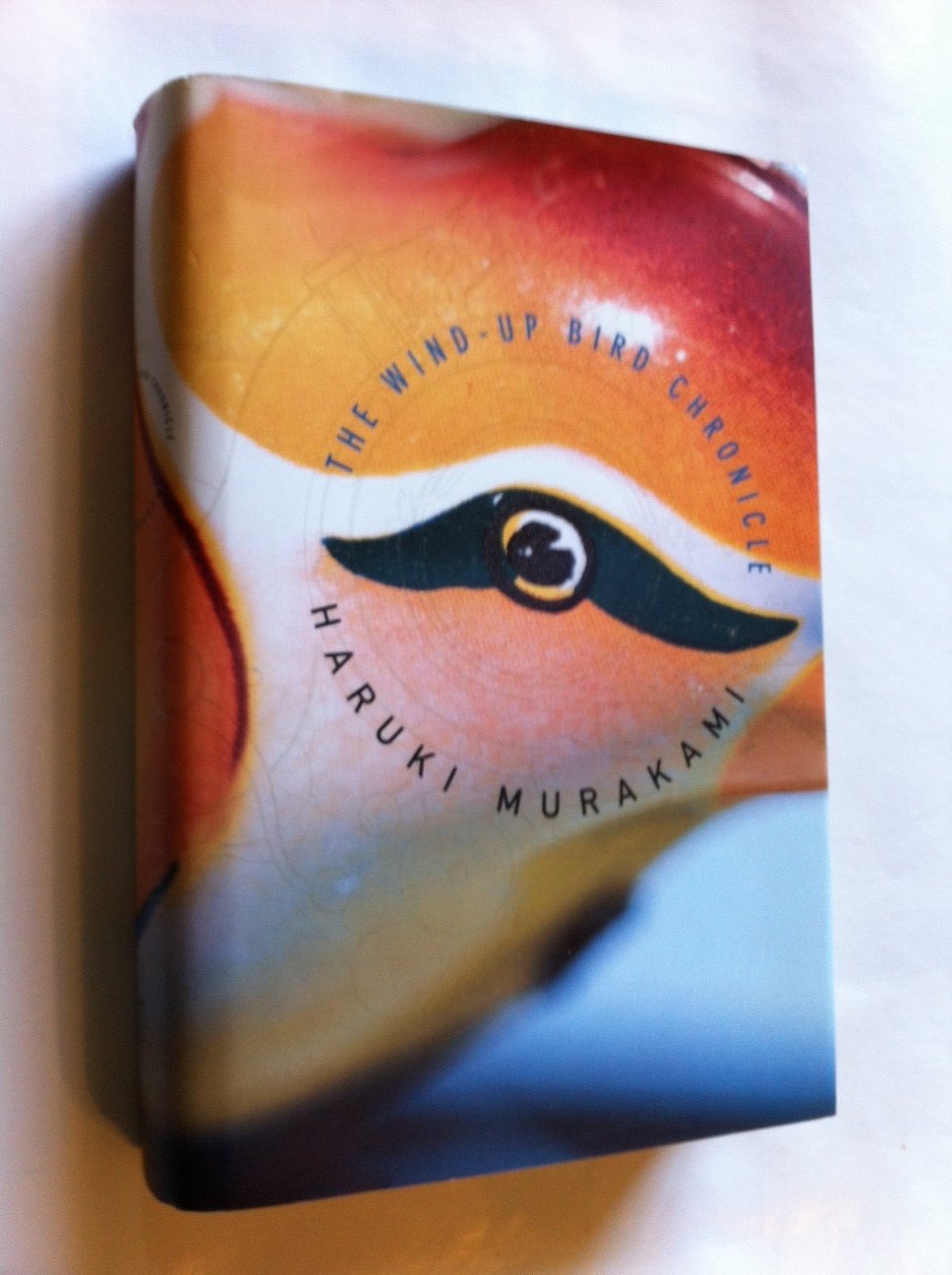



Japan's most highly regarded novelist now vaults into the first ranks of international fiction writers with this heroically imaginative novel, which is at once a detective story, an account of a disintegrating marriage, and an excavation of the buried secrets of World War II. In a Tokyo suburb a young man named Toru Okada searches for his wife's missing cat. Soon he finds himself looking for his wife as well in a netherworld that lies beneath the placid surface of Tokyo. As these searches intersect, Okada encounters a bizarre group of allies and antagonists: a psychic prostitute; a malevolent yet mediagenic politician; a cheerfully morbid sixteen-year-old-girl; and an aging war veteran who has been permanently changed by the hideous things he witnessed during Japan's forgotten campaign in Manchuria. Gripping, prophetic, suffused with comedy and menace, The Wind-Up Bird Chronicle is a tour de force equal in scope to the masterpieces of Mishima and Pynchon. From the Trade Paperback edition. Bad things come in threes for Toru Okada. He loses his job, his cat disappears, and then his wife fails to return from work. His search for his wife (and his cat) introduces him to a bizarre collection of characters, including two psychic sisters, a possibly unbalanced teenager, an old soldier who witnessed the massacres on the Chinese mainland at the beginning of the Second World War, and a very shady politician. Haruki Murakami is a master of subtly disturbing prose. Mundane events throb with menace, while the bizarre is accepted without comment. Meaning always seems to be just out of reach, for the reader as well as for the characters, yet one is drawn inexorably into a mystery that may have no solution. The Wind-Up Bird Chronicle is an extended meditation on themes that appear throughout Murakami's earlier work. The tropes of popular culture, movies, music, detective stories, combine to create a work that explores both the surface and the hidden depths of Japanese society at the end of the 20th century. If it were possible to isolate one theme in The Wind-Up Bird Chronicle , that theme would be responsibility. The atrocities committed by the Japanese army in China keep rising to the surface like a repressed memory, and Toru Okada himself is compelled by events to take responsibility for his actions and struggle with his essentially passive nature. If Toru is supposed to be a Japanese Everyman, steeped as he is in Western popular culture and ignorant of the secret history of his own nation, this novel paints a bleak picture. Like the winding up of the titular bird, Murakami slowly twists the gossamer threads of his story into something of considerable weight. --Simon Leake Kumiko Okada has a satisfying career and comes from a wealthy family. Toru, her husband, is a lawyer. Little mars this young Tokyo couple's life other than the disappearance of their cat. From that minor event, however, their life together devolves into a confusing web of intrigue. Kumiko disappears, telling Toru not to look for her. Then a collection of mystics, clairvoyants, and healers enter Toru's life. Reeling, he begins to spend hours in meditation at the bottom of a dry well, becoming a healer of sorts, until his work brings him into conflict with Kumiko's powerful brother-in-law?a conflict cast in moral terms, with Kumiko's soul in the balance. This very long journey is much less magical than simply strained. There are detours into the history of Japan's occupation of Manchuria and accounts of Japanese prisoners' lives in Siberian coal mines. Though interesting in parts, taken as a whole, this latest from Murakami (Dance, Dance, Dance, LJ 1/94) labors diligently toward some larger message but fails in the attempt.?Paul E. Hutchison, Bellefonte, Pa. Copyright 1997 Reed Business Information, Inc. "Really, Mr. Wind-Up Bird, it's been a lot of fun being with you. No kidding. I mean, you're such a supernormal guy, but you do such un normal things. . . . So hanging around you hasn't been boring in any way. . . . But tell you the truth, it's made me nervous too." The speaker is May Kasahara, a Japanese teenager who bears a strong resemblance to Holden Caulfield. She's speaking to Toru Okada, who lives down the street from May in Tokyo and to whom a series of very strange things has been happening. Her words could also stand as a response to this absolutely mesmerizing, befuddling, unaccountably brilliant novel. Murakami is one of Japan's most popular writers, but while his previously translated books have been well received critically in the U.S., they have yet to garner overwhelming popular acclaim. This one will receive plenty of attention, but it's hard to imagine it sharing best-seller slots with the likes of John Grisham. It's just too much book for that. Just what kind of book is it? That's the befuddling part. Plot summary is nearly useless: Toru Okada loses his cat and then his wife. He devotes himself to finding the latter b