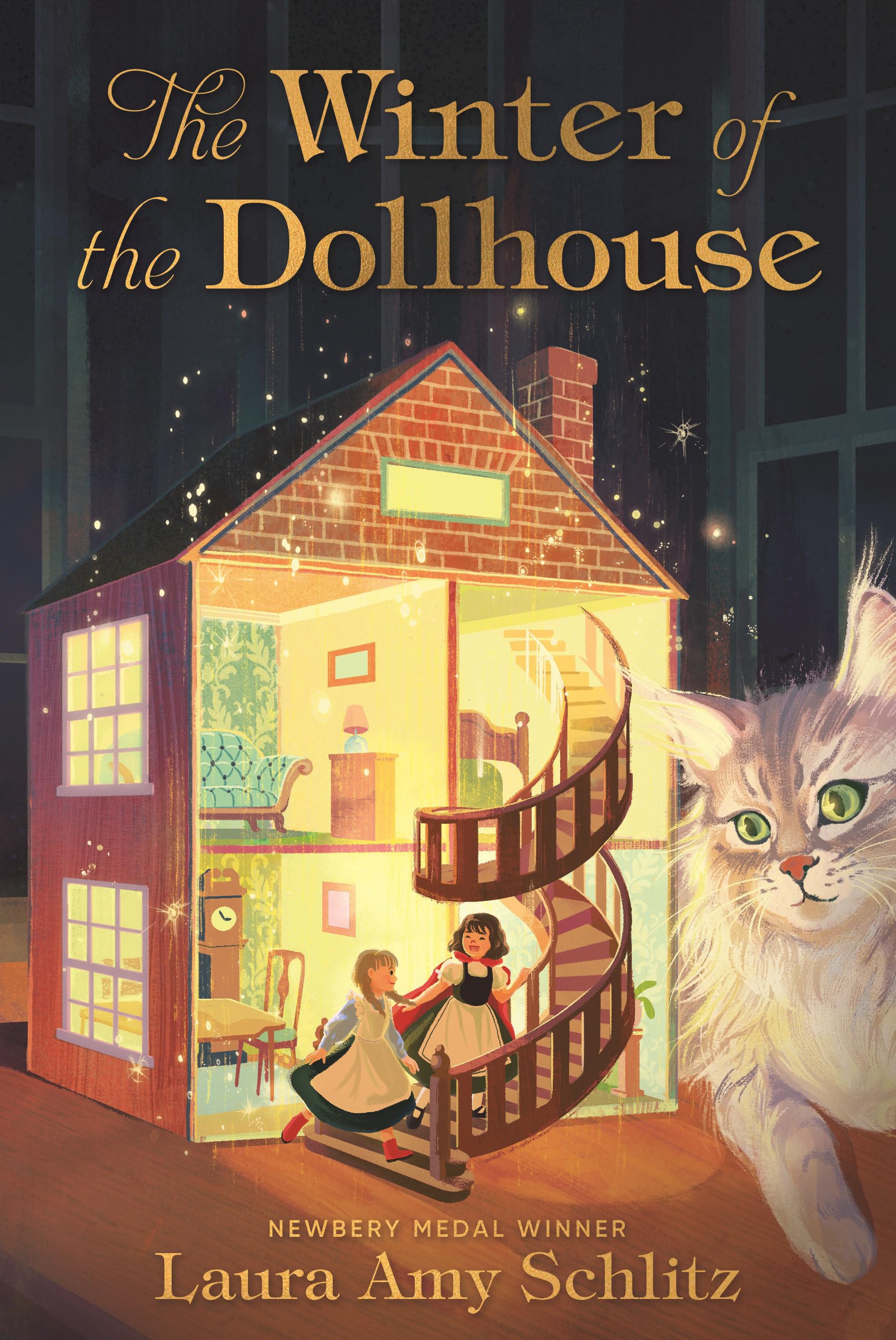



“In the small-scale world of Laura Amy Schlitz’s novel The Winter of the Dollhouse , the emotional stakes are both intimate and enormous. . . . [She] is a masterly storyteller.” — The New York Times Book Review This captivating coming-of-age story is touching, funny, and beautifully layered, with a fairy-tale ending that only Newbery Medalist Laura Amy Schlitz could deliver. On a gloomy November night, eleven-year-old Tiphany Stokes saves an old lady from collapsing in the street. An antique doll named Gretel watches them, longing for Tiph to rescue her from life in a shop window. Though none of these three characters realizes it, their worlds are about to change: Gretel will no longer be a precious prisoner. The old lady—is she a witch?—will discover the secret hidden in her long-neglected dollhouse. And Tiph—whose parents rejoice that she is “never any trouble”—will become a thief, a dog walker, an actor, and best of all, a friend. The Newbery medalist Laura Amy Schlitz is a masterly storyteller best known for her historical fiction. . . . Her new middle grade novel, The Winter of the Dollhouse, though set in the present, has the fully drawn characters, emotional pull and timeless feel of her other works, which make it old-fashioned in the best way. —The New York Times With its animated playthings, secret messages and hidden chambers, “The Winter of the Dollhouse” utilizes enjoyable narrative devices, but it stops well short of being a sugary tale of happy characters having happy times on their way to a happy ending. Ms. Schlitz has a keen moral sensibility, and it shows in the way she draws Tiph (who pilfers) and Néni Szilvia (who can be cranky). It also shows in the overall optimistic message of the book, articulated by Gretel, that the world is “full of promise.” —The Wall Street Journal Newbery Medalist Schlitz (Splendors and Glooms) braids parallel story lines into a cozy fantasy that lauds the power of connection to uplift and inspire. . . . Intricately detailed and nuanced characters, relatable domestic scenes with emotional heft, and evocative writing make for an enchanting, gratifying read. —Publishers Weekly (starred review) In this deep and wide-ranging narrative, Schlitz takes an innovative approach to storytelling. . . .A great choice for readers who like dollhouses, English bulldogs, and the intriguing possibility of fantasy worlds that hide in plain sight. —The Horn Book (starred review) Schlitz tenderly develops her characters, giving each a rough-edged complexity. . . .It’s Schlitz’s clear-eyed portrayal of Tiph’s emotional inner life that anchors this cozy fantasy, with the dolls’ nocturnal adventures providing lift. —Kirkus Reviews The skillfully intertwined stories increase readers’ interest in the well-imagined characters. An appealing, original novel from an Newbery Award–winning author. —Booklist Schlitz’s characters are nuanced with rich and relatable emotions. . . . The ending, which brings the dolls’ and humans’ stories together, is delightful. . . .This is an elegant novel that offers an authentic view of family and community life. —School Library Journal Laura Amy Schlitz is the accomplished author of four previous middle-grade novels— A Drowned Maiden’s Hair, the Newbery Honor Book Splendors and Glooms, The Hired Girl, which won the National Jewish Book Award for Young Adult Literature and the Scott O’Dell Award for Historical Fiction, and Amber and Clay. She was awarded a Newbery Medal for Good Masters! Sweet Ladies! Voices from a Medieval Village. Laura Amy Schlitz lives in Baltimore, Maryland. Prologue: Gretel On the day before Thanksgiving, Mr. DiLucca, the owner of the dollhouse store, unlocked the wooden case where a four-inch doll had spent the past eleven months. He unwrapped her and stood her in the shop window. The doll, Gretel, itched and tingled. Her whole body felt like a foot that had gone to sleep and was waking up again. There was so much to see outside the window: traffic lights shining like wet lollipops, lime and lemon and cherry. Cars swooped back and forth, and so did people on foot; sometimes there were children, sometimes there were dogs. It was exciting to be out in the world again. Last Christmas, Mr. DiLucca had placed Gretel in the window next to a gingerbread house he’d bought from the bakery. From the day after Thanksgiving until Christmas Day, Gretel had stood with her hand raised, as if she were about to steal a dollop of icing. Gretel was a doll, so her hand couldn’t get tired, but she disliked the pose. She knew that gingerbread houses led to trouble: witches and cages and red-hot ovens. She also found out that gingerbread houses attracted mice. Gretel had enjoyed the company of the mice, until Mr. DiLucca discovered mouse droppings in the window. That was the end of the gingerbread house. Gretel was afraid it was also the end of the mice, though she couldn’t be sure. After the gingerbread house was thrown away, she was