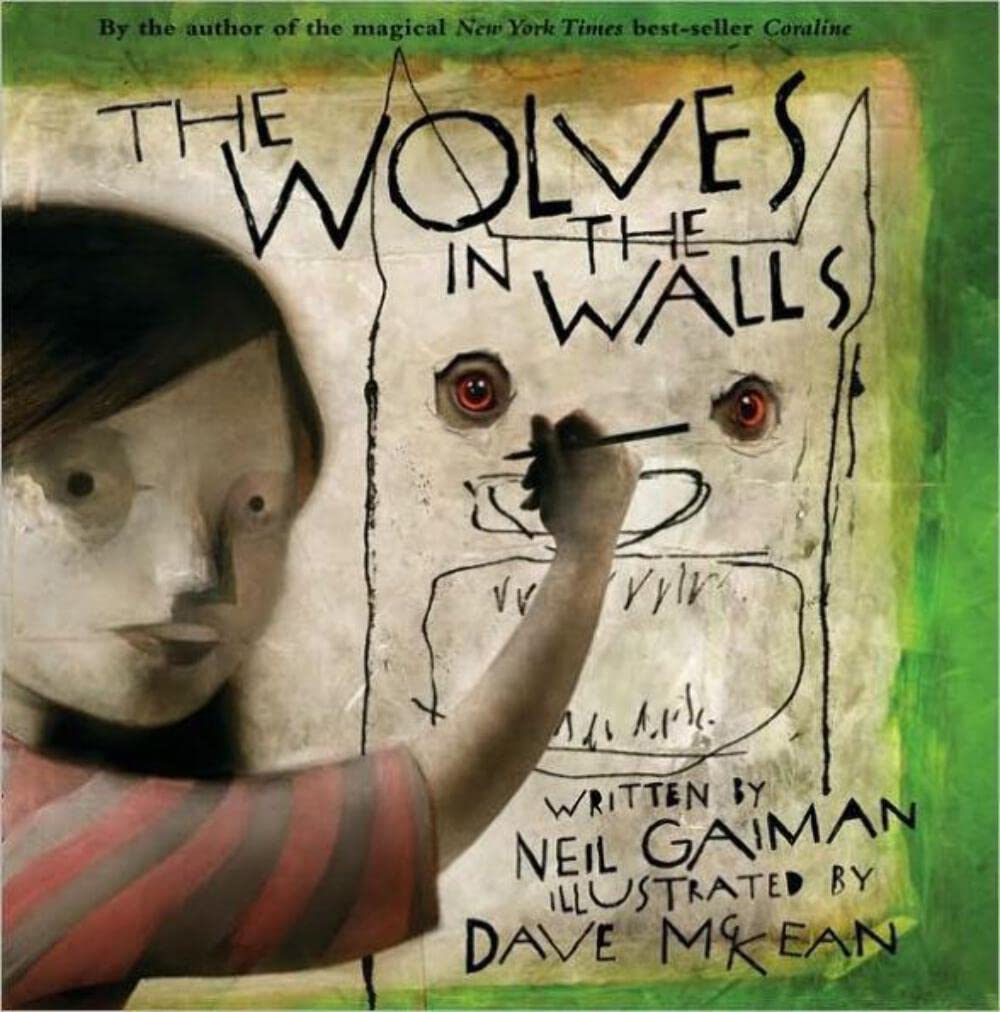



"Gaiman does here for the older picture-book set what he did for middle-grade readers with Coraline ." — Kirkus (starred review) Lucy is sure there are wolves living in the walls of their house—and, as everybody says, if the wolves come out of the walls, it's all over. Her family doesn't believe her. Then one day, the wolves come out. But it's not all over. Instead, Lucy's battle with the wolves is only just beginning. There are sneaking, creeping, crumpling noises coming from inside the walls... This New York Times Best Illustrated Book combines a deliciously creepy tale, a strong heroine, and a happy ending in a package that only Neil Gaiman and Dave McKean could have created. Truth be told, Neil Gaiman and Dave McKean's picture book The Wolves in the Walls is terrifying. Sure, the story is fairytale-like and presented in a jaunty, casually nonsensical way, but it is absolutely the stuff of nightmares. Lucy hears wolves hustling, bustling, crinkling, and crackling in the walls of the old house where her family lives, but no one believes her. Her mother says it's mice, her brother says bats, and her father says what everyone seems to say, "If the wolves come out of the walls, it's all over." Lucy remains convinced, as is her beloved pig-puppet, and her worst fears are confirmed when the wolves actually do come out of the walls. Up to this point, McKean's illustrations are spectacular, sinister collages awash in golden sepia tones evocative of the creepy beauty in The City of Lost Children . The wolves explode into the story in scratchy pen-and-ink, all jaws and eyes. The family flees to the cold, moonlit garden, where they ponder their future. (Her brother suggests, for example, that they escape to outer space where there's "nothing but foozles and squossucks for billions of miles.") Lucy wants to live in her own house...and she wants the pig-puppet she left behind. Eventually she talks her family into moving back into the once-wolfish walls, where they peek out at the wolves who are watching their television and spilling popcorn on slices of toast and jam, dashing up the stairs, and wearing their clothes. When the family can't stand it anymore, they burst forth from the walls, scaring the wolves, who shout, "And when the people come out of the walls, it's all over!" The wolves flee and everything goes back to normal...until the tidy ending when Lucy hears "a noise that sounded exactly like an elephant trying not to sneeze." Adult fans of this talented pair will revel in the quirky story and its darkly gorgeous, deliciously shadowy trappings, but the young or faint of heart, beware! (Ages 9 and older) --Karin Snelson Grade 2-4-Lucy hears sounds in her house and is certain that the "sneaking, creeping, crumpling" noises coming from inside the walls are wolves. Her parents and her brother know "if the wolves come out-, it's all over," and no one believes that the creatures are there-until they come out. Then the family flees, taking refuge outside. It is Lucy who bravely returns to rescue her pig puppet and who talks the others into forcing the animals to leave. Gaiman and McKean deftly pair text and illustrations to convey a strange, vivid story evolving from a child's worst, credible fear upon hearing a house creak and groan. Glowing eyes and expressive faces convey the imminent danger. This rather lengthy picture book displays the striking characteristics of a graphic novel: numerous four-panel pages opening into spreads that include painted people; scratchy ink-lined wolves; and photographed, computer-manipulated images. Children will delight in the "scary, creepy tone" and in the brave behavior displayed by the intrepid young heroine. Marian Creamer, Children's Literature Alive, Portland, OR Copyright 2003 Reed Business Information, Inc. Gr. 3-6. Gaiman's picture book about one little girl's prescient concern for the sanctity of her home is visually realized through collage and other multimedia images that match the sometimes dark, fantastical story, tone for tone. Lucy is the first to hear wolves in the walls of her house, but her family, each of whom seems oblivious to the ambiguity of his or her reassurances, dismisses her worries. Indeed, the wolves do emerge, and the family decamps to the garden, from which Lucy and her "pig-puppet" bravely lead the family's charge back to reclaim their house from the jam-eating, video-game-playing pack. With the rhythms of an old fairy tale (the end is a new beginning of trouble in the walls), and startling graphics that force readers to look deeply into each scene, this is a book for the twenty-first-century child: visually and emotionally sophisticated, accessible, and inspired by both literary and popular themes and imagery. Francisca Goldsmith Copyright © American Library Association. All rights reserved “Gaiman does here for the older picture-book set what he did for middle-grade readers with last year’s Coraline. Slyly deadpan, rich in language