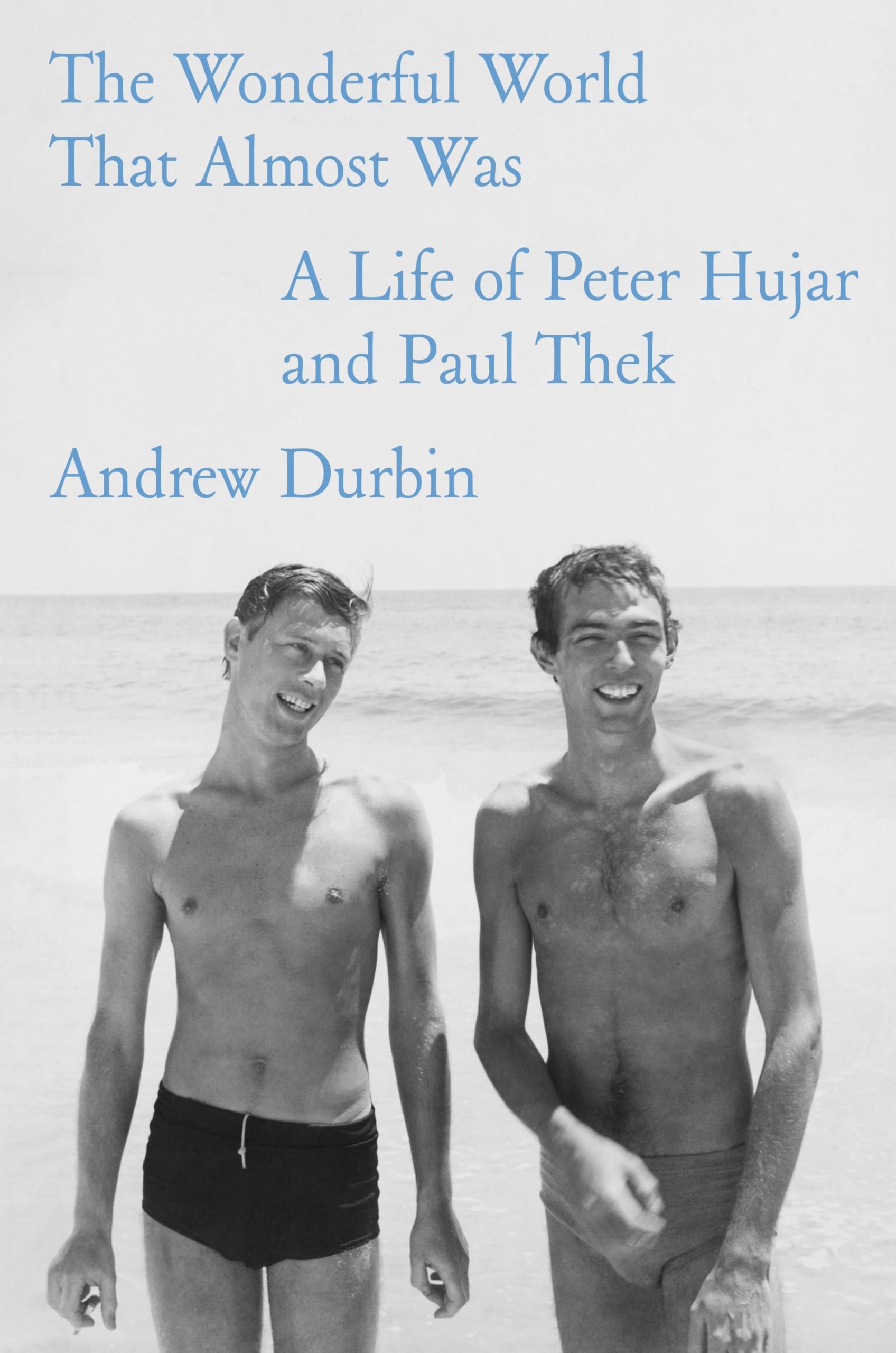
The Wonderful World That Almost Was: A Life of Peter Hujar and Paul Thek
$33.00
by Andrew Durbin



"As official narratives everywhere strain and crack, Peter and Paul―and Durbin―offer a desperately needed alternative way of seeing and being." ―Benjamin Moser, author of Susan Sontag: Her Life and Work, winner of the Pulitzer Prize "[Andrew Durbin] has made of these lives and these times a jam-packed poem in prose. It’s like a trip with these guys, without pulling tight at the ending, just death." ―Eileen Myles, author of A "Working Life " The cinematic, never-before-told story of two intimately entangled artists who redefined queer art. When Paul Thek met Peter Hujar in the winter of 1956 in Coral Gables, Florida, a slow-simmering connection began to burn. Thek, twenty-three and living in Miami, was handsome and itching to make it as a painter; in the twenty-two-year-old Hujar, a shy, sensual photographer, he’d found a kindred spirit. By 1960, they were dating and living in New York, beginning decades of sex, love, competition, and reconciliation―an entanglement that changed American art forever. Surrounded by a robust creative scene populated by Susan Sontag, Andy Warhol, Fran Lebowitz, John Waters, and David Wojnarowicz, Thek and Hujar’s profoundly influential careers, from the early 1960s through the late 1980s, differed as much as the men themselves. The unpredictable and often overlooked Thek crafted visceral installations and sculptures, while Hujar, celebrated and sociable, took penetrating portraits of his world, queer and otherwise. Yet even at their most estranged, and even after their deaths from AIDS, both men were united by a pursuit of liberation―from artistic and sexual limits, from anything short of changing the world. Andrew Durbin’s The Wonderful World That Almost Was unravels, for the first time, the intertwined stories and work of two boundaryburning, paradigm-tilting, never more relevant American artists. Weaving together deft art criticism with moving portraits of both men's inner lives, and assembled with exhaustive research, Durbin’s book is an ode to a lost but still-living world―and two men who defined it. "Durbin’s astute portrait of these two artists, incisive witnesses of their times and cultural vanguards of ours, restores an important chapter in art history and makes for sublime reading." ― Booklist (starred review) "Like an archaeologist sifting through the plastic rubble of the recent past, Andrew Durbin has peeled back layers and layers to reveal two artists once dismissed as 'footnotes,' restoring them and their lost world to a central place in our history. As official narratives everywhere strain and crack, Peter and Paul―and Durbin―offer a desperately needed alternative way of seeing and being." ―Benjamin Moser, author of The Upside-Down World and Susan Sontag: Her Life and Work "This is a great American love story that is also an indispensable account of the growth and emergence of Peter Hujar and Paul Thek as influential artists." ―Colm Tóibín "An era long lost becomes vividly tangible in these pages. Surprisingly relevant for today, the two protagonists' paths through the 1950s and 60s pre-Stonewall times shine up in ways I had never been able to grasp before. Andrew Durbin turns his almost forensic research into a seriously entertaining read.” ―Wolfgang Tillmans "I don’t think I’ve ever read a biography I’d describe as tender before. Is that because this one’s about a relationship, coming and going in a world full of change and detail, travel, and being both unmoored and ecstatic? This book is totally about the failure of love and revolutions and how our presence in and out and around those states is how we know we’re alive. The secret star of the book is Paul Thek’s collaborator, artist Ann Wilson who sees it all. Andrew Durbin does too and has made of these lives and these times a jam-packed poem in prose. It’s like a trip with these guys, without pulling tight at the ending, just death." ―Eileen Myles, author of A "Working Life " "In his lifetime, photographer-flaneur Peter Hujar was overlooked and under-recognized. Not by his downtown bohemian friends―Andy Warhol, Candy Darling, Susan Sontag, Fran Lebowitz―but by the art-going public. Yet he understood sexual glamour as well as Richard Avedon; psychic damage as well as Diane Arbus; and seedy spectacle as well as Robert Mapplethorpe. Critic Peter Schjeldahl placed him at the “historic crossroads of high art and low life in the late twentieth century.” Where anyone who knows what’s what wants to be. And where we get to be thanks to Andrew Durbin’s masterful double portrait (of Hujar and his lover, artist Peter Thek), a work that is as aesthetically ferocious as it is historically erudite." ―Lili Anolik, bestselling author of Didion & Babitz "A dreamy epic that lays bare how two quicksilver talents forged new ways of seeing ― and being. Virtuosic in its research, humming with sultry detail, Andrew Durbin's biography thrusts us into the thick of the action, hot on the heels of dua